Chapter 6
The Developing Negative – Book 1
I woke before sunrise again, the way I always do, though by that Friday morning the waking itself had stopped requiring any real attention, the way a sentence stops requiring translation once you have heard it enough times in its original language. The house around me had settled fully into its week, each small sound in its proper place—my grandfather’s low voice already drifting up from the garden, my grandmother’s kettle beginning its familiar complaint, the particular quiet upstairs that meant Yukine remained, for the moment, defiantly asleep.
I lay still for a moment before rising, listening to the house arrange itself into its Friday shape, distinct in small ways from the shape it had held earlier in the week. Fridays carried their own particular texture in that household—the faint anticipation of a weekend not yet arrived, but close enough that everyone’s movements seemed to loosen slightly in preparation for it, the way a held breath begins to ease before it is actually released.
I have noticed, over the years, that a household develops its own private calendar, one that has little to do with the actual days printed on any wall planner and everything to do with the accumulated small rituals that mark one day as different from another. Monday carried the particular brisk energy of everyone resetting themselves after a weekend’s looseness. Wednesday sagged, slightly, under its own middle-of-the-week weight, my grandmother’s cooking growing a touch more elaborate on exactly that day, as though she had long ago decided Wednesdays required a small, unspoken act of encouragement to get everyone through to the other side. And Friday arrived the way Friday always arrives in a house full of people who love each other—lighter somehow, even before anyone had said a single word to suggest why it should feel that way.
I came down to find Shizuka already at the table, the morning paper open in front of her rather than her phone, an old habit she says she inherited from our grandfather, though I suspect she has simply come to prefer the specific quality of attention a newspaper demands over the scattered, restless attention a phone invites. She read in silence, occasionally frowning slightly at something, and did not look up until I had poured my own tea.
“Anything interesting,” I asked.
“An editorial about the prefecture’s agricultural subsidies,” she said, without much enthusiasm. “Riveting stuff.”
“You’re reading it anyway.”
“Someone in this family should understand how the prefecture actually works,” she said, “and it clearly isn’t going to be Toru.” She turned a page, unhurried. “He’s already half in uniform, by the way. You should brace yourself.”
I did not have to wait long to understand what she meant. Toru arrived a few minutes later wearing his kendo hakama over an otherwise ordinary school shirt, the mismatched combination somehow both absurd and entirely sincere, the particular sincerity of someone who has decided that formal wear should begin the moment the day’s true purpose enters his mind, regardless of whether the rest of the day has caught up to that purpose yet.
“You promised,” he said, before he had even fully sat down, pointing his chopsticks at me with the specific solemnity of someone invoking a sacred contract.
“I remember,” I said.
“You said this week. It’s Friday. This is the last day of this week.”
“I know how weeks work, Toru.”
“I’m just making sure,” he said, though his relief was obvious enough that I understood he had genuinely doubted, at least a little, whether I would follow through, and I felt a small, private twinge of guilt at that, understanding that whatever confidence Toru placed in me had not always been rewarded as consistently as it perhaps deserved.
“Have you told Fujita-sensei I’m coming?” I asked.
“Twice,” Toru said. “He said he’s curious to meet the brother I never shut up about.”
“You talk about me at kendo practice?”
“I talk about you everywhere,” Toru said, with the particular shameless honesty of someone who has never once considered that this might be worth being embarrassed about. “You’re my brother. Why wouldn’t I.”
Shizuka, without looking up from her paper, observed that this was likely the single most sincere thing Toru would say all week, and that everyone at the table should take a moment to appreciate it before he inevitably ruined the effect by demanding second helpings before he’d finished his first.
“That’s fair,” Toru admitted, and reached for the rice regardless, proving her point almost immediately.
My grandfather, entering from the garden just then, glanced between the two of us with the particular quiet attention he brings to moments he has decided are worth watching rather than joining, and said nothing at all, though I caught, in the corner of his expression, something that might have been approval, or might simply have been the ordinary satisfaction of a man watching his family behave the way he had always hoped it would.
School, by that Friday, had settled into the particular unremarkable rhythm that belongs to a week nearing its close—not tired exactly, but comfortable in a way that the sharper energy of Monday never quite manages. I arrived to find Daichi had already claimed the seat beside his own for me, a small, unremarkable gesture that had nonetheless become, over the course of the week, simply expected rather than offered.
“You look like you actually slept,” he said, by way of greeting.
“I did, mostly.”
“Progress.” He leaned back in his chair, stretching until something in his shoulder popped audibly, an action he performed with no apparent concern for how alarming the sound was to anyone nearby. “You’re coming to Toru’s practice today, right? He hasn’t shut up about it all week.”
“How do you know about that?”
“He told half the school. I think there’s a rumor going around that you’re secretly some kind of prodigy who’s been hiding his skills for years.”
“I’m not hiding anything. I’ve genuinely never done kendo.”
“That’s not what the rumor says,” Daichi said, grinning, “but I’ll let you disappoint everyone in person.”
Aiko turned around almost immediately to ask whether I’d finished the literature homework, a question I suspected she already knew the answer to, since I had, in fact, finished it, the way I generally finish things before they become urgent, and her real interest lay less in my homework than in confirming she still had time to finish her own before the bell.
“You could just say you haven’t finished it,” she said, once I confirmed I had. “For my sake. Just this once.”
“That wouldn’t help you finish yours any faster.”
“No, but it would make me feel better about not having finished mine.” She sighed dramatically and bent back over her own notebook, pencil moving quickly now, and I noticed, glancing over, that she had already sketched a small, unflattering caricature of Horiuchi-sensei in the margin, mid-lecture, arms flung wide in some exaggerated gesture that bore only a passing resemblance to anything the actual man had done that week.
Emi, seated nearby, glanced once at the small notebook I keep for observations unrelated to schoolwork, the one I had been filling, that week, with fragments about the club and its members rather than photography assignments. She said nothing about it directly, though I noticed her studying the visible page for a moment longer than casual curiosity would require, filing away, I suspected, one more detail to consider at her leisure.
“You write more than you talk,” she observed, finally, not quite a question.
“Probably,” I said.
“That’s not a criticism. I do the same thing. Just with fewer words per entry.”
It was Sora, during the lull before the first bell, who finally asked the question I had been expecting since Wednesday.
“Have you decided?” he asked. “About the club.”
“I think I have,” I said.
“That’s not a yes.”
“It’s close enough to one.”
He studied me for a moment with his usual careful, unhurried attention, then nodded once, apparently satisfied with an answer that would have frustrated someone less patient than he generally is. “Good,” he said. “I already told Suzu you would. I don’t like being wrong.”
“You told her before I’d decided?”
“I told her what I already knew,” he said, simply, and returned his attention to the window, where the same bird from earlier in the week appeared to be finishing whatever nest it had been building all week, and I found myself, not for the first time, quietly grateful for the particular kind of friendship that requires no explanation for how thoroughly it has already understood you.
The editorial meeting that afternoon carried a different energy than the two before it—less the tentative, half-formed shape of a new arrangement finding its footing, more the settled rhythm of a group that had already decided, without needing to say so aloud, that this was simply how things worked now.
Haruka ran the meeting with the same calm, unhurried authority she had shown from the first day, moving through the room’s business with an efficiency that never once tipped into brusqueness. She asked Ren for an update on the student council story he was chasing, listened to his answer with genuine attention, and offered a single, precise suggestion about a source he hadn’t yet thought to contact, delivered so gently that it read entirely as help rather than correction.
“You could also try the vice president,” she said. “Everyone always goes to the president first, because that’s the obvious choice, and it means the vice president usually has more time and more patience for actually answering your questions properly.”
“That’s a good point,” Ren said, jotting it down immediately.
“It’s not a secret trick,” Haruka said. “It’s just something I learned after enough interviews where the obvious source gave me nothing and the second choice gave me everything.” She smiled slightly. “You’ll learn your own version of it eventually. Everyone does.”
Haruto, who had been quietly waiting his turn, raised a hand of his own once Ren’s business had concluded. “I’ve got the tournament bracket finalized,” he said. “Assuming nobody drops out this time.”
“Someone always drops out,” Mika said, without looking up from her layout grid.
“Not this time. I threatened everyone with extra conditioning if they backed out again.”
“You don’t have the authority to threaten anyone with conditioning.”
“They don’t know that,” Haruto said, entirely unbothered, and the room laughed, the particular easy laughter of people who have already decided they enjoy each other’s company enough that even the small disagreements carry no real edge.
Asato, meanwhile, had already organized the photographers into a rotation for darkroom time that Kaito, at least, seemed considerably relieved to see formalized, no longer needing to negotiate access on an ad hoc basis with whoever happened to have claimed the equipment first. He moved through his own portion of the meeting with the same economical authority, correcting Nozomi’s exposure notes with a brief, practical suggestion rather than a lecture, and complimenting one of the first-years’ contact sheet with just enough specificity that the praise clearly meant something beyond simple encouragement.
“This one,” Asato said, holding up a print for the room to see, one of the first-years’ work from earlier that week, a quiet shot of rain collecting on the courtyard’s drainage grate. “Notice how she didn’t center it. The water pools slightly off to the left, which means your eye actually has to travel to find it, instead of landing on it immediately.” He looked toward the first-year, whose name I gathered was Rina, with genuine approval. “That’s not accidental. That’s someone starting to understand composition instead of just following a rule about it.”
Rina flushed slightly, clearly unused to praise delivered with that much specific attention, and I noticed Suzuha, beside her, nudge her gently with an elbow, a small, wordless gesture of shared pride that struck me as more meaningful than anything either of them could have said aloud.
“How long have you been shooting?” I asked Rina, once Asato had moved on to the next print in the stack.
“Since I started here,” she said, still slightly pink. “So, not long. A few weeks longer than the other first-year.”
“You already understand something a lot of people spend years failing to learn.”
“What’s that?”
“That the center of a frame isn’t always where the meaning lives,” I said. “Most people photograph exactly what they’re looking at. You photographed what you were looking at, and then let your eye travel somewhere else to find it. That’s a much harder habit to build than it looks.”
She considered this for a moment, clearly turning it over more carefully than the brief exchange might have suggested she would, and then nodded, something in her posture straightening slightly, the particular quiet confidence of someone who has just been handed a compliment specific enough to actually believe.
Kaito, listening nearby, glanced down at his own contact sheet with a faint, self-conscious frown, apparently measuring his own work against the exchange he’d just witnessed, and I found myself, watching him, remembering my own early years with a camera, the particular anxious comparison that afflicts almost everyone learning something seriously for the first time, before they’ve built enough confidence in their own eye to stop measuring it constantly against everyone else’s.
“Today,” Haruka said, once the smaller business had been settled, “I want to introduce the first real feature of the semester.” She let the room’s attention gather fully before continuing. “It’s called ‘The Places That Remember.'”
She explained the concept the way I imagine she explains most things—clearly, without unnecessary elaboration, trusting the room to fill in the details themselves rather than spelling out every implication in advance. Not the school’s famous places, she said. Not the gymnasium during a tournament, or the auditorium during a ceremony, the places already documented a hundred times over in a hundred nearly identical photographs. The quieter places instead—the ones that had simply been there long enough to absorb something of everyone who had passed through them, without ever being asked to perform that significance for a camera.
“The old classroom past the science wing,” Suzuha said immediately, and I noticed several heads nodding, the idea clearly already familiar to at least some of the room from an earlier conversation.
“The garden by the dormitory gate,” Yuzuha added. “Nobody uses it anymore, but somebody still weeds it every spring.”
“The workshop,” Kaito offered, somewhat shyly. “The old one, not the new woodworking room. It still has tools nobody’s used in years.”
“The music room on the third floor,” Mika said, surprising everyone slightly, since she had said very little throughout most of the meeting. “The one they stopped using after they built the new practice rooms. There’s still an old piano in there. Nobody’s touched it in years, but somebody keeps it tuned. I don’t know who, or why.”
That last suggestion drew a small, thoughtful silence from the room, the particular quiet that follows an idea landing more deeply than its plain description would suggest it should.
Haruka let the suggestions accumulate for a while, writing them without comment on the whiteboard Mika had already claimed, and only once the list had grown sufficiently long did she begin, gently, shaping it into something like an actual assignment structure—pairing writers with photographers, suggesting which locations might benefit from interviews with specific staff or alumni, trusting the students themselves to negotiate the finer details.
Yuzuha had already begun sketching a rough outline of questions in her notebook before Haruka had even finished assigning pairs, her pen moving with the particular urgency of someone who has found, in a topic, exactly the kind of story she has been waiting to tell. Suzuha, beside her, had started a different kind of list entirely—not questions, but angles, framings, the particular quality of light she imagined each location might offer at different times of day.
I wrote very little that afternoon, though what I did write, in the small margin of my own notebook, was only two words.
Observe first.
I understood, watching the room organize itself around a shared idea with more energy than any single member could have generated alone, that this was precisely the instruction the assignment itself was quietly teaching, whether or not anyone had stated it directly. You could not photograph what a place remembered, or write honestly about it, until you had first spent enough time inside it to notice what it was actually saying, rather than what you had already decided, in advance, you expected it to say.
I walked to the dojo with Toru once the final bell released us, his energy considerably higher than it had been even at breakfast, talking almost continuously about the instructor, the other students, the specific form he’d been struggling to perfect for weeks, none of it requiring much from me beyond the occasional confirming sound that I was, in fact, still listening.
“You have to bow when you walk in,” he said, for what I suspected was at least the third time that week. “Properly. Not just a nod.”
“I know how to bow, Toru.”
“I know you know. I’m just making sure you know that it matters here specifically. Some places it’s just polite. Here it’s actually part of the training.”
“I understand the difference.”
“Okay. Just checking.” He was quiet for almost a full ten seconds, which for Toru constituted a significant silence, before continuing. “Fujita-sensei doesn’t really care how strong you are when you walk in. He cares whether you respect the room before you’ve done anything else. That’s the whole first lesson, before you even pick up a shinai.”
“That sounds like a good first lesson.”
“It is,” Toru said, with more seriousness than he usually brings to explaining anything. “I didn’t get it for the first few months. I thought the bowing was just something you did because everyone else did it. Then one day he explained it, and I understood it wasn’t really about him at all. It was about everyone who trained here before me, and everyone who’ll train here after.”
I glanced at him, faintly surprised by the depth of the observation, and he caught the look and shrugged, slightly embarrassed. “I pay attention sometimes,” he said. “Even when it doesn’t look like it.”
“I never doubted that.”
“You kind of did.”
“Maybe a little,” I admitted, and he laughed, apparently satisfied by the honesty more than he would have been by a denial.
The dojo occupied a modest building near the edge of the athletic complex, its interior smelling of clean wood and old sweat in the particular combination that belongs to any space where people have trained seriously for a long time. The instructor, a compact, unhurried man named Fujita, greeted Toru with the easy familiarity of someone who has taught him for years, and turned his attention to me with open, unhidden curiosity once Toru had, with visible pride, introduced me as his brother.
I bowed properly at the entrance, the way my grandfather had taught me to bow at any dojo regardless of discipline, and again before stepping onto the floor, and I noticed Fujita’s expression shift slightly at that small formality, the particular recognition of someone who has spent years watching visitors either perform respect too theatrically or ignore it entirely, and rarely encounters someone who simply offers it as unremarkable habit.
“You’ve trained somewhere,” Fujita said, not quite a question.
“Judo,” I said. “Wing Chun. Koryu. Not kendo.”
Fujita’s eyebrows lifted slightly at that, the first real crack in his otherwise neutral appraisal. “How long in koryu?”
“Ten years.” I hesitated a moment before continuing, choosing the next part carefully. “But none of my training was for sport. It was… for defense.”
Something in the way I said it seemed to land more heavily than I’d intended, and Fujita studied me for a moment longer than the exchange strictly required, the particular unhurried attention of a man recalculating an assessment mid-sentence. He did not press further, though, and I understood, watching him file the answer away without comment, that he had decided, whatever he made of it, that it was not his business to ask more than I’d offered.
“You’ll start as a true beginner, then. No shortcuts.”
“That’s the idea.”
Something in my answer seemed to satisfy him more than the answer itself would suggest, and he nodded once, the particular nod of a teacher deciding a new student was going to be worth his patience, before setting me beside Toru with instructions to simply watch the opening forms before attempting anything myself.
I want to be honest about what happened next, because I think the honesty matters more than a flattering version of the story would suggest: I was better at kendo, faster, than I had expected to be, and worse than Fujita seemed to expect once he’d learned what I’d trained in. Ten years of koryu translates a great deal into kendo, more than most people outside either discipline would assume—the footwork shares a common root, the maai, the particular sense of distance and timing that governs when a strike actually becomes a strike rather than merely a gesture toward one, all of it drawn from the same old well kendo itself grew out of centuries ago. My hands understood the shinai faster than I expected them to, my feet found the correct spacing almost without needing to think about it, and within the first twenty minutes I was already executing forms that Fujita clearly hadn’t anticipated from a true beginner.
That, I came to understand quickly, was its own kind of problem.
“Your grip is wrong,” Fujita said, the first time, adjusting my hands with brisk, impersonal efficiency, though I noticed him studying the rest of my stance with something closer to open curiosity than correction. “You’re holding it like a sword you already know how to use.”
“I do know how to use a sword,” I said. “Just not this one.”
He considered that for a moment. “Then the problem isn’t that you don’t understand kendo. The problem is that you understand something adjacent to it well enough to fool yourself into thinking the two are the same art wearing different clothes. They aren’t.”
“I know.”
“Show me you know,” he said, and stepped back to watch.
I did not attempt to substitute what I already knew for what he was teaching, even where the temptation was greater than I’d expected—my koryu instincts wanting, more than once, to finish a motion the way ten years of different training had taught my body to finish it, rather than the way kendo actually demanded it be finished. My grandfather’s voice arrived, unbidden, somewhere in the middle of that second, careful correction: every art deserves the respect of being learned as itself. I understood, holding that thought, why he had said it to me so often over the years, and why it mattered now more than it ever had in the quiet solitude of our own studio. It would have been simple enough to let the overlap between koryu and kendo carry me further than my actual understanding of kendo warranted, to let my body’s fluency in one grammar quietly stand in for fluency in another that merely resembled it. It would also have been, I understood, a kind of quiet disrespect—both to the discipline itself, and to Fujita, who had spent decades refining a craft that deserved better than being treated as a variation on something I already knew, even when the variation was closer than most people’s would ever be.
“You’re not struggling the way a true beginner struggles,” Fujita observed, partway through the hour, watching me correct my own stance before he had to. “You’re struggling the way someone struggles when he already half-knows the answer and refuses to let himself simply reach for it.”
“Is that better or worse?”
“Harder,” he said. “Which is usually better, in the long run.” He did not elaborate further, though I caught him watching me with a different kind of attention for the remainder of the session, the particular interest of a teacher who has just discovered his newest true beginner is not quite so simple a case as he’d first assumed.
There was something almost freeing, I found, in being genuinely uncertain about something in front of people who had every reason to expect otherwise. I had spent so many years being competent—at photography, at judo, at the particular quiet discipline of witnessing difficult things without flinching—that the plain, careful humility of holding myself back from something my body half-already-knew felt, oddly, like a kind of rest. Nobody in that room expected anything from me beyond what I actually earned honestly that afternoon, and earning less credit than the overlap in my training might have bought me carried no weight at all, no disappointment, nothing beyond the simple, practical correction of a teacher doing his job properly.
Fujita paired me with Toru for the remainder of the session, a decision that struck both of us, I think, as equally strange the moment he announced it.
Toru had trained in kendo for nearly two years by then, long enough to have developed a genuine, unselfconscious competence that I found myself, more than once, quietly admiring—the particular fluid confidence of someone who has stopped needing to think consciously about the mechanics of a strike, the same fluid confidence I recognized from my own years of practicing judo alongside my grandfather.
“This is so weird,” Toru said, adjusting my grip for what must have been the fourth time, his voice carrying the particular delighted disbelief of someone experiencing a role reversal he had clearly never expected to witness.
“Why is it weird?”
“Because you’re supposed to be the one who’s good at everything.”
“I’m not good at everything. I’m good at some things I’ve spent years practicing. This isn’t one of them.”
“But you’re still better than me at basically every other thing we’ve ever done together.”
“That doesn’t mean anything here,” I said. “Here, you know more than I do. That’s just true. It doesn’t need to be complicated.”
He considered this for a long moment, adjusting my stance once more with the small, careful precision of someone taking his sudden authority seriously rather than treating it as a novelty to enjoy briefly before returning to the usual order of things. “Okay,” he said finally. “Then do it like this,” and demonstrated the strike again, slower this time, watching my hands rather than the target, correcting the angle of my elbow with the patient specificity of a teacher who has decided his student deserves his full attention.
“Your elbow drops when you commit to the strike,” he said. “You do it every time. It’s small, but Fujita-sensei will catch it eventually if I don’t tell you first.”
“How do I fix it?”
“Stop thinking about the target and think about the elbow instead. Just for now. Once your body remembers on its own, you can go back to thinking about the target.”
I followed his instruction as precisely as I could, and though the strike I produced still lacked the polished economy of two years’ dedicated practice, something in his expression when I finally executed it correctly carried a genuine, unguarded pride that I understood, immediately, mattered to him far more than any compliment I could have offered about his own skill.
“There,” he said, quietly delighted. “That one was actually good.”
“You’re a patient teacher.”
“I had to be. Fujita-sensei was patient with me for like a year before I stopped dropping my shoulder on every single strike. I figure I owe someone the same patience eventually.”
“And you decided that someone was me.”
“You’re my brother,” he said, as though this settled the matter entirely, which, I understood, watching him return to correcting my stance with the same careful attention, it apparently did.
Fujita observed the exchange from across the floor without commenting directly, though I caught him watching for longer than the moment strictly required, the particular attention of a teacher noticing something worth noticing in how two students had arranged themselves around each other’s strengths without being told to.
That evening, several club members had stayed behind after the final bell to begin preliminary work on the feature, and I returned to the school briefly after dinner, at Yuzuha’s request, to hear how her first interview had gone.
She found me near the clubroom, her expression carrying an uncertainty I hadn’t seen from her before, the particular deflation of someone who suspects their afternoon’s work has failed to produce what they had hoped for.
“I interviewed the groundskeeper,” she said. “The one who’s been here longest. I wanted him to talk about the buildings. What’s changed. What he remembers about specific rooms.” She frowned slightly, flipping back through her notes. “He wouldn’t talk about any of that. He just kept talking about the cherry trees. Which ones he planted, which ones he’s had to replace, how long it takes one to properly establish itself.” She looked up at me, clearly frustrated with herself rather than with him. “I think I failed the interview. I couldn’t get him back on topic.”
“Read me some of it,” I said.
She hesitated, then flipped back to the beginning of her notes and read, haltingly at first, then with more confidence as she continued—an account of a cherry tree near the east gate that had refused to bloom properly for six consecutive years, planted the same season the groundskeeper’s own daughter had been born, a fact he had mentioned almost in passing, she said, without seeming to think it mattered much to the story she was trying to get from him. He had talked about grafting techniques passed down from the man who’d trained him decades earlier, about a particular late frost that had nearly killed half the property’s older trees one especially hard winter, about the quiet satisfaction of walking the grounds each morning before anyone else arrived, simply to see what, if anything, had changed overnight.
“None of that is about the school,” she said, when she’d finished reading. “It’s about trees.”
I considered her notes for a moment, the pages full of careful transcription about grafting techniques and root systems and the particular stubbornness of one tree near the east gate that had refused to bloom properly for six consecutive years before finally, unexpectedly, producing the fullest blossoms on the entire property.
“Maybe the trees were the story,” I said.
She looked at me for a long moment, something shifting slowly behind her expression, the particular recalibration of someone reconsidering an entire afternoon through a different lens than the one she had walked in with. “He’s tended this school longer than almost anyone still working here,” she said slowly, thinking it through as she spoke. “And when you ask him what he remembers about it, he doesn’t talk about the buildings at all. He talks about what he’s grown here.”
“That might be truer than anything a building could tell you.”
“I was trying to force him into the story I’d already decided I wanted,” she said, half to herself. “The one about walls and history. He was already telling me the actual story. I just wasn’t listening for it.”
“You’re listening now.”
She was quiet for a moment, flipping back through her notes with new attention, and when she looked up again there was something considerably steadier in her expression than the frustration that had greeted me a few minutes earlier. “The tree that wouldn’t bloom,” she said slowly. “The one near the east gate. It’s the same age as his daughter. He mentioned that almost like it was nothing. Like it wasn’t the whole point of everything else he’d just told me.”
“Maybe it wasn’t nothing to him. Maybe it was simply too obvious, to him, to think it needed pointing out.”
“That’s what I missed the first time,” she said. “I was so focused on redirecting him back to the buildings that I almost didn’t notice he’d handed me something better.” She closed the notebook slowly, something settling in her expression that looked, to me, considerably like relief. “Thank you,” she said. “I think I know how to write this now.”
“You already knew,” I said. “You just needed someone to say it back to you before you trusted it.”
Suzuha found me shortly afterward, her camera already in hand, and asked, with a directness I had come to expect from her by then, whether I would walk the campus with her for a while.
“Not to teach me anything,” she clarified, quickly, as though anticipating an assumption I hadn’t actually made. “I just want to see what you notice. I think it might help me see the assignment differently.”
“I’m not sure I’ll notice anything you haven’t already noticed yourself.”
“Let me be the judge of that.”
We walked slowly through the emptying school, the late afternoon light turning long and amber across surfaces that had, only hours earlier, been full of ordinary noise and motion. She photographed as we went—an empty hallway, its floor still faintly marked with the day’s scuffed footprints; a row of shoes left outside the dojo entrance, arranged with more care than their owners had likely intended; a worn staircase whose center steps had been visibly hollowed by decades of feet finding the same path; a window where the light fell in a long, deliberate column across an otherwise unremarkable stretch of floor.
“Why the shoes?” I asked, watching her frame the shot for a third time before finally releasing the shutter.
“Because somebody lined them up,” she said. “Nobody kicks their shoes off carelessly outside a dojo. Even first-years who don’t care about anything else in the building care about that. It’s the one place in the whole school where everyone, without being told, decides to be careful.”
“That’s a good observation.”
“It’s an easy one,” she said. “I’ve walked past those shoes a hundred times. I only actually saw them today.”
Near the baseball field, empty now except for the last few members of the team finishing their equipment checks, she paused, lowering the camera slightly, studying the scene without immediately raising it again.
“What are you trying to photograph?” I asked, finally, watching her hesitate.
“The school,” she said.
“Then don’t photograph buildings.”
She lowered the camera fully at that, turning to look at me with an expression I recognized immediately, because I had felt some version of it myself more than once—the particular quiet shock of understanding something that had, in retrospect, always been obvious, and had simply required someone else’s plain observation to finally become visible.
“The buildings aren’t the school,” she said slowly. “They’re just where the school happens.”
“That’s closer to what your sister figured out an hour ago, with the groundskeeper.”
“What did she figure out?”
“That the story isn’t in the walls. It’s in whatever the walls have quietly witnessed.” I gestured toward the field, where one of the remaining players was carefully coiling a length of rope near the equipment shed, unaware of being watched, his motions unhurried and habitual, the particular economy of someone performing a task he has performed hundreds of times before. “That’s not a photograph of a baseball field. That’s a photograph of someone who’s spent years learning exactly how to put things away properly, because someone taught him it mattered.”
She raised the camera again, slowly, and I watched her frame the shot several times before finally releasing the shutter, the particular patience of someone who has just begun understanding, in her hands rather than merely her mind, the difference between photographing a place and photographing what a place has taught the people inside it.
“This changes basically everything I was planning to shoot for this feature,” she said, once she’d lowered the camera again, something almost rueful in her voice.
“Is that a problem?”
“No,” she said, after a moment’s consideration. “It’s just more work than I expected an afternoon walk to turn into.”
“The best assignments usually are.”
She glanced at me sideways at that, something sharpening slightly in her expression, the particular look she gets when she has decided a sentence carries more history behind it than its plainness lets on. She did not ask what history, though, and I found myself, walking the rest of the way back toward the clubroom beside her, quietly grateful, once again, for her particular restraint.
Dinner that evening carried its usual overlapping warmth, though Toru dominated most of it, recounting the afternoon’s kendo practice with an enthusiasm that showed no sign of diminishing no matter how many times he’d already told parts of the story to anyone within earshot.
“He bowed properly,” Toru told the table, gesturing at me with his chopsticks, apparently still delighted by this detail hours later. “Fujita-sensei noticed right away. And then Kyo was weirdly good, but also kind of holding himself back, which was really strange to watch, and I still got to actually teach him something, which never happens.”
“I’m sure he appreciated the correction,” my grandmother said, mildly amused, setting another dish on the table.
“He really did,” Toru said, with real sincerity beneath the exaggeration. “He listened to everything I said. Actually listened, not the way people pretend to listen to me sometimes.”
“Who pretends to listen to you?” Shizuka asked, though without much genuine surprise in the question.
“You, mostly,” Toru said, without missing a beat, and Shizuka did not deny it, which struck the table as a considerably more damning admission than any actual denial would have been.
“Was he really that bad?” Yukine asked, grinning at me across the table. “I need details. This almost never happens.”
“He held the shinai like a sword from a completely different style,” Toru said, with the particular relish of a younger sibling finally granted license to critique an older one. “But then his feet already knew half the footwork, somehow, which Fujita-sensei found extremely suspicious. He kept stopping to ask him questions about it.”
“This is the best thing I’ve heard all week,” Yukine said, delighted.
“It got better,” Toru allowed, generous now that he’d had his moment. “By the end he actually looked like he knew what he was doing. Mostly because I kept correcting him.”
He paused, something in his expression shifting toward a seriousness that sat a little unusually on him, given how rarely I’d seen him hold that particular register for long. “He’s the first person I’ve ever seen start over without pretending he already knew everything.”
The table went briefly quiet at that, the particular quiet that follows a much younger sibling saying something considerably more perceptive than the moment had prepared anyone to expect.
My grandfather said nothing, though I caught the small, private smile that crossed his face before he returned his attention to his rice, and I understood exactly what the smile meant, because I had spent years learning to read it. He had spent decades teaching precisely that lesson, in various forms, to everyone who passed through his patient instruction—that real strength includes the willingness to be taught, that discipline earned through years of practice in one art does not exempt you from beginning honestly, humbly, in another. Watching Toru arrive at that same understanding on his own, simply by observing me fumble through an unfamiliar kendo strike that afternoon, seemed to please him more than almost anything else that had happened that week.
“You’re a good teacher,” I told Toru, and meant it plainly, without exaggeration.
“I know,” he said, entirely without false modesty, and the table laughed, and the moment passed into the ordinary, comfortable noise of the rest of the meal, though I noticed my grandfather’s small smile lingered a while longer than the joke itself would have warranted.
I called Mion a little after nine, once the house had settled, and found myself telling her about the day in the particular unhurried way I had come to reserve only for her—not the summarized version I might offer my family at dinner, but the fuller one, complete with the small details that mattered more to me than they might to anyone else.
“Toru actually taught you something,” she said, once I’d finished describing the dojo. “I need you to understand how much I wish I’d seen that.”
“He was better at it than I expected. Patient, in a way I didn’t know he had in him yet.”
“He’s always had it,” Mion said. “You just don’t usually get to see it, because you’re usually the one being patient with everyone else. It’s good for him to get to be the patient one for once.”
“That’s more or less what my grandfather seemed to think, too, watching from across the table.”
“Your grandfather doesn’t say much, but he sees everything,” she said. “I’ve always thought that about him.”
I told her, too, about Yuzuha’s interview, and Suzuha’s afternoon at the baseball field, and she listened the way she always listens, asking occasional small questions that revealed she was turning each detail over more carefully than the casual pace of the conversation suggested.
“You’re going to be very good for that club,” she said, once I’d finished. “Not because you’ll lead it. Because you already know how to say the one sentence someone needs, right when they need it, and then get out of the way and let them do the rest themselves.”
“Is that a skill?”
“It’s a rare one,” she said. “Most people either say too much, because they want credit for having helped, or too little, because they’re afraid of overstepping. You just say the true thing and then trust the other person to carry it the rest of the way. I’ve watched you do it with me for years. I’m glad other people are finally getting to see it too.”
I did not have a ready answer for that, and she did not seem to expect one, the conversation settling instead into the easy, unhurried quiet that had become, over the years, one of the things I trusted most about talking to her—the sense that neither of us needed to fill every silence, that some things were better simply felt together across whatever distance happened to separate us on a given evening.
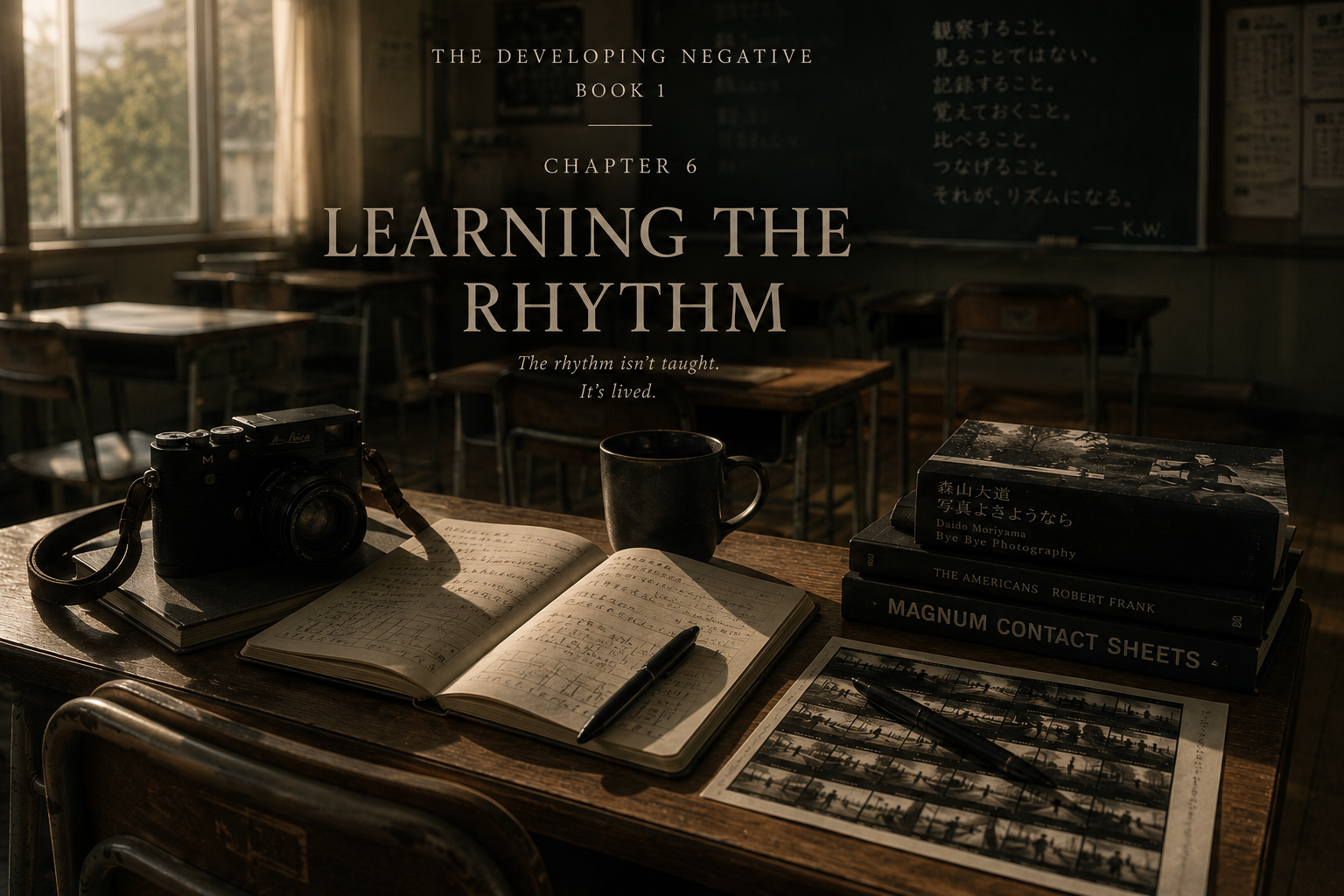
I went out to the studio once the house had quieted, and sat for a while cleaning the M11-P with the same unhurried attention I always bring to the task, the M6 resting beside it in its case, neither camera carrying any assignment that evening beyond the quiet maintenance of simply being cared for properly.
I opened my notebook and wrote for a while, not about any specific assignment, simply recording the day the way I have always recorded days that felt, in some way I could not always articulate in advance, worth setting down before they faded into the general blur of ordinary time.
I wrote about Yuzuha’s interview, and the moment her frustration had turned, quietly, into understanding. I wrote about Suzuha lowering her camera at the baseball field, the particular shock of a true realization arriving plainly, without ceremony. I wrote about Toru’s hands correcting my grip, patient and precise, and about my grandfather’s small, private smile at dinner, the smile of a man watching a lesson he had spent a lifetime teaching finally take root in someone new, planted there not by his own instruction but by mine, offered without my even realizing I was offering it.
I thought, setting the pen down for a moment, about how strange it was that the day’s most meaningful lessons had all arrived sideways, unannounced, none of them delivered as anything resembling a formal teaching moment. Fujita had corrected my grip without any interest in whether the correction felt significant to me. Toru had taught me patience simply by practicing the patience Fujita had once shown him. Yuzuha and Suzuha had each discovered, independently and within an hour of each other, the same fundamental truth about where a real story actually lives, neither of them needing more from me than a single sentence offered at exactly the right moment to let them recognize what they had already, on some level, begun to suspect.
Perhaps that was the entire shape of real teaching, I thought. Not instruction delivered deliberately, but simply the quiet, consistent example of taking something seriously enough that anyone watching closely enough eventually catches the seriousness themselves, the way a held note in music eventually settles into the room around it without anyone needing to announce that the sound has arrived.
One entry, when I read back over what I had written, stood out from the rest more clearly than I had expected it to.
A school isn’t remembered because of its buildings. It’s remembered because of the people who quietly changed inside them.
I closed the notebook.
Before turning off the studio light, I opened the Billingham, checking, out of habit, that everything inside sat exactly where it belonged. My gaze caught on the small laminated card Kimura had handed me that morning, once I’d finally submitted the completed membership form—Journalism & Photography Club, my name printed in plain, unremarkable type beside a title that specified nothing more than Staff.
I slid it into the bag’s inner pocket, beside the notebook, beside the small collection of things that had accumulated there over years of carrying exactly this bag into exactly this kind of quiet, ordinary evening.
It was not, I understood, closing the flap and setting the bag by the door for the morning, simply a symbol of having joined something. It was a reminder, small and unremarkable as the card itself, that this, too, was now simply part of my life—not separate from the rest of it, not compartmentalized into some corner labeled school and left there, but woven into the same continuous fabric as Ukraine, and Mion, and the koryu forms my grandfather had spent a lifetime teaching me, and Toru’s careful hands adjusting my grip that afternoon, patient and precise, teaching me something I suspect I will carry considerably further than a single kendo strike ever could.
I turned off the studio light and stood for a moment in the doorway, looking back at the room in the dim spill of light from the garden beyond—the shelf where the M11-P and M6 now rested side by side, the darkroom door closed for the night, the desk where a week’s worth of small, ordinary observations had accumulated into something that already felt, faintly, like the early shape of a much longer story I had not yet finished learning how to tell.
Tomorrow was Saturday, and the household would slow into its own particular weekend rhythm, looser and later than the week that had just closed behind it. But walking back toward the main house under a sky just beginning to show the same stars I had watched from an apartment in Kyiv only a few weeks earlier, I understood that the week now ending had taught me something I suspected I would still be turning over long after its details had faded—that a life is not built from the dramatic weeks, the ones that announce themselves loudly enough to be remembered on their own. It is built from weeks exactly like this one: ordinary, quietly accumulating, full of small lessons offered sideways by people who had no idea, most of the time, that they were teaching anything at all.