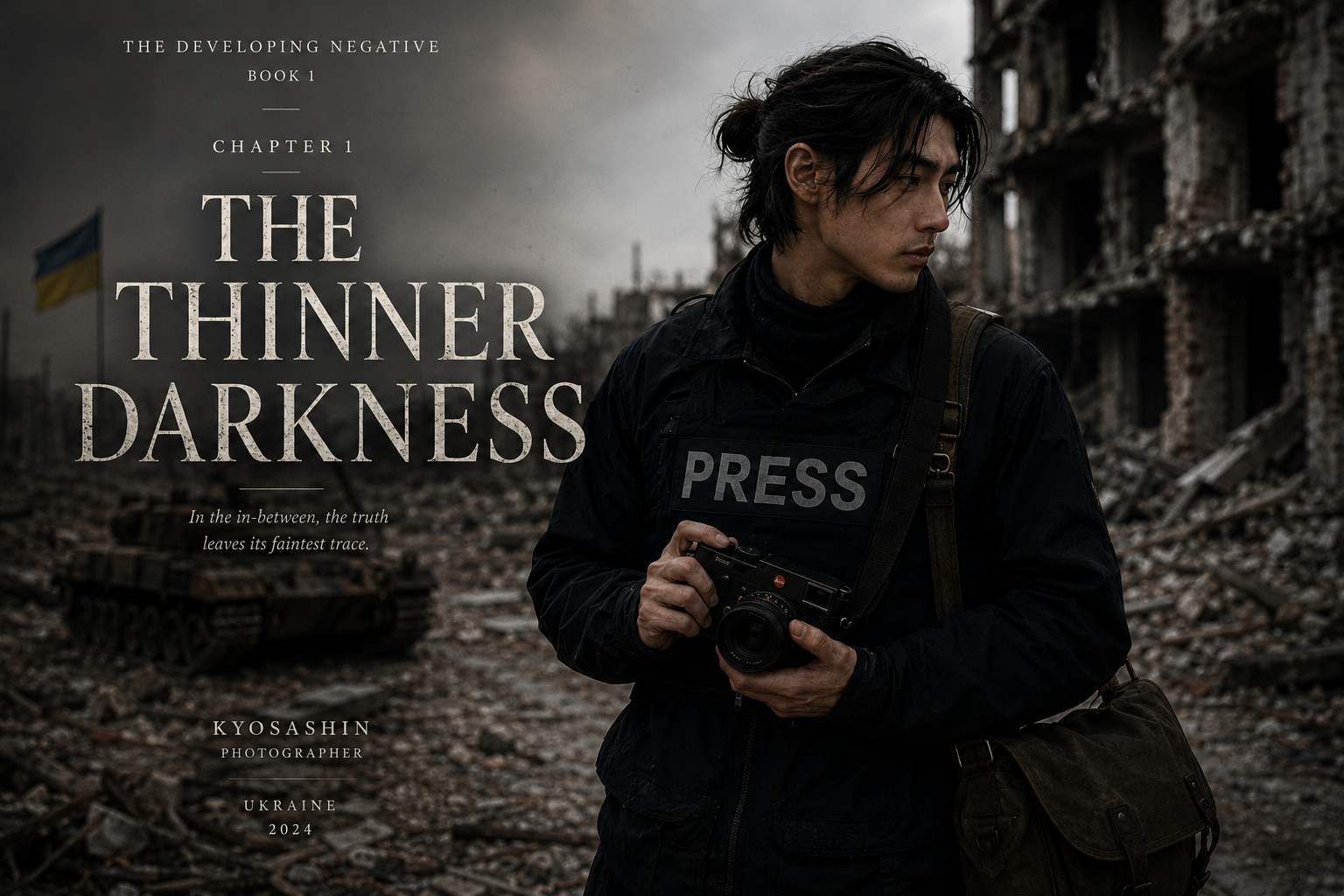
Chapter 1
The Developing Negative – Book 1
March 2025
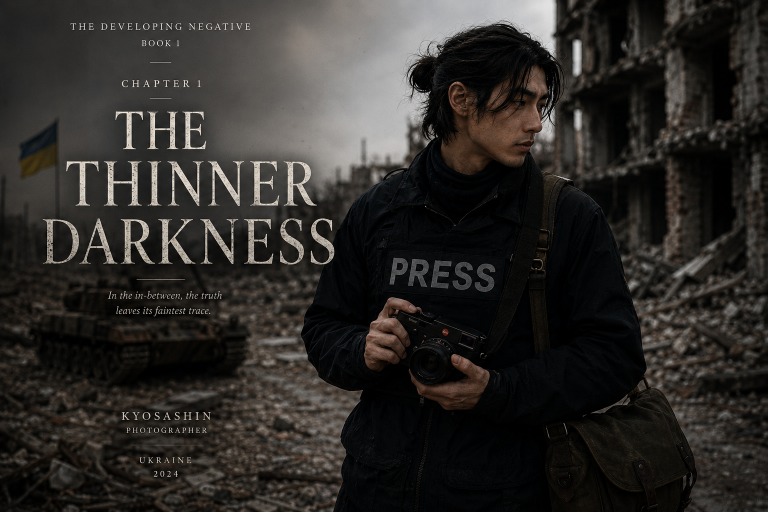
There is a particular kind of darkness that exists only in the hour before dawn, and it is different from every other darkness. It is not the darkness of midnight, which is full and certain of itself. It is a thinner darkness, one that already knows it is losing, the way a person knows they are losing an argument long before they stop arguing. I have always liked that hour best. I have liked it in Tokyo, where it arrives quietly beneath the hum of vending machines, and I have liked it in Takasaki, where it arrives with the smell of my grandmother’s garden still wet from the night. And I liked it, too, in Kyiv, in an apartment that was not mine, on a street whose name I could pronounce but never quite spell, in the last week of a March that would end, four days later, with me eating rice at my grandparents’ table as though none of this had happened at all.
I woke without an alarm. I always do. Some part of me has never trusted alarms, the way some people never trust umbrellas, believing that if you prepare too visibly for a thing, you invite it. I lay still for a moment, staring at a ceiling I did not recognize even after two weeks of staring at it, and I listened.
The building did not creak the way buildings creak in Japan. It settled differently, the way an older person settles into a chair they have sat in for forty years, without complaint, simply making room for the day. Somewhere below, a car passed, then another. Somewhere further away—far enough that it belonged to the city rather than to the morning—something detonated, low and distant, like a door closing three rooms away. I did not flinch. I want to be honest about that, though I am not entirely sure honesty is a virtue here. I did not flinch because by then I had learned that flinching accomplishes nothing except waking you up faster than you intended, and I intended to wake up slowly, the way I always do, with coffee.
I got up.
The apartment belonged to a woman named Halyna who had left for Lviv in the autumn and rented the rooms to whoever needed them, mostly journalists, mostly foreign, mostly people like me who came and went without really living there. She had left behind a French press, a chipped mug with a fox on it, and a small collection of postcards from cities she had apparently visited before the war made visiting anywhere complicated. I never asked her story directly. I have found that people tell you their stories eventually, in fragments, while you are doing something else—washing a cup, tying a shoe—and if you wait, you learn more than if you ask.
I filled the kettle. I ground the beans I had brought with me from Tokyo, because I have never trusted coffee I cannot trace to its origin, which my grandmother says is either admirable discipline or an early symptom of becoming an old man, and she has not yet decided which. The grinder was loud in the quiet apartment, loud enough that for a few seconds it was the only sound in the world, and I found that I liked it that way. There is something honest about a sound you have chosen to make, in a place full of sounds you have not.
While the water heated, I opened the shutters.
Kyiv in the last hour of darkness looks, from a certain height, almost like any other city. Streetlights. A tram, empty, moving through an intersection because the schedule does not know there is a war, only that it is Tuesday. A woman walking a small dog with the particular patience of someone whose dog is old and does not walk quickly anymore. I watched her for a while. I did not photograph her. Some mornings are not for photographs. Some mornings are simply for being awake in them.
The coffee finished. I poured it into the fox mug, added nothing, and stood by the window with both hands around the ceramic, feeling the heat travel slowly into my palms the way it always does, as though the mug were reluctant to let it go all at once. Steam curled upward and disappeared into the colder air near the glass. Somewhere in the eastern part of the sky, so faint I might have imagined it, the black was beginning to soften into something closer to blue.
I thought, not for the first time, that mornings do not care what country they are in. They arrive the same way everywhere, indifferent and patient, whether or not the people below deserve them.
I have noticed, over the years, that people who have never worked in a place like this imagine it as a single, unbroken emergency, a state of permanent alarm stretching from one horizon to the other. It is not like that, or at least it was not like that in the apartment above that particular street in the last week of that particular March. It was, instead, something stranger and somehow more difficult to explain: an ordinary life, occurring in the same hours as an extraordinary one, both of them true at the same time, neither canceling out the other. The tram still ran. The woman still walked her old dog at the pace old dogs require. Somewhere, a baker was almost certainly opening a shop, setting out bread that people would buy that morning the same way they had bought bread the morning before, and the morning before that, because a person has to eat, regardless of what else is happening in the world around the eating.
I have thought about this many times since—the way the ordinary and the terrible can occupy the same city block, the same hour, sometimes the same breath, and how strange it is that people manage to live inside both at once without being torn apart by the contradiction. Perhaps that is simply what living is, in the end. Perhaps every life, everywhere, is some version of the same arrangement, and it is only in places like this that the arrangement becomes visible enough to notice.
I finished my coffee slowly, the way I always do, watching the blue deepen slightly at the edge of the sky, and I thought, with the small, private satisfaction of a thought I had had many times before and would likely have many times again, that noticing this arrangement—the ordinary folded inside the extraordinary, indistinguishable from it if you did not look closely—was, in the end, the entire reason I did this work at all.
I placed the Billingham on the small kitchen table.
It is a strange thing to admit, but I have never owned a piece of equipment that means as much to me as that bag. It is not the newest. It is not the most expensive. My mother bought it for me when I was twelve, before she understood what it would become to me, before I understood it myself. The canvas has faded in places, the leather has darkened in others, and there is a small ink stain on the left strap that I have never tried to remove, because removing it would mean pretending the stain never happened, and I am not in the business of pretending things never happened. I ran my thumb once across the worn brass buckle, the way I always do before I begin, and then I began.
I have never packed the way other photographers pack. I have watched them do it—laying gear out like surgical instruments, checking each item off a list taped inside a case—and I understand the impulse. But for me, packing has always been closer to a kind of prayer, if prayer is the right word for something you repeat every day without quite believing it will be answered.
The Leica M11-P Safari came first, because it always comes first. It is the camera I reach for the way another person might reach for a familiar coat—not because it is the best choice for every occasion, but because my hands already know its weight, its shutter, the particular resistance of its focus ring, better than they know almost anything else in the world. The 35mm was already mounted. I packed the 24mm and the 50mm into the divided compartment of the bag, along with two spare batteries and enough memory cards that running out would require a kind of bad luck I did not intend to invite.
The SL2 Reporter went in next, fitted with the 24–70mm, because there are days when patience is a luxury and speed is a necessity, and a person who cannot tell the difference between those two kinds of days has no business doing this work. I have learned, slowly and sometimes at some cost to myself, which camera belongs to which kind of morning.
The Osmo Pocket and the small wireless microphones went into the outer pocket, where I could reach them without opening the bag fully, because sound arrives before understanding does, and I did not want to miss the sound of anything simply because I was still deciding whether it deserved a photograph.
I checked my press credentials, folded into the same leather wallet they had always been folded into. I checked my notebook, the pages softened at the corners from being carried against my body for two weeks. I checked, out of habit rather than necessity, that my passport was where I had left it the night before, tucked into the inside pocket of my jacket, close enough to my chest that I would notice immediately if it were gone.
I never packed for photographs.
I packed for the possibility that something worth remembering might happen, and for the certainty that if it did, I did not want to be the reason it went unrecorded. There is a difference between hoping something happens and preparing in case it does. I have always tried to live on the second side of that difference.
By the time I finished, the sky outside had turned the color of weak tea, and the coffee in the fox mug had gone lukewarm, the way it always does when I let a ritual run too long. I drank it anyway. I have never believed that coffee needs to be perfect to be worth finishing.
Solomiya was waiting for me outside, exactly on time, which by that point in our working relationship no longer surprised me. She was smoking, though she always put it out the moment she saw me, an old habit she claimed had nothing to do with me and everything to do with the fact that cigarettes and mornings did not belong together, a philosophy I privately admired even as I said nothing about it.
“Hospital first,” she said, in English, because her Japanese was nonexistent and we had long ago settled on English as the language most efficient for the two of us, though by then my Ukrainian had climbed to something I privately measured at around seventy-five percent—enough to follow most conversations, enough to order food or ask directions without embarrassing myself, not yet enough to argue, or joke, or lie convincingly, which I have always thought are the three true tests of fluency in any language.
I have never been able to explain, to people who ask, how I came to speak as many languages as I do, mostly because the answer is neither interesting nor difficult: my mother spoke to me in Mandarin when she was tired and wanted comfort, and in Japanese the rest of the time; my father, when he visited, spoke to me only in Russian, a habit from his own childhood he never quite abandoned; and somewhere in the middle of all of that, Korean arrived the way languages arrive in households that refuse to simplify themselves for the sake of convenience—overheard, absorbed, practiced without anyone deciding it should be practiced. English and German came later, deliberately, the way you learn things you have decided you need rather than things that were simply given to you. Ukrainian came later still, and differently than any of the others—not from a parent, not from a classroom, but from necessity, from two weeks of listening carefully to announcements I could not yet fully understand and asking Solomiya, patiently, to repeat words until they stopped being sounds and became meaning.
“Then the station,” she continued, as though she had not noticed my mind wandering somewhere into its own private catalogue of languages, which she likely had not. “Then, if there is time, the distribution point near the depot.”
I nodded. My editor’s message from the night before had said much the same thing, three lines, no elaboration, the kind of message that trusts you to understand what is not written as much as what is.
Children’s hospital. Railway station. Humanitarian distribution. Use your judgment. Come home safe.
There is no exposition in a message like that, and there was none in the morning that followed it either. We simply got into Solomiya’s car, an old grey hatchback with a cracked windshield she refused to repair because, she said, the crack reminded her of something she did not want to forget, though she never explained what, and I never asked. Some mornings you do not ask.
The hospital was smaller than the word hospital usually suggests, a converted building that had been something else before the war and would perhaps be something else again after it, if anyone could agree on what after meant anymore. A generator hummed somewhere behind the building, providing the electricity the city itself could not always guarantee. Inside, the halls smelled of antiseptic and, faintly, of the soup someone was preparing in a kitchen too small for the number of people who needed to eat from it.
I did not photograph what people expect a photographer to photograph in a place like this. I have never believed that suffering, displayed loudly enough, teaches anyone anything they did not already know. Instead I photographed a nurse adjusting the strap of her mask before entering a room, the small, unconscious gesture of someone preparing herself for the next hour of her life. I photographed a volunteer sorting donated children’s shoes into pairs by size, her hands moving with the patient efficiency of someone who had done this so many times that her fingers had stopped needing her attention. I photographed, near the end of the hallway, three children playing some version of a game involving a ball made from rolled socks, their laughter entirely unbothered by the walls around them, because children, I have found, possess a kind of resilience that adults spend the rest of their lives trying and failing to imitate.
The M11-P remained in my hands for nearly the entire visit. Its shutter is quiet, quieter than most cameras, quiet enough that I could work without becoming the center of a room simply by entering it. I have always believed that the best photograph is one the subject barely notices being taken, because a person who forgets they are being photographed is, for that moment, entirely themselves.
A mother, folding laundry in a small room beside her son’s bed, looked up once, caught my eye, and smiled—not for the camera, but because smiling, in that moment, seemed to require less effort than not smiling. I took the photograph, and then I lowered the camera and smiled back, because there are moments when the correct response to a person’s kindness is simply to return it, without a lens between you.
We ate lunch at a small café two streets from the hospital, one of the few still open, its windows taped in a crosshatch pattern that had become so common throughout the city that I suspected people had stopped seeing it as tape and started seeing it simply as a kind of decoration, the way you stop noticing wallpaper after enough years in the same house.
Solomiya ordered varenyky for both of us without asking what I wanted, which I did not mind, because I have found that being told what to eat by someone who knows a place better than you is one of the small pleasures of traveling, a pleasure too easily lost to the modern habit of researching everything in advance.
“You are quiet,” she said, not as a criticism, simply as an observation, the way you might mention that it had started raining.
“I am always quiet,” I said.
“No.” She considered this while chewing, unhurried. “You are quiet in a way that is different from your usual quiet. Younger.”
I did not answer that directly, though something in me noted, with a kind of distant amusement, that she had accidentally arrived at something true without knowing how true it was.
She had assumed, from the beginning, that I was somewhere in my mid-twenties, an assumption I had never corrected, partly because correcting it seemed unnecessary and partly, I admit, because I had grown curious to see how long the assumption could survive without help from me. It survived the entire lunch. It survived, in fact, the entire assignment.
I have found that people believe what makes the world easiest to understand. A seventeen-year-old carrying two Leicas through a children’s hospital in a country at war does not fit easily into anyone’s understanding of the world, and so, quite reasonably, no one arrived at that conclusion unless I told them directly. I told very few people directly.
We ate slowly. Outside, a tram passed, its bell ringing once, the sound oddly cheerful against the gray light of the afternoon. I thought about Yukine, briefly, about how she would have found something to say about the varenyky, something warm and a little too loud, the way she always does when she is pretending not to worry about me. I thought about my grandmother’s kitchen, four thousand kilometers and, in every way that mattered, an entire universe away. Then I finished eating, and the thought passed, the way thoughts of home always eventually pass when there is still work left to do.
The railway station, by the time we arrived in the late afternoon, had become something closer to a small ocean of movement than a building. Families stood in clusters near the platforms, suitcases stacked against legs, children carrying stuffed animals with the fierce, unthinking grip that only children apply to things that matter more than anything else in the world for exactly as long as they are holding them. Volunteers moved through the crowd carrying luggage that was not theirs, offering water, offering direction, offering, mostly, the simple reassurance of another person moving calmly through chaos.
The announcements echoed overhead in a language I understood only partially, though understanding the words was never really the point. The tone told me everything I needed—urgent, but practiced, the tone of people who had made these announcements so many times that urgency and calm had somehow learned to occupy the same sentence.
I switched cameras without deciding to switch cameras, which is, I think, the truest sign that a decision has already been made somewhere beneath the level of conscious thought. The M11-P is a camera for patience, and patience was not, in that moment, available to me. Events were moving faster than a rangefinder’s careful focus could follow, faster than I could trust my own hands to keep pace with using an instrument built for stillness. The SL2 came out instead, the 24–70mm already prepared for exactly this, and I moved through the crowd the way I imagine a current moves through a river—not fighting the movement around me, simply finding the spaces within it.
A boy, no older than six, stood on the platform holding his mother’s hand with one fist and a stuffed rabbit with the other, his rabbit missing one ear, worn thin in the way toys become worn only through being loved rather than merely owned. I photographed him twice—once as the train arrived, steam and noise rising around him, and once as he turned, briefly, to look back at the platform they were leaving, an expression on his face too complicated for a six-year-old to have earned, and yet there it was.
I did not know, then, whether that second photograph would ever be published. I still do not know. Some photographs exist simply because a moment insisted on being witnessed, and witnessing does not always require an audience beyond the person who was there.
Nearby, an elderly man sat alone on a bench with a small case balanced across his knees, the kind of case that might once have held tools, or documents, or perhaps nothing more important than a change of clothes and a photograph of someone he had left behind. He was not crying. He was not doing anything, in fact, that a photograph could easily explain—simply sitting, watching the platform the way a person watches a river they have decided not to cross. I photographed him from a distance, using the longer end of the zoom, because some moments do not want you close to them, and a good photographer learns to recognize the difference between a subject who invites you nearer and one who has earned the right to be left exactly where he is.
A volunteer in a reflective vest crouched beside a woman who had begun, quietly and without drama, to cry—not the loud grief of films, but the smaller, more exhausting kind, the kind that arrives after a person has already spent every other emotion they had available to them that week. The volunteer said nothing. She simply put a hand on the woman’s shoulder and stayed there, and I understood, watching them, that this was its own kind of language, one that required no translation and no camera, though I photographed it anyway, because I have found that even wordless kindness deserves to be remembered.
By the time the train departed, the platform had grown quieter, though quieter is a relative term in a place like that. The announcements continued for a while longer, softer now, almost apologetic, as though even the loudspeakers understood that the worst of the afternoon’s urgency had passed. I lowered the camera and stood for a moment amid the settling dust and diesel smell, feeling, as I often do after moments like that one, a kind of exhaustion that has nothing to do with the body. It is the exhaustion of having paid very close attention to something for a very long time, and I have never found a way to prepare for it in advance. You simply feel it when it arrives, the way you feel hunger, or cold, and you learn, eventually, to let it pass through you rather than resist it.
Solomiya found me there a few minutes later, having finished her own conversations with the volunteers coordinating luggage further down the platform. She did not ask how the afternoon had gone. She had been in that station herself, doing her own kind of witnessing, and I think we both understood that some experiences do not require comparison to be validated.
“There is still the distribution point,” she said. “If you have time.”
I looked at my watch, though I already knew the answer before I looked. “There’s time.”
The distribution point near the depot was housed in what had once been a warehouse, its high metal roof doing little to keep out the cold that had settled in with the evening. Long tables had been arranged in rows, each one staffed by volunteers distributing bread, tinned food, blankets, and the particular kind of soap that smells like nothing in particular, the smell of things donated rather than chosen.
I moved through the space slowly, the M11-P back in my hands now that the day’s urgency had eased into something closer to routine. An old woman argued good-naturedly with a volunteer half her age about whether she truly needed two blankets or only one, insisting the second should go to someone who needed it more, and the volunteer insisting, just as good-naturedly, that there was enough for everyone and she should simply take what was offered. Neither of them noticed me photographing the exchange, which is, as I have said, precisely how I prefer it.
A group of teenagers, perhaps Toru’s age or a little older, had organized themselves into an assembly line, passing boxes hand to hand from a truck outside to the tables within, laughing occasionally at some joke I could not follow, their voices carrying an energy that felt almost defiant in a building otherwise so quiet with exhaustion. I thought, watching them, that there is a kind of courage that has nothing to do with weapons or speeches, the courage of simply continuing to laugh, to help, to organize boxes into orderly rows, because the alternative is to stop, and stopping has never solved anything.
Near the back of the warehouse, half-hidden behind a stack of crates, a man sat with a small dog curled against his side, both of them still, both of them watching the activity around them with the same patient expression, as though they had agreed, without discussing it, to simply wait out whatever came next together. I photographed them last, before the light failed entirely, and something about the frame—the man’s hand resting on the dog’s back, neither of them moving—felt, even in the moment I took it, like the photograph I would keep longest from that day.
By the time Solomiya and I left, full dark had settled over the depot, and the volunteers were lighting small lanterns along the tables, the warm, uneven light making the whole warehouse look, for a moment, almost like a festival rather than what it actually was. I thought that this, too, was a kind of truth worth recording—not that suffering had been erased, but that people had found a way to make room, within it, for something resembling warmth.
Back at the apartment that evening, I sat at Halyna’s small kitchen table with my laptop, transferring the day’s photographs, and began the second half of the work that no one ever photographs—the editing.
I have always believed that editing is simply another form of observation, delayed by several hours and performed at a smaller scale. A day produces, on average, somewhere between two and three thousand frames. By the time I finished, perhaps forty remained, and even that felt generous. The rest were not failures, exactly. They were simply moments that had already said what they needed to say the instant they were taken, without requiring anyone else to see them.
I moved slowly through the frames from the hospital, the station, the earlier, quieter moments of the morning that already felt like they belonged to a different week. I discarded photographs that asked for sympathy too directly, the way you discard a sentence that tries too hard to be moving. I kept photographs that simply told the truth and allowed the truth to do whatever work it was going to do on its own, without my assistance.
The apartment was very quiet by then. Somewhere outside, the city continued whatever version of nighttime it had learned to live with, sirens rising occasionally in the distance and falling again, the way waves rise and fall without ever fully stopping. I made a second cup of coffee I did not entirely need, mostly because my hands wanted something to hold.
Around eleven, feeling the particular hollowness that comes at the end of a long day of witnessing things you cannot un-witness, I called home.
Yukine answered on the fourth ring, her voice carrying the specific irritation she reserves for people who do not answer their messages quickly enough, which, in fairness, was me.
“You’ve been ignoring me,” she said, by way of greeting.
“I’ve been working.”
“You’re always working.” A pause, softer. “Are you eating?”
“I ate varenyky today.”
“That’s not an answer.”
I smiled, alone, in a kitchen four thousand kilometers from hers. “I’m eating, Yukine.”
We talked for a while about nothing important—a neighbor’s cat that had gotten into Grandmother’s garden again, a professor who had assigned Yukine a paper she considered beneath her considerable intelligence, whether or not I would be home in time for the start of the new term. I told her yes. I did not tell her where, exactly, working overseashad taken me that week. She did not ask directly, though I suspect, even now, that some part of her already understood more than she let herself say aloud. There are things people choose not to ask because asking would require them to worry about an answer they cannot change.
I called my grandmother next, briefly, mostly to hear her voice ask whether I wanted more rice when I returned, a question she has asked before every homecoming since I was small enough that the question made more practical sense than it does now. I told her yes, of course, always yes, and she seemed satisfied with that, the way she is always satisfied by small, certain answers to small, certain questions.
Mion I called last, because I have always saved the calls that matter most for the moments when I have the least energy left to perform composure, trusting that whatever remains of me by then is closer to the truth than whatever I might have presented earlier in the day.
“You sound tired,” she said, before I had said more than her name.
“I am tired.”
“Where are you?”
I did not answer the way I had answered Yukine, and I did not answer the way I had answered my grandmother. There has only ever been one person to whom working overseas was never going to be enough, and it was not because she demanded more than the others. It was because I had never wanted to give her less.
“Kyiv,” I said. “Near Donbas before that.”
She was quiet for a moment, not the quiet of shock, but the quiet of someone recalculating something carefully, privately, the way she always does before she lets you see what she has decided to feel about a thing.
“Is that where you’ve been all week.”
“Yes.”
“Are you safe.”
“I am now.”
I heard her breathe out, slowly, on the other end of the line, and I understood that she had been holding something in her chest since the moment I said Kyiv, and had only now allowed herself to set it down. She did not scold me, though I had half expected her to. She did not ask why I hadn’t told her sooner, either, which surprised me more than anything else that night, until I remembered that she already knew the answer—that I had not told her sooner because there had been no way to tell her without also telling her while I was still there, still in it, and I have never been able to make myself do that to the people I love. Telling her now, safe, on a plane home in every way except the fact of the plane itself, felt like something closer to honesty than cruelty.
“Thank you for telling me,” she said finally.
“You’re the only one who knows.”
“I know.” A small pause, softer than the others. “You don’t have to carry that alone, Kyo. Not with me.”
I have thought about that sentence many times since, turning it over the way you turn over a stone you have decided to keep, and I have never found a better way to explain why Mion has always been different from everyone else I love, though I love them all completely. It was never that she asked more of me. It was that she had, somewhere along the way, without either of us deciding it formally, become the one place where the truth did not need to be managed before it was spoken.
“Come home soon,” she said.
“I will.”
“I mean it, Kyo.”
“I know you do.”
We talked a little longer, about nothing in particular, the way people talk when the point of the conversation is not the words themselves but the simple fact of hearing each other’s voice across a distance that otherwise felt too large to measure. When we finally said goodnight, I sat for a moment in the quiet apartment, the phone still warm in my hand, feeling something in my chest loosen slightly, the way a held breath loosens when it is finally released.
I had told Yukine and my grandmother only that I was working overseas, and I would tell them nothing more than that even after I returned, because I did not want them carrying worry over something they could not change, four thousand kilometers away, unable to do anything except worry. But Mion had asked, and I had answered her honestly, the way I always eventually answer her honestly, because somewhere in the years before this story begins, without either of us deciding it out loud, we had already agreed that whatever we would eventually build together could not be built on the small, protective omissions I still allowed myself with everyone else.
My editor arrived the next morning, a man named Watanabe who had flown in the day before to review the work in person, something he did rarely enough that his presence always meant either exceptional trouble or, more happily, that the assignment had reached its natural end.
He reviewed the final edit in silence, scrolling slowly, occasionally pausing on a frame long enough that I understood, without needing him to say it, which photographs had done what they were meant to do. He said very little throughout, which from Watanabe has always meant approval rather than disappointment; he has never been a man who withholds criticism when criticism is warranted.
When he finished, he closed the laptop gently and looked at me for a long moment, the way a person looks at something they have decided to say carefully.
“Good work,” he said. Then, after a pause: “Go home. School starts next week.”
I do not know, even now, whether he said it as a simple statement of fact or as something closer to a kindness, an acknowledgment of a thing we both understood but had never discussed directly during the two weeks I had spent working alongside people twice, sometimes three times, my age, none of whom had ever asked, and none of whom, I suspect, would have believed the answer if I had told them without being asked first.
I was seventeen years old.
I mention this now, plainly, because I think it matters that the reader understand it plainly, the way it mattered to me, standing in that small kitchen in Kyiv with my editor’s words settling over me like the last light of an ending day. Not as a twist, not as a revelation designed to surprise, but simply as a fact that had been true the entire time, quietly, beneath everything else that had happened that week, the way the ground remains true beneath a person’s feet regardless of whether they think to notice it.
The flight home took most of a day, three connections, each one smaller and more ordinary than the last, until finally I was simply a passenger among passengers, unremarkable, tired, carrying a bag that held two cameras and several thousand photographs that would eventually become forty, and eventually, perhaps, fewer than that.
I spent much of the final flight scrolling slowly through the last gallery from Ukraine, the way I always do, though I am never entirely sure what I am looking for when I do this. Perhaps I am looking for permission to stop thinking about it. Perhaps I am simply confirming, frame by frame, that everything I witnessed actually happened, the way you might touch a bruise to confirm that the pain that woke you was real and not simply a dream you had not yet finished waking from.
I thought about observation, the way I often do on planes, in that strange suspended hour where you are neither where you were nor where you are going. I thought about memory, about how a photograph is not really a memory at all but a kind of promise—a promise that something happened, that it mattered enough to be recorded, that somewhere, someone besides the person who lived through it will eventually know it occurred.
I thought about returning to ordinary life, and about how strange that phrase always sounds to me, ordinary life, as though ordinary were a place you could simply return to, like a station on a familiar train line, rather than something you built again, quietly, one unremarkable day at a time.
Outside the window, clouds moved past in slow, indifferent formations, the way clouds have always moved, regardless of what is happening beneath them. I closed my eyes for a while, not quite sleeping, simply resting in that particular gray space between one country and another, between one version of myself and the version that would, in four days, be sitting at a familiar table eating rice that had been made a hundred times before in exactly the same way.
In four days I would be back in Takasaki.
My grandparents would ask whether I wanted more rice.
Yukine would probably complain that I hadn’t answered enough messages.
Mion would smile the way she always did when she was trying to decide whether to hug me or scold me.
It was strange how quickly a person could travel from one world to another.
Stranger still that both of them felt like home.