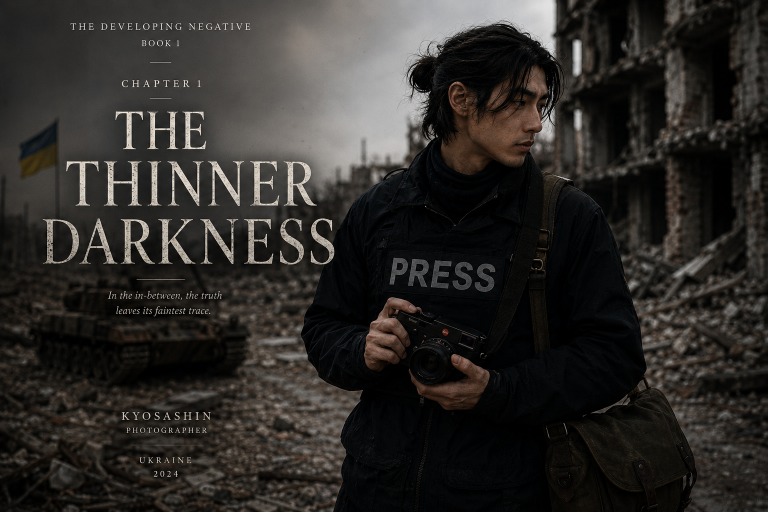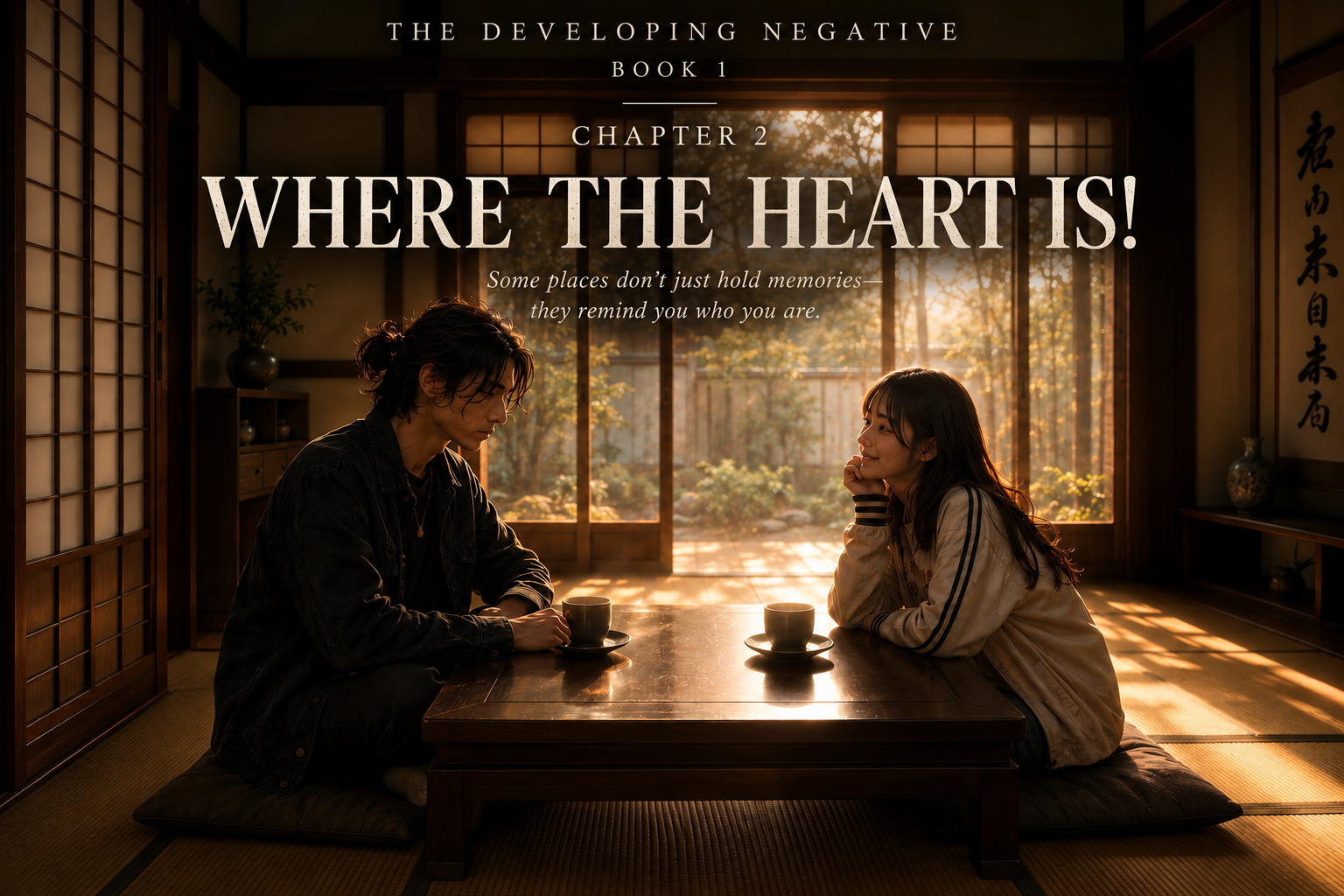
The Developing Negative – Book 1
Chapter 2
Late March 2025
There is a specific sound that Narita Airport makes, and it is unlike the sound of any other airport I have ever passed through. It is not silence, exactly. It is something quieter than sound, a kind of collective agreement among several thousand people that noise should be kept to the size of the room it occupies and no larger. I noticed it the moment I stepped off the jet bridge, the way you notice, after a long illness, that your own house smells slightly different from how you remembered it—not wrong, just unfamiliar in a way that takes a moment to resolve into familiar again.
Announcements arrived in careful, evenly spaced Japanese, followed by English that had clearly been rehearsed rather than merely translated. People stood in lines the way people stand in lines only in a handful of countries in the world, an orderliness that asked nothing of anyone except patience, and received it without complaint. A vending machine near the baggage claim sold seventeen kinds of canned coffee, and I stood in front of it for perhaps thirty seconds longer than necessary, simply admiring the fact that seventeen kinds of anything could exist so calmly beside each other, unguarded, in a country where nobody seemed to feel the need to protect a vending machine from itself.
I bought one. Boss, the blue can, the same one I have been buying since I was young enough that my grandmother worried it would stunt my growth, a worry that never entirely made sense to either of us but which she voiced anyway, the way people voice worries they have simply inherited from someone else’s worries.
I drank it slowly, standing near the window while I waited for my bag, watching the ground crew in reflective vests move with the unhurried precision of people who have done the same job for years and no longer need to think about doing it well. Outside, the sky over Narita was a pale, scrubbed gray, unremarkable in every way, and I found myself grateful for how unremarkable it was. I had spent two weeks noticing things. For a few minutes, standing in an airport that asked nothing of me except to wait quietly for a suitcase, I allowed myself to notice nothing at all.
A family stood near the carousel a little further down—parents, two small children, a grandmother trailing slightly behind with a cart of luggage stacked higher than seemed reasonable—arguing cheerfully in a dialect I could place only approximately, somewhere southern, and I found myself watching them the way I might have watched anyone two weeks earlier, out of instinct rather than intention, before remembering, with a small, private amusement, that I did not need to photograph this. Nobody needed evidence that this family had returned safely from wherever they had been. Their safety required no witness beyond themselves.
The air, when I finally stepped outside to find the train, tasted clean in a way I had not expected to notice until I noticed it—faintly of exhaust, faintly of rain that had fallen sometime in the last hour, but clean beneath all of it, the way air only tastes clean when you have spent enough time somewhere it does not.
I did not go directly home.
I never do.
I have always stopped in Tokyo first, even when there was no professional reason requiring it, even when the straightest, most sensible route home led directly through Ueno without any obligation to leave the platform. I have never fully explained this habit to my family, though I suspect Yukine understands it better than she lets on, and I suspect my grandmother understands it best of all, because she has never once asked me to explain it, which in her particular language of understanding is its own kind of acknowledgment.
I think the truth is simple enough, though it took me years to say it plainly even to myself: I have never been able to walk directly from one version of the world into another. There has always needed to be a room in between, a place where I could set down whatever I was carrying long enough to become, again, someone capable of walking through my grandparents’ gate without frightening anyone with what I had seen.
Tokyo, and specifically Ueno, has always been that room.
I checked into the apartment above Beautiful Light a little past noon, dropped my bag inside the door without unpacking it, and went straight back out again, because unpacking felt, that particular afternoon, like committing to a stillness I was not yet ready for.
I walked without a destination, which is different from walking without purpose. Ueno Park was still cold in the way early spring is cold in Japan—not the sharp, punishing cold of deep winter, but a softer, more patient cold, the kind that seems to know it will not last much longer and has stopped trying very hard. The cherry trees along the main path had not yet opened, though a few of the more impatient branches showed the faintest suggestion of pink at their tips, buds clenched tight as fists that have not yet decided whether to open.
I sat on a bench near the National Museum for a while, watching an old man feed pigeons from a paper bag with the unhurried ritual of someone who has been feeding the same pigeons, or pigeons enough like them that the distinction no longer matters, for many years. A group of university students walked past arguing cheerfully about something I did not try to understand, their laughter loud in the way laughter is only loud when you have not yet learned to worry about who might be listening. Two small children chased each other in wide, looping circles around a patch of grass their mother had clearly told them, more than once, not to run through.
None of it needed me. That was, I think, the entire point of sitting there. For two weeks I had been necessary to a kind of witnessing that mattered, that people were depending on, in ways large and small, and there is a particular exhaustion that comes from being necessary for that long without pause. Ueno Park did not need me to notice anything. The pigeons would be fed whether or not I watched. The children would keep running through grass regardless of whether a photograph existed of them doing it.
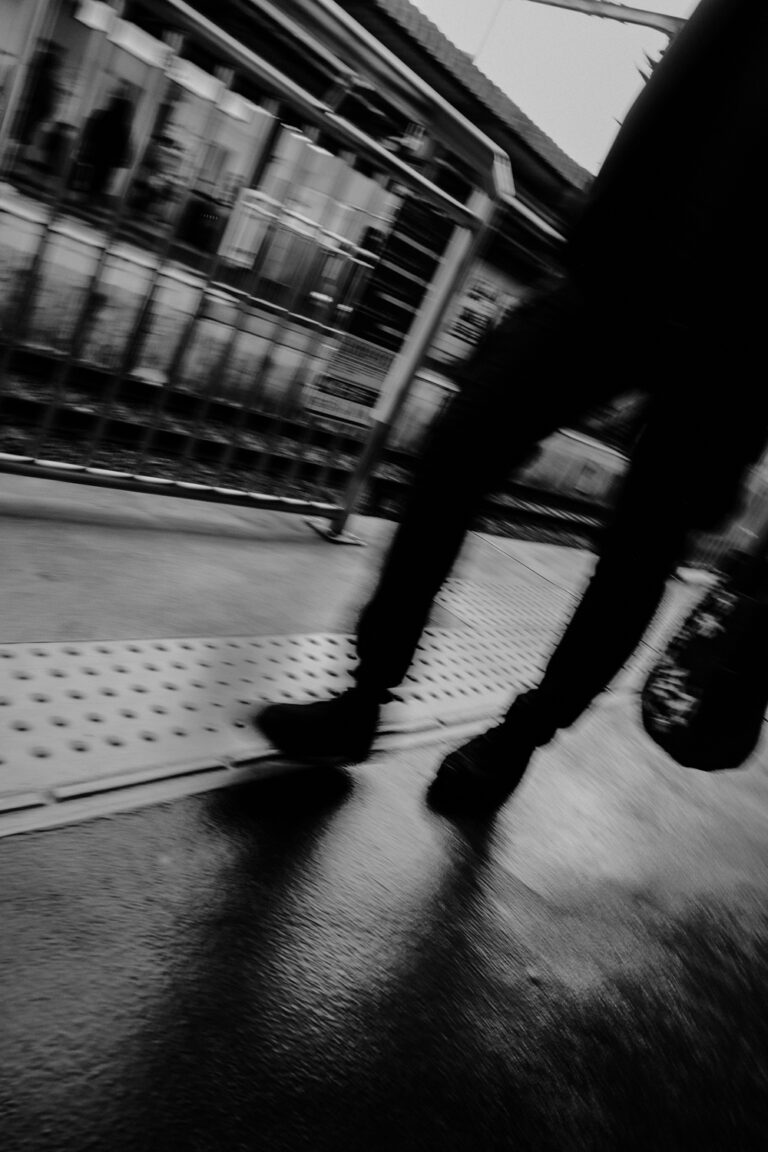
I took out the M11-P anyway, not because the moment demanded documentation, but because some part of me simply wanted to remember what it felt like to photograph something for no reason except that it was beautiful and mine to notice. I photographed the old man’s pigeons, the students’ laughter caught mid-motion, the children’s blurred, joyful legs. I did not think about composition the way I usually do. I simply pointed the camera at whatever made me feel, briefly, like a person rather than an instrument, and pressed the shutter, and let that be enough.
I walked down to Shinobazu Pond as the light began softening toward evening, the water the color of pewter beneath a sky that could not decide whether it wanted to rain. A heron stood motionless at the water’s edge, so still that for a long moment I mistook it for something ornamental, until it moved, once, with the sudden, total commitment that herons apply to everything they do, and caught something I never saw clearly enough to identify.
I thought, watching it, that herons have always understood something about patience that most of us spend our whole lives failing to learn.
I ate dinner alone that night at a small stand in Ameyoko, standing at the counter beside strangers who did not know, and had no reason to know, where I had been the week before. I ordered without needing to think about what I wanted, in Japanese, surrounded by Japanese, and there was something almost overwhelming about how ordinary that felt—how strange it was that ordinary could feel like a kind of mercy, when only days earlier ordinary had felt like a language I was slowly forgetting how to speak.
I went to the Brand Idols office the following morning, mostly because Watanabe had asked me to bring the physical memory cards in person rather than trusting the upload, a request he makes often enough that I no longer question it, though I suspect it has less to do with data security than with his own particular need to see, with his own eyes, that I had returned from wherever I had gone.
The meeting was brief. He reviewed the final edit once more on a larger screen, made a handful of small adjustments to the sequencing that I agreed with immediately because he was right, and told me the piece would run within the month, pending final approval from an editor above him whose name I have never learned and have never particularly wanted to.
“You still have four days before school,” he said, not quite a question, sliding a modest envelope of payment across the desk along with a form I signed without reading closely, because I have long since learned to trust Watanabe’s paperwork the way I trust very few other things in this business.
“That should be enough,” I said.
He looked at me for a moment the way he sometimes does, a look I have never fully learned to interpret, somewhere between concern and a kind of quiet respect he does not often put into words. “Sleep,” he said finally. “You look like you haven’t.”
I told him I would, which was not entirely true, though it was true enough that I did not feel I was lying.
Mion was waiting outside a small café near Yanaka, the kind of place with mismatched chairs and a chalkboard menu that changed depending on what the owner felt like cooking that week, a place we had found together years earlier and had quietly, wordlessly agreed belonged to us in the small, private way certain places belong to certain people.
She saw me before I saw her, which is unusual, and stood up from the table she had already claimed, and for a moment neither of us said anything at all. She simply looked at me, the way she looks at photographs sometimes, carefully, as though checking that what she was seeing matched what she had been imagining.
“You look tired,” she said finally, which was not an accusation, only an observation, delivered with the same gentleness she had used on the phone days earlier.
“I am tired,” I said, which by then had become something close to the truest sentence available to me.
She did not ask about the hospital. She did not ask about the station, or the distribution point, or any of the photographs that would, within the month, belong to strangers who would look at them and feel something without ever knowing my name. I understood, sitting down across from her, that she had already decided, somewhere before I arrived, that this particular reunion was not going to be about the war at all.
“How are you?” she asked instead, and something in the plainness of the question caught me slightly off guard, the way a familiar door sometimes surprises you by opening more easily than you expected.
I considered the question honestly, which is not something I do automatically, even with her. “Tired,” I said again. “And a little far away, still. I think part of me is still landing.”
She nodded, as though this made complete sense to her, which perhaps it did, given how many times over the years she had watched me arrive somewhere still half-inhabiting somewhere else.
We ordered coffee, and later lunch, without either of us paying much attention to what we were eating, which has always been one of the quieter pleasures of being with her—that food, in her company, has never needed to be an event. She talked about a project she was considering, something involving a documentary series Brand Idols had proposed to her, still uncertain whether it fit the direction she wanted her work to take. I listened more than I spoke, partly because I did not yet trust my own voice to carry a full conversation, and partly because listening to her has always been one of the more restful things available to me in this world.
At some point, without either of us deciding to walk anywhere in particular, we left the café and simply moved through the neighborhood, past a shuttered temple gate, past a shop selling secondhand kimono fabric, past an old woman sweeping the same three meters of sidewalk she had likely swept every morning for decades. Mion walked close enough beside me that our shoulders occasionally brushed, and neither of us moved to correct the distance, and I found that I did not want to.
“I keep thinking about the boy with the rabbit,” I said eventually, without deciding in advance that I was going to say it. “The one at the station.”
She did not ask which rabbit, or which station, though I had never described that particular photograph to her in any detail. She simply waited, the way she always waits, leaving room for a sentence to finish arriving in its own time.
“He looked back,” I said. “Just once. And I don’t know what he was looking at. His whole life, maybe. Or maybe nothing. Maybe he just liked the platform.”
“What do you think he was looking at?” she asked, and it was, I realized, the same question in a different shape—how are you, said again, more quietly, through someone else’s eyes instead of my own.
“I don’t know,” I admitted. “I think that’s why I kept the photograph.”
We walked a while longer without speaking, and I found that the silence between us has never once, in all the years I have known her, felt like something that needed to be filled. Other silences, with other people, sometimes ask to be broken. Hers never has.
“I’m glad you told me,” she said eventually, as the light began turning the particular gold it turns in Tokyo in the last hour before evening. “Where you really were.”
“I know.”
“I don’t need you to protect me from things, Kyo.”
“I know that too,” I said. “I think I’ve always known it. I think that’s part of why it was you.”
She smiled at that, small and unhurried, the smile I have come, over the years, to recognize as the one she reserves for moments she has decided are worth remembering exactly as they happened, without embellishment. We did not discuss what any of it meant, not directly, not that afternoon. Some understandings, I have found, are strongest when they are allowed to exist quietly, without being forced into the shape of a declaration before they are ready.
We found a bench near the edge of a small shrine garden, half-forgotten by the tourists who crowded the more famous ones elsewhere in the city, its stone lanterns worn soft at the edges by decades of rain. Mion sat with her knees drawn up slightly, her shoes off, tucked beneath her the way she has always sat since we were young enough that neither of us thought to notice how we sat at all.
“Tell me something that isn’t about any of it,” she said. “Something small.”
I thought for a moment. “The coffee at the airport machine. There were seventeen kinds.”
“Seventeen.” She said the number slowly, testing it, the way she tests words she finds unexpectedly delightful. “Which one did you get?”
“Boss. The blue can.”
“You always get that one.”
“I know.”
“Doesn’t that bother you? Getting the same thing every time, when there are sixteen others?”
I considered this honestly, because she had asked it honestly, without any of the performance that usually accompanies a question like that. “No,” I said. “I think that’s the point of it. Everything else that day was going to be uncertain. The coffee didn’t have to be.”
She was quiet for a moment, turning that over the way she turns over most things I say, carefully, without rushing to respond simply to fill the silence. “That’s very you,” she said finally. “Finding the one certain thing and holding onto it like a life raft.”
“Is that a criticism?”
“No.” She smiled again, softer this time. “I think it’s why you’ve never drowned.”
We sat there a while longer as the light continued its slow retreat, the shrine’s stone lanterns beginning to hold shadow rather than shed it, a few sparrows arguing over something in the gravel near our feet. She told me, eventually, about a photograph she had seen recently in a gallery near Roppongi, an old print by a photographer whose name I recognized but whose work I did not know well, and she described it with such care—the exact angle of light across a woman’s shoulder, the particular tension in the composition between stillness and movement—that I found myself wishing I had seen it myself, if only to compare her description against the thing itself, the way you sometimes want to hear a song again after someone has described, too beautifully, what it made them feel.
“You should have been a critic,” I told her.
“I’d be terrible at it. I’d only ever want to talk about the things I loved.”
“That sounds like the best kind of critic to me.”
She laughed at that, and the sound of it carried further in the quiet street than it would have carried anywhere busier, and I thought, not for the first time, that I had spent two weeks surrounded by people whose laughter had to fight for space against everything else happening around it, and that there was something almost unbearably gentle about sitting somewhere her laughter did not have to fight for anything at all.
I took the train to Takasaki the following morning, and there are few things in this world I love as unreasonably as I love that particular kind of train journey—the slow, deliberate unspooling of Tokyo into suburb, suburb into farmland, farmland into the low, patient mountains of Gunma, each stage arriving with its own unhurried logic, asking nothing of the passenger except attention.
I sat by the window with my bag beside me and watched the city thin out by degrees. Apartment towers gave way to smaller buildings, smaller buildings gave way to houses with actual gardens, actual gardens gave way, eventually, to rice paddies still flooded and waiting for planting season, their surfaces catching the pale morning light in long, silver sheets that seemed, from a distance, almost like something poured rather than grown.
Small stations passed without stopping, platforms empty except for a single figure here or there, waiting for a different train than mine, going somewhere I would never know and had no need to know. I have always found something quietly moving about those platforms—the sense that an entire life was continuing there, invisible to me, exactly as complete and complicated as my own, requiring nothing from me except the courtesy of noticing it existed at all.
An elderly woman boarded at one of the smaller stations, settling into the seat across the aisle with a basket of vegetables balanced carefully on her knees, and for a while she simply looked out the window the same way I was looking out mine, though I imagined her view held sixty years of memory layered beneath it where mine held only two decades and a handful of countries. She did not seem to need conversation, and I did not offer any, and there was something companionable in that mutual silence, two strangers riding the same unremarkable stretch of track, each occupied by an entirely private version of the same passing scenery.
I thought about the way trains like this one had always felt, to me, like a kind of decompression chamber, the sort divers use when surfacing too quickly from deep water might otherwise do them harm. I had read once, I no longer remembered where, that the human body needs time to adjust to changes in pressure, that rising too fast from the depths could fill the blood with something dangerous, something that needed a slow, patient return to the surface in order to pass through safely. I have never been able to shake the feeling that something similar happens to whatever exists inside a person that is not quite the body—that returning too quickly from one kind of life to another risks a version of the same danger, some pressure released too fast, and that this train, moving unhurried through fields and small stations toward the mountains, was performing exactly that function for me, mile by patient mile.
I thought, watching the mountains rise slowly into view, blue-gray and still capped faintly with the last of winter’s snow, about observation. About how the last two weeks had asked me to observe things that mattered in a way most photography does not—things that would outlive the moment of their taking, that would go on meaning something to someone long after I had forgotten the exact temperature of that particular Tuesday, the exact smell of that particular hallway. And I thought about how strange it was that this train, this ordinary, unremarkable train carrying me toward rice fields and mountains and eventually toward my grandmother’s kitchen, was asking me to observe something entirely different: not what mattered to strangers, but what mattered to me. The distinction had never seemed larger than it did that morning, watching Gunma assemble itself outside the window, one quiet field at a time.
By the time the train pulled into Takasaki Station, something in my chest had already begun, without my permission, to loosen.
The walk from the station to the estate takes perhaps twenty-five minutes if you walk at an ordinary pace, and I have never once, in all the years we have lived there, walked it at an ordinary pace. I walked it slowly that afternoon, the way I always do on the first walk home, letting the neighborhood arrive around me one familiar detail at a time—the bakery on the corner with its faded blue awning, the vending machine outside the shuttered stationery shop that has sold the same brand of barley tea for as long as I can remember, the narrow river with its concrete banks where I used to catch small fish as a child, before I understood that catching them was less interesting than simply watching them.
The gate came into view before the house did, the way it always does, the old stone wall rising just high enough to suggest privacy without insisting on it. Someone had swept the path recently; the stones were clear of the small drifts of dead leaves that gather there every winter and take my grandmother’s quiet, determined effort each spring to finally clear away.
I found my grandfather in the garden, exactly where I expected to find him, kneeling beside the smaller of the two maples with a pair of pruning shears in one hand, examining a branch with the particular unhurried attention he applies to everything he does. He did not look up immediately, though I have long suspected he heard the gate open before I had even finished opening it.
“You’re thinner,” he said, without turning around, which was somehow exactly the greeting I needed, ordinary enough to make the last two weeks feel, briefly, like something that had happened to someone slightly different from the person now standing in his garden.
“I’m fine, Grandfather.”
“I didn’t say you weren’t fine.” He straightened slowly, the shears still in hand, and looked at me properly for the first time, his eyes moving over my face the way they always do, cataloguing something I have never asked him to explain. “I said you’re thinner.”
“The food was different,” I said, which was true enough to satisfy him, and he nodded, apparently deciding that this explanation required no further investigation, and returned his attention to the maple.
“Your grandmother has been cooking since this morning,” he said. “She knew you were coming before your train left Tokyo.”
I did not ask how she knew. She has always known, in a way that has never required explanation, the way certain birds know a storm is coming before the sky has given any visible sign of it.
Dinner that evening was, in every way that mattered, exactly what I had needed without knowing I needed it.
My grandmother had prepared far more food than the table required, which is not unusual, and set an extra place beside mine without being asked, which Mion filled a little after seven, having taken the earlier train from Tokyo the moment her afternoon had cleared, still in the same soft gray sweater she had worn the day before, as though she had simply decided that today deserved to continue directly from yesterday without much of a seam between them.
Nobody asked me about Ukraine. I want to note that plainly, because I think it matters more than almost anything else about that evening. They knew I had been working overseas, and for my family, that phrase has always functioned less as information than as a kind of agreement—a signal that whatever had happened belonged, for now, to me alone, and that love did not require them to pry it loose before I was ready to share it.
Instead, the conversation moved the way family conversations always move in that house, circling comfortably through the small, essential subjects that make up an ordinary life. My grandmother asked whether I had been eating properly, and did not entirely believe my answer, and added more rice to my bowl regardless of what I said. Yukine complained, with real affection buried beneath the complaint, that I had answered exactly four of her eleven messages that week, and demanded to know what I intended to do about the remaining seven. My grandfather asked, without much interest in the answer beyond the asking itself, whether the neighbor’s cat had finally stopped digging in his vegetable bed, a question that had nothing to do with me and everything to do with the particular rhythm of a family simply talking, the way families talk when nothing urgent needs discussing and everything ordinary deserves its turn.
My grandfather, meanwhile, had moved on from the neighbor’s cat to a longer, meandering account of a disagreement he’d overheard between two of the tenants at the apartment building regarding whose turn it was to sweep the shared stairwell, a dispute he clearly found more entertaining than consequential, and which he recounted with the dry, unhurried humor he reserves for exactly this kind of small domestic comedy. Yukine interjected periodically with her own theories about which tenant was truly at fault, arguing her case with far more conviction than the subject strictly required, until my grandmother pointed out, mildly, that Yukine had never once swept a stairwell in her life and was therefore poorly positioned to judge anyone else’s diligence, a remark that produced the kind of laughter around the table that comes easily only among people who have spent years learning exactly where each other’s soft spots for teasing lie.
Mion mostly listened, occasionally adding some small detail about Tokyo, or about her mother, or about a project she was still deciding whether to accept, and I noticed, watching her across the table, how completely she belonged there—how nobody at that table, including her, seemed to consider the possibility that she might not. At one point she reached without looking to refill my grandfather’s tea before he had even finished asking for it, a small, automatic gesture that told me more about how long she had been part of that table than any formal explanation could have.
At one point my grandmother asked, apropos of very little, whether I had lost weight, echoing my grandfather’s earlier observation almost word for word, and when I gave the same answer I had given him, she simply reached over and added, once again, more food to my bowl, as though weight loss were a problem best solved through sufficient quantities of rice rather than through conversation.
“You’ll need your strength for training tomorrow,” she said, which was, I understood, less a statement about training than a small, practical justification for feeding me more than I could reasonably finish, a habit I had never once succeeded in discouraging in seventeen years of trying.
“I ran plenty this month,” I said, which was true in a sense she did not need explained further, and she nodded as though this confirmed something she had already suspected, and did not press the matter.
I ate slowly, and completely, and felt, somewhere in the middle of that meal, the last of Kyiv finally begin to release its grip on my shoulders.
After dinner, once the dishes had been cleared and Yukine had disappeared upstairs with the particular urgency of someone finishing an assignment she had left too late, I brought Mion out to the studio, mostly because I wanted, after two weeks away, to see it again with my own eyes rather than simply remember it.
The studio smelled the way it always smells—of chemical fixer from the darkroom next door, of old paper, faintly of the coffee I inevitably leave half-finished on the desk more mornings than not. I set my bag down on the worktable and began, slowly, the small ritual of unpacking that always signals, more clearly than anything else, that a trip has actually ended.
The Billingham came first, its faded canvas looking, in the warm light of the studio lamp, exactly as worn as it had looked leaving Kyiv, which is to say exactly as it always looks, since a bag like that does not really age so much as accumulate. I set the M11-P onto its shelf beside the darkroom door, beside the SL2 Reporter, which I wiped down briefly out of habit before setting beside it. The Osmo Pocket went into its drawer. The memory cards, already delivered to Watanabe, left an oddly light space in the bag’s front pocket, the kind of absence that always makes the whole bag feel, for a day or two afterward, strangely unbalanced.
Mion wandered the room while I worked, the way she always does, drawn without seeming to notice it toward the shelf of contact sheets I keep along the far wall, some of them years old, faded slightly at the edges. She paused at one from perhaps three years earlier, a photograph of her taken during a quiet afternoon at this very estate, unposed, unaware, laughing at something just outside the frame.
“I still don’t remember what was funny,” she said, studying it.
“Toru,” I said. “He’d just fallen into the koi pond.”
She laughed then, the real version of the laugh in the photograph, and for a moment the studio held both versions of that laughter at once, three years apart, equally true.
In the corner, beneath a canvas cover I had not yet removed, sat the Fujifilm GFX100 II, reserved for the slower, more deliberate work I do only when I am home—portraits, still lifes, the kind of photography that requires time I rarely have anywhere else. I did not uncover it that night. Some equipment, I have found, prefers to wait until you are truly ready to use it, rather than merely present.
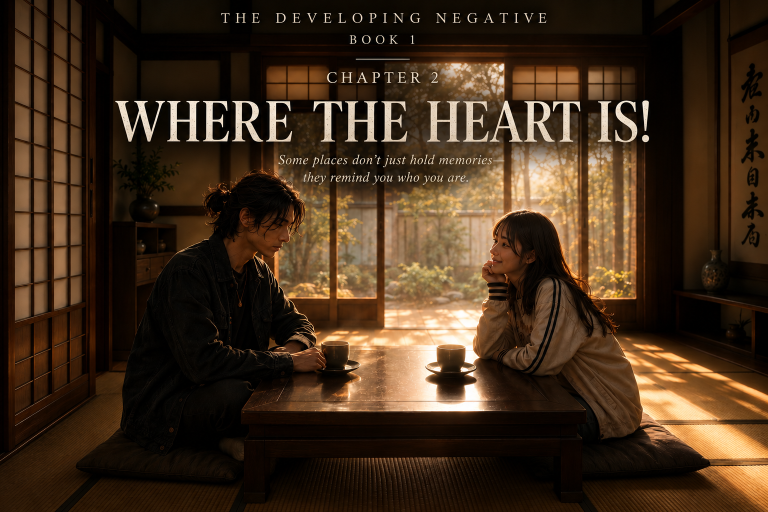
We sat for a while afterward on the low bench near the studio window, not talking especially much, watching the garden darken outside, the koi pond catching the last thin light before it disappeared entirely. Mion left a little before nine, walking back not toward the grandparents’ house but toward the main house itself, where the fifth bedroom—one more than the four of us siblings strictly required—had belonged to her in every way that mattered for longer than either of us had bothered to mark the occasion.
My grandmother had never called it a guest room, not once, not even in the earliest days when Mion’s presence there might still have been described, technically, as an arrangement rather than a fact. She had simply referred to it, the first time anyone asked, as Mion’s room, for now, and left it at that, the way she leaves most things that she has already decided the shape of and sees no reason to explain further.
Yukine had asked her once, years ago, why she always added those two words—for now—when nothing about the room had ever seemed remotely temporary.
My grandmother had only looked at Mion, briefly, the particular look she gives when she already knows something the rest of us have not yet caught up to, and said, “Wait and see.”
Mion had simply smiled, the same unhurried smile she still gives now when a subject arrives sideways instead of directly, and said, “In time.”
Neither of them had ever explained further, and nobody in the family had ever pressed them to.
I woke the next morning before sunrise, out of habit rather than intention, the way I always wake in that house, and lay still for a moment simply listening to a silence that had nothing false about it—no distant detonations disguised as ordinary sounds, no uncertainty about what any given noise might actually be. Only the house settling, and somewhere further off, a bird beginning its first tentative notes of the morning.
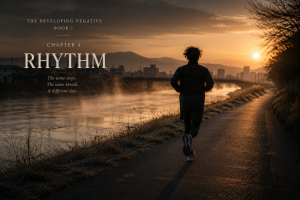
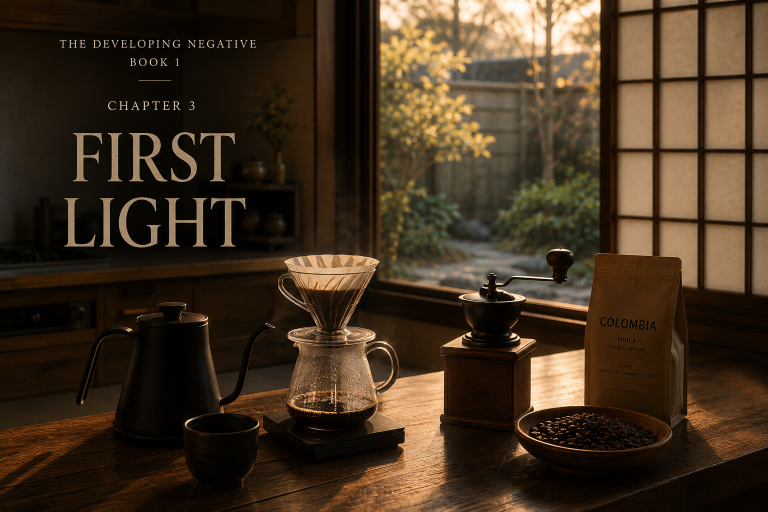
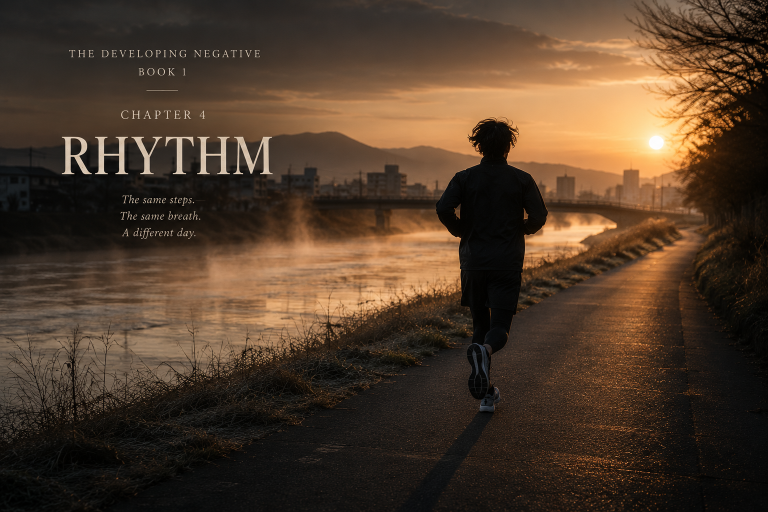
I made coffee in the kitchen, quietly, so as not to wake anyone, and drank it standing at the window overlooking the garden, watching the sky lighten by degrees the way it always does, indifferent to which country it happens to be lightening over. Then I changed, and went out to run along the river the way I have run along that river more mornings than I can count, my breath clouding faintly in the cold, my feet finding the same worn path they have always found without needing my attention.
After the run came the training I have done since I was young enough that it no longer feels like training at all, only another form of breathing—judo forms practiced alone in the studio’s cleared space, the slower, more deliberate movements of Wing Chun, and finally the flowing, economical patterns of Silat, all of it built, at its foundation, on the judo my grandfather had taught me himself, patiently, from the time I was small enough that the mat still seemed larger than I was.
My grandfather holds sixth dan through the Kodokan, a fact he has never once mentioned to me directly, though I learned it the way I learn most things about him—sideways, through someone else’s passing comment, confirmed only later and only reluctantly. He still trains with me most mornings when I am home, not out of any remaining need to prove something, but because he has always believed that even a teacher benefits from continuing to practice beside the person he taught, and because, I suspect, those quiet hours on the mat have become their own kind of conversation between us, one that neither of us has ever needed to translate into words. He still corrects me. He still, on occasion, still puts me on my back with an ease that seventy-some years should not, by any reasonable expectation, allow him to keep. I have stopped being surprised by this. Some lessons, I think, are meant to continue being taught long after the student assumes he has already learned them.
None of it required thought by then, whatever the discipline. That, I think, is the entire point of practicing something for so many years—that eventually your body simply knows what to do, and your mind is free to think about something else entirely, or nothing at all.
I have never fully explained, even to myself, why I continue training as rigorously as I do, in a life that mostly requires patience and a camera rather than anything resembling combat. Perhaps it is simply my grandfather’s voice, still present somewhere beneath my own thoughts, insisting that a person who understands his own body completely makes fewer mistakes in everything else. Perhaps it is only habit, the kind that outlives its original purpose and becomes, eventually, its own justification. Or perhaps, and I suspect this is closer to the truth, it is that after two weeks spent documenting a world where control belonged to almost no one, I have always needed, upon returning home, to spend an hour proving to myself that my own body, at least, still answered when I asked something of it.
By the time I finished, the household had woken fully around me—my grandmother already in the kitchen, my grandfather already in the garden, Yukine’s radio already audible faintly through her window, complaining musically about something I could not identify from that distance.
That night, the last before school began, I laid my uniform out across the chair beside my bed, pressed and ready, the way I always do the night before something I already know how to do arrives. My camera bag sat beside my school bag near the door, the M11-P returned to its place inside, in case something worth noticing happened to occur between home and the gates of Takasaki High School, though I did not expect it to. My notebook, its corners still slightly softened from two weeks against my chest in another country entirely, sat closed on the desk, ready for whatever new pages it would eventually need.
I turned off the light and lay in the dark for a while, listening to the particular quiet of that house at night—the settling of old wood, the faint call of some bird I never bothered to identify, the almost imperceptible sound of my sister turning over in the next room.
Tomorrow I would become ordinary again.
At least that was what everyone at school believed.