Chapter 3
The Developing Negative – Book 1.
Early April 2025
I woke before the alarm I had set the night before, the way I always do, as though some part of me distrusts the alarm’s promise to do its job and insists on doing it first. The room was still dark, though not the thinner darkness of a place I did not know—this darkness was familiar down to its texture, the particular way it settled into the corners of a room I had slept in since I was old enough to remember sleeping anywhere at all.
I lay still for a moment, listening. Somewhere below, my grandmother was already awake; I could hear, faintly, the specific sound a kettle makes in that kitchen, different from every other kettle I have ever heard, a low complaint that rises slowly into something closer to song. Beyond the window, a bird had begun its first tentative notes, uncertain whether the morning had truly arrived or whether it was merely rehearsing for the one still to come.
I got up.
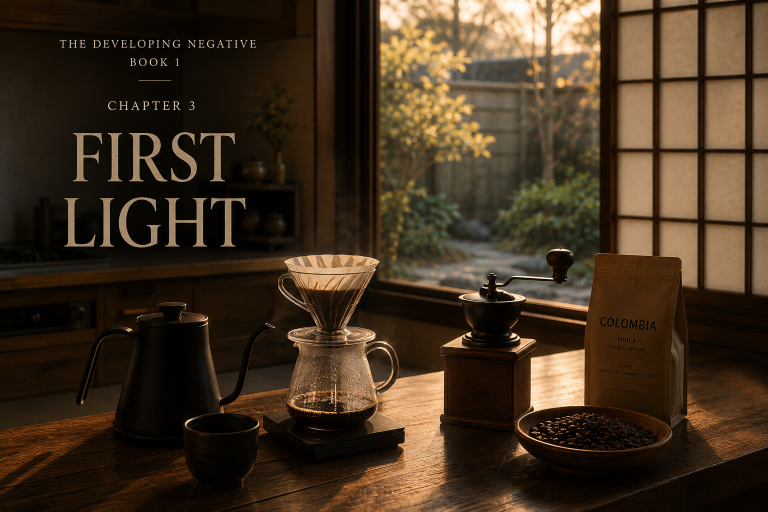
Coffee first, the way it is always coffee first, my grandmother already at the stove despite my quiet protest that she did not need to wake this early simply because I was starting school again. She waved the protest away without looking at me, the way she waves away most protests she considers unworthy of a proper argument, and set a bowl of rice and miso soup in front of me before I had finished pouring my own cup.
“You’ll want a good breakfast,” she said. “First days are tiring, even for people who don’t think they’ll be tired.”
“I’ve done this before, Grandmother.”
“Every year is a different year,” she said, which was not really an answer, though I had learned long ago that some of her sentences function less as arguments than as small, immovable stones placed in the middle of a conversation, meant simply to be acknowledged and stepped around.
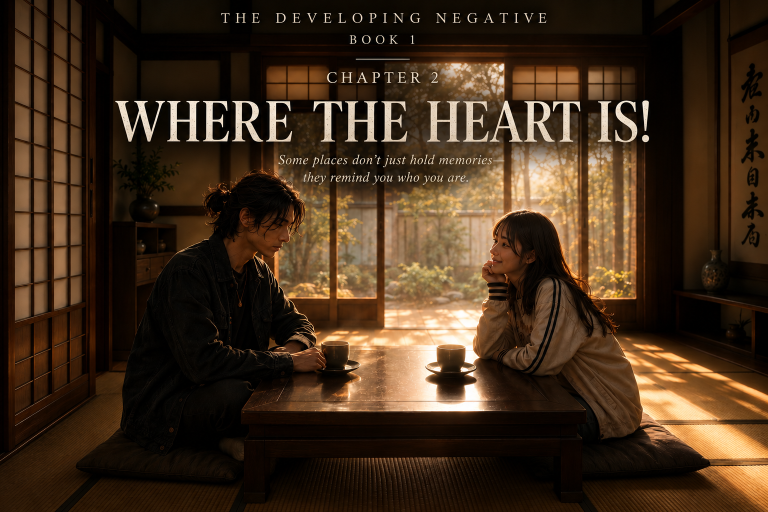
My grandfather came in a few minutes later, his hands still faintly smelling of the garden, having already been out among the maples before either of us had finished our tea. He sat across from me, ate without much comment, and asked, eventually, whether the cherry trees near the school had begun blooming yet.
“I don’t know,” I said. “I haven’t walked that way yet this year.”
“You’ll see soon enough,” he said, which struck me, quietly, as true of more than the cherry trees.
Yukine appeared last, moving with the particular urgency of someone who has decided, once again, that five more minutes of sleep was worth the resulting chaos, and ate standing at the counter, complaining without any real anger that university started a week later than my own school year and that this seemed, to her, like an obvious cosmic injustice she intended to raise with someone eventually, though she could never quite specify with whom.
Mion had returned to Tokyo two days earlier, a small assignment for Brand Idols that could not be postponed, and the table felt very slightly different without her, the way a room always feels slightly different when a chair that is usually occupied sits empty, even briefly. No one mentioned her leaving as anything unusual. She would be back, the way she is always eventually back, and in the meantime the household simply continued, one place setting lighter than usual, without treating the absence as anything worth remarking on beyond a passing comment from my grandmother about how quiet breakfast felt without her.
“She called last night,” Yukine said, around a mouthful of rice, in the tone of someone delivering information she considered mildly important but not urgent. “She said to tell you good luck today. And that you should wear the blue tie, not the gray one.”
“I’m not wearing a tie either way that anyone would notice the difference on,” I said.
“She’ll notice,” Yukine said, with the particular confidence of an older sister who has decided a subject is settled. “She always notices things like that.”
I did not argue the point, mostly because I suspected she was right, and finished my tea instead.
Nobody mentioned Ukraine. Nobody had mentioned it in days, not because they had forgotten, but because it had already settled, the way these things always settle in that house, into the particular silence my family reserves for things they trust me to share when I am ready and not one moment before. I finished my rice, thanked my grandmother, and went to dress.
I walked to school rather than taking a bicycle, the way I always have, though my classmates had stopped commenting on it sometime around November of the previous year, having apparently decided it was simply another one of my habits not worth further discussion. I have never seen the appeal of arriving anywhere faster than necessary. Walking has always given me the twenty-five minutes I need to finish becoming, fully, whoever I am supposed to be by the time I arrive.
The morning was cool in the specific way early April mornings are cool in Gunma, carrying just enough chill to make the eventual warmth of midday feel earned rather than given. The bakery on the corner had its shutters half-raised, the owner arranging trays of milk bread in the window with the unhurried precision of someone who has arranged the same trays for decades and sees no reason to hurry now. A cluster of elementary school children passed in the opposite direction, their yellow hats bobbing in a loose, cheerful line behind a teacher who counted them under her breath without appearing to count them at all.
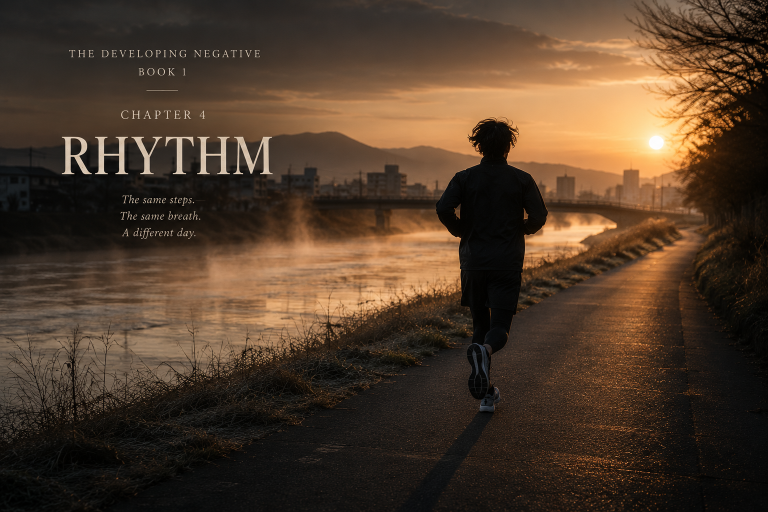
The river ran low and clear beside the road for a stretch, its surface catching the early light in small, restless fragments, and I noticed, without deciding to notice, that the cherry trees lining its bank had begun, finally, to commit to their blossoms—not yet the full, extravagant bloom that would arrive within the week, but enough pale pink scattered among the branches that the trees looked, from a distance, like they were still deciding how much of themselves to reveal.
I carried my school bag over one shoulder and the Billingham over the other, the way I always carry it, out of habit rather than necessity, the M11-P riding inside more from the discipline of always having it near than from any real expectation that today would offer anything worth photographing. I have never been able to leave it behind entirely. Even on the most ordinary of mornings, some part of me has always wanted the option, however unlikely I was to use it.
Shop owners along the route were opening for the day in the particular unhurried sequence I had watched them follow for over a year now—the flower shop first, then the stationery store, then, later than either, the small camera shop whose owner, an elderly man named Endo, had once spent the better part of an hour explaining to me, unprompted, the entire history of a rangefinder he had no intention of selling, simply because I had paused too long in front of his window and he had mistaken my curiosity for genuine interest in buying something I could not, at the time, afford.
Endo raised a hand as I passed that morning, not quite a wave, more a small acknowledgment offered without breaking the rhythm of arranging his window display, and I returned it in kind, and neither of us slowed our respective mornings for the exchange. It struck me, walking on, that this was one of the quieter pleasures of having lived somewhere long enough—that greetings no longer needed words, that a raised hand could carry an entire relationship’s worth of familiarity without either party needing to stop and prove it.
A delivery truck idled outside the small grocery a few doors further along, its driver hauling crates of vegetables through a side door with the brisk efficiency of a man who had performed the same task at the same hour for longer than I had been alive. Somewhere behind me, a bicycle bell rang twice, and I stepped instinctively toward the edge of the road without needing to look, the particular reflexive courtesy of someone who has walked this stretch of pavement often enough that its rhythms have become part of his own.
None of it felt unusual to me. It felt, instead, like exactly what it was—an ordinary walk through an ordinary neighborhood on an ordinary morning, indistinguishable, to me, from a hundred other mornings before it.
What was different, I understood, was only the particular anticipation that belongs to the first day of a new term rather than the first day of an unfamiliar place—the small, specific curiosity of wondering who had grown taller over the break, whose hair had changed, which of the friendships I had made the year before would simply continue where they had left off, unbothered by the two weeks that had passed, and which, if any, might have quietly shifted in my absence, the way friendships sometimes shift without anyone deciding they should.
The gate of Takasaki High School came into view a few minutes before the first bell, students already gathering in loose clusters along the walkway, uniforms slightly too crisp with the particular newness of a term that had not yet had time to wrinkle them properly. I heard my name before I saw who had called it.
“Kyosuke!”
Daichi was waving from near the bicycle racks, one arm raised high enough that he nearly struck a passing first-year, apparently untroubled by this near miss and entirely focused on closing the distance between us before I reached the gate. He looked, if anything, slightly taller than he had two weeks earlier, though I suspected that was less a fact of biology than a trick of how much I had missed ordinary faces during my time away.
“You look like you didn’t sleep,” he said, by way of greeting, clapping a hand briefly on my shoulder. “Rough break?”
“Long one,” I said, which was true enough without inviting the fuller explanation I had no intention of giving him.
Aiko appeared a moment later, falling into step beside us with the easy familiarity of someone who had walked this same stretch of pavement alongside me more mornings than either of us had bothered to count over the past year. “You still haven’t gotten a bicycle,” she said, not quite a greeting, more an observation she had apparently been saving since the last time the subject came up.
“I still don’t see the point of one,” I said.
“You never do.” She studied me for a moment with the same narrowing, cataloguing look I had come to recognize as simply hers, the look she gave anything she found mildly curious and fully intended to think about further later. “You look thinner. Did you even eat while you were wherever you were?”
“I ate.”
“That’s not really an answer.”
I did not offer a fuller one, and she did not press for it, which was, I had learned over the past year, one of the quieter kindnesses she was capable of—asking a question honestly, and then allowing an honest but incomplete answer to stand without forcing it further than I wished to take it.
Homeroom smelled the way homerooms always smell in early April—new paper, fresh chalk dust, the faint chemical sweetness of freshly waxed floors. I found my assigned seat near the window, a location I was quietly grateful for, since it meant I could watch the courtyard’s single cherry tree without appearing to be watching anything at all.
I noticed, scanning the room as students filed in and found their own assigned seats, that Aiko had been placed two rows ahead of me, and Daichi beside her, both of them turning at nearly the same moment to locate me, the small, satisfied confirmation on both their faces suggesting they had already checked the posted roster before the bell and simply wanted to see the arrangement made real. Emi took a seat further back, quieter about her own small satisfaction, though I caught the faint upward movement at the corner of her mouth that passed, in her, for open pleasure. Sora arrived last, glanced once at the seating chart taped beside the door, and settled into his own seat without comment, though something in the unhurried way he did it suggested he, too, had already known where the year would place him.
We had spent the previous year as classmates only in the loose, general sense that everyone at Takasaki High School is a classmate of everyone else—crossing paths in hallways, sharing a handful of elective classes, occasionally eating lunch together when circumstance rather than habit brought us to the same bench. This was the first year the four of them, and I, had been placed together properly, in the same homeroom, for the entire length of a term, and I understood, watching them settle into seats near mine with the particular ease of people already comfortable with each other, that whatever had existed between us the year before was about to become something considerably more concentrated.
The homeroom teacher, a compact, energetic woman named Tachibana, new to our year though not new to the school, called the class to order with a briskness that suggested she had done this exactly enough times to have stopped needing to think about how to do it well, and moved through roll call with an efficiency that left little room for ceremony. When she reached my name, she said it plainly, the way she said every other name on the list, and I answered simply that I was present, the way everyone else answered, and that was the whole of it.
There was no introduction required, no unfamiliar face to explain to a room of strangers. And yet something in the year ahead already felt different from the year behind it, the way a familiar song sounds different the first time you hear it played by musicians who have finally learned to play it together rather than merely alongside one another.
Tachibana-sensei moved through the rest of the roster without pause, though I noticed, in the weeks that followed, that she watched me slightly more closely than she watched most of her other students, the way a person watches something they suspect is more complicated than it first appeared, without yet having evidence enough to say so.
The first classes of the day passed the way first classes of a term always pass—reviews of material everyone had technically already covered, syllabi distributed and half-read, teachers reintroducing themselves to students who mostly already knew them from the year before. I answered when called upon, listened more than I spoke, and otherwise occupied myself with the quiet, unhurried observation that has always been more natural to me than conversation, though this time the observation had somewhere familiar to land.
I noticed, without seeking to notice, how differently I saw them now than I had a year earlier, when they had still been mostly faces attached to names I was slowly learning to keep straight. A year of shared hallways and occasional lunches had already told me the broad outlines of each of them. What homeroom offered now was the chance to fill in the details, the way a photograph slowly resolves from a rough shape into something with texture, once you have spent enough time in the same room as its subject.
Aiko, seated two rows ahead, kept a small notebook I already knew well, having watched her fill its margins during lulls the year before with quick, unselfconscious sketches of whatever happened to be in front of her—a pencil case, a classmate’s profile, once, memorably, an entire unflattering caricature of a substitute teacher she’d disliked. That morning she filled it with something I couldn’t quite see from my angle, glancing back at me twice with the same narrowing, cataloguing look I had grown used to over the past year, the look that meant she had noticed something and intended to return to it later, in her own time.
Daichi, beside her, leaned over during a lull to ask whether I’d brought back anything interesting from wherever I’d been, a question I’d fielded some version of from him after every trip I had ever taken, and one I answered, as I always did, with something true but incomplete.
“Just tired,” I said.
“That’s what you always say.”
“It’s usually true.”
He accepted this the way he always accepted my deflections, with a shrug and an easy return to whatever he had been doing before, apparently satisfied simply by the fact that I had answered him at all, a quality of his I had come, over the past year, to genuinely appreciate—that he asked questions without needing them fully answered to remain comfortable in a friendship.
Further back, Emi watched the room the way she always watched rooms, without appearing to watch anything at all, her attention moving methodically from one detail to the next with the same patience I had noticed in her since the previous spring. I had learned, over the intervening year, that her silence was not shyness but a kind of deliberate economy—she spoke when she had something worth saying, and not before, and I had come to trust her observations precisely because they were so rarely offered without cause.
Sora, meanwhile, continued the quiet, ongoing study of the classroom’s behavior that I suspected he had been conducting since the day I first met him, his attention moving in careful, unhurried sweeps from one student to the next. When his attention landed on me, it lingered slightly longer than it lingered on anyone else, the way it always had, not with suspicion, but with the particular patient curiosity of someone who has spent a year gathering small inconsistencies about a person and has decided there is no urgency in resolving them.
None of them had become close friends over the past year in the dramatic, sudden way stories sometimes describe. What had happened instead was smaller, and I think ultimately more honest: four people, and myself, had spent a year simply noticing one another, carefully, the way people do before anything real is allowed to grow between them, and this new term, this new homeroom, felt like the moment that year of noticing was finally being given room to become something more.
I found something quietly reassuring in being known that carefully by people who still did not know everything about me. It has always been easier, I think, to be understood in layers, by people willing to wait for the deeper ones, than to be fully explained all at once to people who mistake a single fact for the whole of a person.
Lunch, as it turned out, was where the morning’s quiet reunion finally settled into something closer to its old, comfortable rhythm.
I had taken my bento to the same bench near the edge of the courtyard we had claimed as ours sometime the previous autumn, beneath the cherry tree that was, by midday, showing considerably more pink than it had that morning, when Daichi dropped down beside me without asking, the way he always did, already halfway through unwrapping his own lunch before he had fully settled.
“Feels like nothing’s changed,” he said, glancing around the courtyard with evident satisfaction, “except the tree’s a little further along than it was last year.”
Aiko arrived a moment later with Emi trailing just behind her, and Sora last of all, settling slightly apart from the rest of us in the specific way that had become simply his way of joining a conversation—present, attentive, but never quite at its center until he decided to be.
The conversation moved easily, the way conversations move among people who have already done the harder work of learning each other’s rhythms. Daichi wanted to know whether I’d done anything interesting over the break, and I told him, honestly enough, that I’d been working, which prompted no further questions from him beyond a sympathetic grimace and his own lengthy, enthusiastic account of a family trip to visit relatives in Niigata that had involved, by his telling, at least one minor domestic disaster involving his younger cousin and a bowl of hot pot.
Aiko, ever more direct, eventually turned the conversation toward the Billingham, which she had asked about more than once over the past year without ever fully satisfying her curiosity. “You still haven’t told me what’s actually in that bag half the time,” she said. “Just that it’s ‘work.'”
“It is work,” I said.
“You always say that like it explains everything.” She studied me with the same narrowed, cataloguing look she’d worn all morning. “Someday I’m going to actually get a straight answer out of you.”
“Maybe,” I said, and she seemed to accept this the same way she always accepted it—not quite satisfied, but patient, the way a person is patient with a puzzle they’ve decided is worth solving eventually rather than immediately.
Emi, who had said very little since sitting down, finally spoke without looking up from the rice she was eating in slow, deliberate bites. “You look more tired than usual. Even for you.”
It was not really a question, and I answered it as such. “It was a long two weeks.”
“Working overseas again?”
“Something like that.”
She nodded, apparently satisfied, or at least satisfied enough not to press further, and returned to her rice, though I had the distinct sense, watching her, that she had filed the exchange away carefully, the way she filed most things, for later use I could not yet predict.
Sora, quiet through most of the exchange, finally spoke as the bell signaling the end of lunch began to ring somewhere across the courtyard. “You should just join the photography club already,” he said, with the flat, unhurried certainty of someone who had apparently been waiting the better part of a year to say exactly that. “You clearly care more about it than you let on.”
“Maybe,” I said again, though this time I felt, privately, that the word carried considerably more truth in it than he could have known.
I found, gathering the empty wrapping of my own lunch, that I did not mind how much they still didn’t know, even after a year of this same easy, unhurried company. There was something almost restful in remaining, for them, only the tall, quiet friend with the old camera bag and the habit of disappearing for work he never fully explained, rather than everything else I also happened to be. I understood that this particular incompleteness would not last indefinitely between people who cared about each other as steadily as we, by then, plainly did. But it did not need to resolve itself that particular afternoon, and I found I was in no hurry to resolve it myself.
The afternoon passed in the unremarkable rhythm of ordinary classes, and it was during the transition between two of them, in a hallway crowded with students moving in the particular disorganized current of a passing period, that I first noticed the kind of quiet, unglamorous moment that would, over the coming months, become something of a pattern without my ever deciding to make it one.
A first-year student, still visibly uncertain of the building’s geometry, had dropped an armful of papers near the stairwell, the sheets scattering in the small, chaotic way papers always scatter when dropped in a crowded hallway, several of her classmates stepping carefully around the mess with the particular guilty haste of people who notice a problem and choose, for reasons of their own, not to become involved in solving it.
I crouched and gathered what had fallen within reach, handed the stack back to her without comment, and continued toward my next class before she had fully finished stammering her thanks. I did not think much of it at the time. It seemed to me the most unremarkable possible response to the most unremarkable possible problem.
Later that same period, a different first-year—clearly lost, checking a folded campus map against the numbers on classroom doors with mounting, visible anxiety—asked me, tentatively, whether I knew where the second science laboratory was located. I walked him there myself rather than simply pointing, since pointing seemed, in that moment, like an insufficient answer to how genuinely lost he appeared, and left him at the door without waiting for thanks I suspected he was too flustered to offer properly anyway.
Near the end of the day, a teacher struggling to move a stack of folding chairs from a storage closet to the gymnasium glanced up as I passed and, apparently deciding I looked capable, asked if I might help carry a few. I did, without being asked twice, and left again as quietly as I had arrived, the exchange lasting perhaps ninety seconds in total.
None of these moments felt, to me, like anything worth remembering. I want to be honest about that, because I think the honesty matters more than a more flattering version of myself might prefer. I did not help because I was trying to be noticed. I helped because helping seemed, in each case, like the smallest and most obvious response available to the situation in front of me, and I have never seen much virtue in withholding a small, obvious response simply because withholding it would also have been possible.
I understood only later, from the way certain classmates began looking at me slightly differently by the end of the week, that these small moments had not gone as unnoticed as I assumed. People remember kindness, I have found, particularly the kind that expects nothing in return, precisely because it is rare enough to be memorable even in its smallest forms.
I passed the photography club’s room on my way toward the front gate that afternoon, more by accident of geography than by intention, and found myself slowing, then stopping, in the doorway without quite deciding to stop.
The room smelled faintly of developer fluid, familiar in a way that struck something quiet and immediate in my chest, and beneath the smell lay the particular hum of students arguing gently over composition, someone’s photograph passed hand to hand for opinions, someone else adjusting an aperture ring with the careful, uncertain attention of a person still learning what the numbers actually meant.
I did not enter.
I stood in the doorway for perhaps ten seconds, long enough to notice the advisor—a thin, unhurried man near the back of the room, examining a contact sheet through a loupe with the particular patience of someone who has spent decades doing exactly this—glance up and notice me noticing the room. He did not say anything. He simply held my gaze for a moment, the way a person holds the gaze of someone he suspects he will be speaking with eventually, whether or not either of them yet knows when.
A few students near the front noticed me as well, their conversation faltering slightly, though the curiosity on their faces was the milder, more familiar kind reserved for a known face doing something slightly unexpected, rather than the sharper curiosity of encountering a stranger.
I turned and continued on toward the gate.
I knew, even as I walked away, that I would be back. I did not know when, exactly, or what would finally draw me through that doorway rather than simply past it. But I have learned, over the years, to trust the particular pull certain rooms exert on me, the way you trust a river’s current even before you have decided to enter the water, and I understood that whatever pull I had just felt in that doorway was not the kind that resolves itself by being ignored.
I thought, walking on toward the gate, about how strange it was that a room full of strangers, doing something I already knew how to do better than most of them likely realized, could still feel like an invitation rather than a redundancy. I had spent two weeks photographing things that mattered more than composition, more than aperture, more than any of the small technical concerns I imagined that room was still occupied with. And yet the smell of developer fluid had reached into my chest the same way it always has, since I was young enough to first stand beside my mother in a darkroom not so different from my own, and I understood, walking away from that doorway, that the two versions of photography I carried inside me—the quiet, deliberate craft practiced in that cluttered little clubroom, and the urgent, necessary witnessing I had practiced in Kyiv—were not actually so far apart from one another as they might have first appeared. Both, in the end, asked the same question of whoever held the camera. Both asked you to look closely enough, and patiently enough, that something true might finally agree to be seen.
The walk home followed the same route as the morning, though it felt, by then, like an entirely different walk, the way the same stretch of road always feels different depending on which direction you are traveling and what kind of day sits behind you.
The elementary school children I had passed that morning were long gone, replaced now by a scattering of high schoolers moving in loose, unhurried groups, backpacks slung low, conversations carrying the particular relief of a first day successfully survived. Two young boys chased each other across a small park near the river, their laughter carrying further than seemed reasonable for their size, and an old woman I did not recognize swept the entrance to a shop I passed nearly every day, nodding to me without any particular curiosity, the ordinary nod of a neighbor who has simply seen you pass by often enough to stop wondering who you are.
The cherry trees along the river had opened further even in the few hours since morning, entire branches now committed fully to their blossoms, pale petals beginning, here and there, to loosen and drift toward the water below. I stopped for a moment near the bridge, watching a single petal travel the surface of the current before it disappeared beneath the low railing further downstream, and thought, without any particular urgency to the thought, that the day had been a good one, in the quiet, unremarkable way most good days actually are, rather than the dramatic way stories tend to describe them.
I thought, too, about the particular strangeness of being known for a year and still, somehow, only partly known—of existing, for the people who sat beside me every day, as a series of details they had gathered patiently over months and still had not fully assembled into something coherent. The bag. The trips I never fully explained. The tiredness that sometimes lingered a little too long after a break. I understood, standing there, that the fuller picture, whatever picture that turned out to be, would arrive slowly, the way most true things arrive, and that some part of me was in no particular hurry to speed up that arrival. There was a small, private tenderness in that thought—the tenderness of being patiently studied by people who cared enough to keep looking, without ever demanding I explain myself before I was ready.
I did not take out my camera. Some afternoons, I have found, are meant simply to be walked through, rather than recorded.
Dinner that evening followed the same rhythm it always follows in that house—my grandmother asking after my first day with the particular thoroughness of someone determined to extract every detail whether or not I offered it willingly, my grandfather listening with quieter interest while pretending to be more occupied with his rice than he actually was, Yukine texting someone under the table with the specific unconvincing subtlety of a person who believes, incorrectly, that no one has noticed.
I told them little of substance, mostly because there was little of substance to tell—new teachers, familiar subjects, a handful of classmates whose names I mentioned only briefly, without elaboration. My grandmother seemed satisfied regardless, the way she always seems satisfied by small, ordinary reports of an ordinary day, and added, unprompted, more vegetables to my plate before I had finished what was already there.
After dinner, once the dishes were cleared and the house had settled into its quieter evening rhythm, I went out to the studio and sat for a while at the editing desk, opening not the folder from Ukraine—already delivered, already becoming, slowly, someone else’s story to publish—but the small, private folder of photographs I had taken in Ueno the week before, the ones that belonged to no assignment and answered to no editor.
I moved slowly through them. The old man feeding pigeons. The university students, laughter caught mid-motion. The heron, patient and still, committing entirely to a single sudden movement after minutes of appearing not to move at all. I adjusted very little. These photographs had never needed correcting. They had simply needed, I think, to be looked at again, quietly, by the same person who had taken them, now that some of the distance between that afternoon and this one had settled.
I thought, sitting there, about the day behind me—about Aiko’s narrowed, curious eyes, patient as ever but no less determined to eventually get her straight answer; about Daichi’s easy directness, content with incomplete truths as long as they were offered honestly; about Emi’s careful, silent attention, filing away one more detail she had not yet decided what to do with; about Sora’s quiet certainty that I belonged somewhere I still hadn’t fully claimed. About the photography club’s doorway, and the advisor’s steady, unhurried gaze, and the particular pull I had felt standing there, unresolved.
They already knew my name. They had known it for a year, called it across courtyards, written it beside their own in the margins of shared notes. What they did not yet know was everything the name did not say—Kyosashin, Brand Idols, the two weeks I had just spent somewhere considerably further from that courtyard than Tokyo, the whole quiet architecture of a life that ran alongside the one they saw every day without ever quite intersecting it.
Tomorrow would look almost exactly like today.
But I understood, sitting there in the quiet studio with the last of the evening settling around me, that a year of patient noticing does not stay patient forever. Sooner or later, the questions I had spent a year deflecting with a shrug and a maybe were going to arrive in a shape I could no longer answer quite so easily.
I wasn’t sure yet whether I wanted to answer them.