Volume I — The Space Between
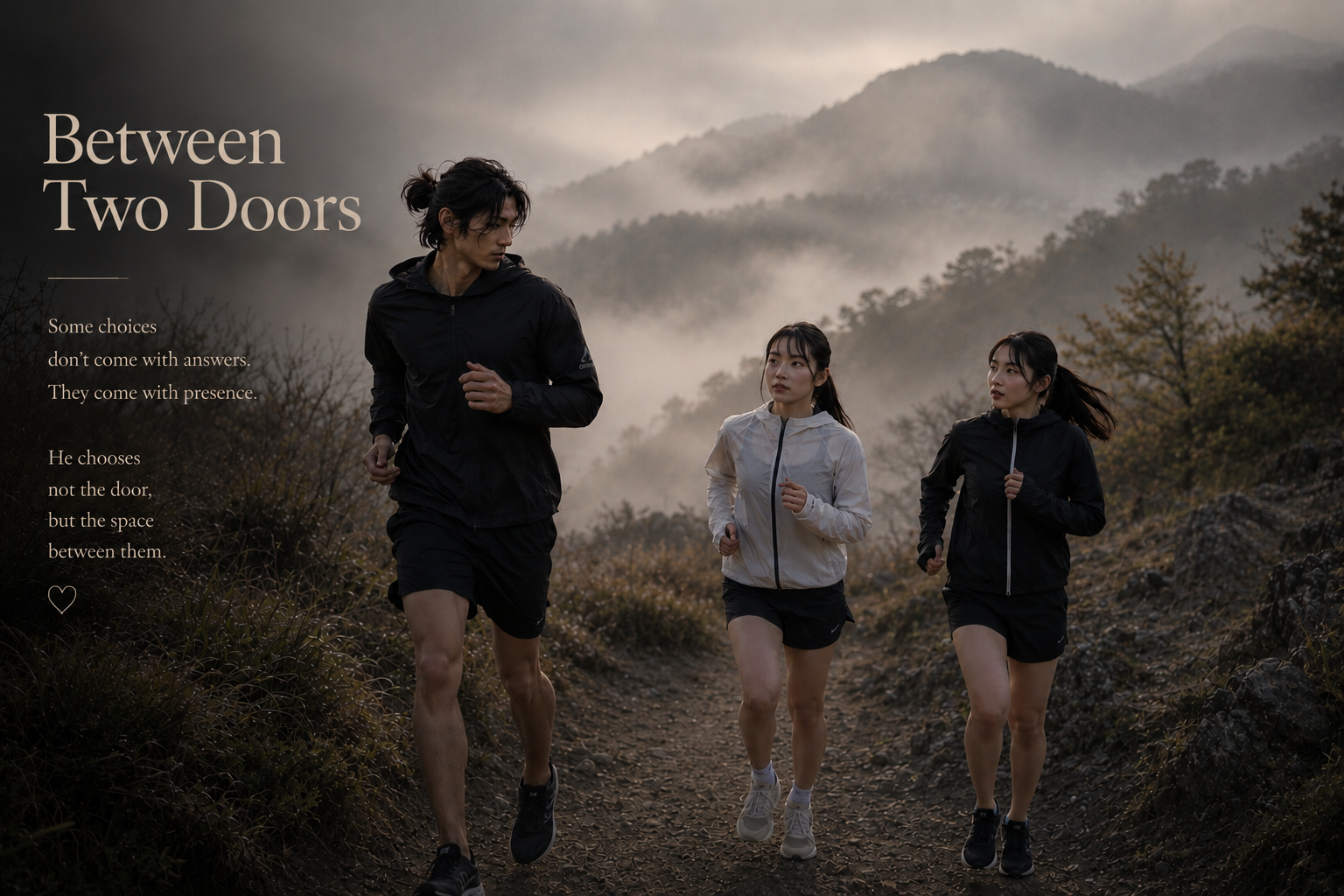
Chapter Three: Between Two Doors
Five-thirty. Exactly the same as always.
I woke without an alarm, the way I always do, the room still dark, the house holding the particular silence it holds before anyone else has decided to disagree with it. I opened the window first, the way I always do, and let the cold in, March air a little sharper than it had been the day before, though I couldn’t have said whether that was the season changing or just my own attention sharpening along with it.
Coffee. Grinder, kettle, scale, cup, the whole sequence unfolding in the same eleven seconds and ninety seconds it always takes, the smell filling the kitchen the same way it always fills the kitchen, the steam rising off the mug in the same thin ribbons that twisted once and disappeared into the dark.
I looked out across the garden while it cooled. Ojichan’s study light was already on, steady, unmoving, exactly where it always is at this hour.
Everything was unchanged. That was the part I noticed most, standing there with the mug warming my hands — that nothing about the house, the garden, the light across the way, had shifted even slightly to acknowledge what today actually was. The world at home stays exactly the same regardless of what’s waiting outside it. I’d come to depend on that, the way you depend on a foundation without ever really thinking about it until you need to stand on something solid. School wouldn’t be like this. School would be its own thing entirely, full of people who hadn’t yet agreed to be unchanging, and I drank my coffee slowly, the way I always do, holding onto the last few minutes of a morning that didn’t yet require anything of me.
I left a little earlier than usual, not because I was anxious — I want to be precise about that, because anxious isn’t the right word for what I was — but because I didn’t want to arrive rushed. There’s a difference between being early and simply refusing to be late, and I’ve always preferred the version of myself that has time to stand still for a moment before a door, rather than the version that comes through it already out of breath.
The streets were the same streets, the flower shop opening the same shutters, the café owner sweeping the same stretch of pavement, the bakery sending out the same warm thread of bread-smell two streets before I reached it. Small fixed points, holding their positions, indifferent to the fact that today was different for me even if it wasn’t different for them.
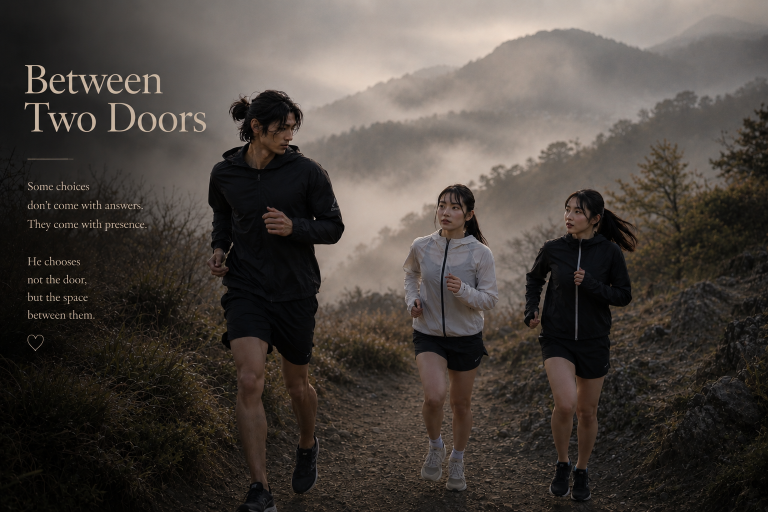
I saw Suguha before I reached the embankment path this time, which had never happened before — usually I caught sight of the two of them already in motion, already well into their morning, but this time she was standing still, near the low rail where the path curves down toward the river, hands on her hips, watching the direction I usually came from with the particular impatience of someone who has been waiting longer than they intended to admit.
“I knew you’d come,” she said, before I’d even gotten close enough that she should have been able to identify me with any certainty.
“You said I would.”
“I did say that. I’m always right about this kind of thing.” She fell into step beside me without any of yesterday’s hesitation, as if the conversation we’d had the morning before had simply been paused rather than ended, picked back up now exactly where it left off. “Today’s the big day. First day at Takasaki. Are you nervous? You don’t look nervous. You never look like anything, honestly, it’s a little unsettling.”
“I’m not nervous.”
“Everyone says that. Then they get nervous anyway.”
“I didn’t say I wasn’t going to be nervous. I said I’m not nervous right now.”
She considered that with more seriousness than I expected, her head tilting slightly, the same way it had the day before when I’d given her an answer she hadn’t anticipated. “That’s actually a smart distinction. I’m stealing that. Next time someone asks if I’m nervous about a race I’m going to say I’m not nervous right now, which implies I might become nervous later, which buys me sympathy either way.”
“That’s not really what I meant.”
“It doesn’t matter what you meant. It’s useful now that I’ve heard it.” She grinned, entirely unbothered by the correction, and matched my stride more naturally than she had the day before, as if her body had already started adjusting itself to the rhythm of running beside me without her needing to think about it. Aiko was a little further back today, deliberately, I thought, giving her sister room to do whatever it was she’d apparently decided needed doing this particular morning.
“What’s it actually like,” Suguha asked, after a stretch of comfortable quiet that she clearly hadn’t intended to let last very long, “moving somewhere completely new. I’ve never done it. We’ve lived in the same house since I was born. I don’t even know what that would feel like.”
I thought about the question seriously, the way I try to consider most things she actually wants answered, which I was beginning to realize was most of what she asked, underneath all the talking. “It’s quieter than you’d expect,” I said. “Everyone assumes it’s loud. New noises, new faces. But mostly it’s just quiet. You’re paying attention to everything because none of it’s familiar yet, and attention takes up more space than people think.”
“That’s almost poetic. For someone who barely talks.”
“I don’t barely talk. I just don’t talk unless there’s something worth saying.”
“That’s the same as barely talking, just with better marketing.” She laughed at her own observation, the sound carrying easily across the cold morning air the way it had the day before, and I found myself, against whatever instinct usually governs these things, not minding it.
Aiko caught up to us as the path narrowed near the bend by the old footbridge, slowing just enough to fall in on my other side without quite joining the conversation, the way she does, present without participating, which I’d come to understand wasn’t disinterest so much as a different kind of attention entirely.
“She’s decided you’re part of her morning now,” Aiko said, not quite an apology, though something close to one. “I should warn you. Once she decides that about someone, it doesn’t really change. You should prepare accordingly.”
“I don’t mind,” I said.
It wasn’t a large sentence. I want to be honest about that — it was three words, nothing dramatic, nothing that should have meant very much to anyone listening. But Aiko looked at me for a second longer than the sentence probably warranted, the same careful, evaluating look she’d given me the day before, like she was checking the sentence against some internal measurement she kept for exactly this purpose, and whatever she found there seemed to satisfy something, because she nodded once, briefly, and let the subject go.
“Good,” she said. “Because she’s not going to stop regardless.”
“I heard that,” Suguha said. “I’m right here.”
“I know. I wasn’t being subtle.”
We ran together for another stretch, the three of us, the conversation drifting the way conversations drift when nobody’s trying too hard to keep it going in any particular direction — Suguha talking about her events, about a meet coming up in a few weeks that she was equal parts excited and terrified about, about a teammate who’d apparently said something unkind about her form that she was still privately furious over despite insisting, three separate times, that she didn’t care. Aiko said very little, the way she always says very little, but occasionally added a single correction or clarification that suggested she’d actually been listening the entire time, more carefully than her silence let on.
“You should come watch the meet,” Suguha said, out of nowhere, the suggestion arriving with the same casual confidence as everything else she said. “It’s in three weeks. You could bring your camera. I bet you have a good camera, you seem like the type.”
“I do have a good camera.”
“I knew it. What kind?”
“A Leica.”
“I don’t know what that means, but you said it like it should mean something, so I’m going to assume it’s impressive.” She grinned at her own admission, entirely unembarrassed by it. “Will you come? You don’t have to take pictures of just me. You could take pictures of the whole meet. Athletic photography. It’s basically a real genre, I looked it up once.”
“I’ll think about it.”
“That’s what you said yesterday about choosing a running event. You never actually decide anything, do you. You just say you’ll think about it and then time passes and somehow the thinking turns into a decision without you ever announcing it.”
I considered that, because it was, unfortunately, an accurate description of how I tend to operate. “That’s usually how decisions work for me, yes.”
“That’s terrifying. How do you know what you actually want if you never have to say it out loud?”
“I don’t always know. Sometimes I find out after, the same way you’d find out what a photograph actually captured once you’ve developed it.”
She slowed slightly, just for a second, processing that with more seriousness than she usually let show. “That’s actually kind of beautiful. Don’t let it go to your head, though. I’m only saying it once.”
“Understood.”
Aiko, beside us, made a small sound that might have been a laugh, quickly suppressed, the kind of sound she allows herself only when she thinks no one’s specifically watching for it. I was watching for it. I’d started watching for it the day before, without entirely deciding to.
“She’s never going to stop talking to you, you know,” Aiko said, after a moment, not quite to me, not quite to her sister either, somewhere in between. “I want you to understand that clearly. This isn’t a phase. This is just what’s happening now.”
“I understood that yesterday.”
“And you’re still here.”
“I don’t mind being here.”
She looked at me again, the same careful, evaluating look, and this time something in her expression shifted slightly, settling into something closer to approval, though she didn’t say anything more about it. We ran in comfortable quiet for a stretch after that, Suguha’s energy finally, briefly, spent, the three of us simply moving together through a morning that was beginning, properly, to feel less like coincidence and more like routine.
Eventually our paths split — theirs toward their own house, mine back toward the Washimine property — and we slowed together at the corner where the divide happened, the way we had the day before, except today there was something else attached to the parting, some small additional weight neither of us quite said out loud.
“Good luck today,” Aiko said, and meant it plainly, without any particular ceremony.
“You too,” I said, which was true in its own way — Aiko had her own first day of something ahead of her too, even if it was a day that looked, on the surface, identical to every other day she’d had at that school.
“See you tomorrow,” Suguha added, already half-turned to follow her sister, throwing the words back over her shoulder with the easy certainty of someone who had never once considered the alternative. “Same time. Same place. I’ll be waiting again, probably.”
“Probably,” I agreed.
She seemed satisfied with that, the same way she’d seemed satisfied with most of what I’d given her so far — not much, by most standards, but apparently enough. She took two more steps and then turned back around entirely, jogging backward a few paces just to get one more sentence in before the distance made it impractical.
“Text me how the meet thing goes! I mean the first day thing! Tell me how the first day goes!” she called, already laughing at her own mistake, not bothering to correct it any further than that.
“I don’t have your number,” I called back.
“I’ll get it from my sister! She has it because of team stuff! Don’t think about it too hard!”
She turned forward again before I could answer that, catching back up to Aiko’s side with a few quick strides, and I stood there for a second longer than necessary, watching the two of them recede down the path, thinking that I probably wouldn’t think about it too hard, and that I probably would anyway, regardless of the instruction.
Yukine was already in the kitchen when I got back, dressed in clothes I hadn’t seen before, the kind of carefully chosen outfit that tries hard to look like it wasn’t carefully chosen — a soft sweater, a skirt that fell just right, her university orientation lanyard already looped around her neck even though she had hours before she’d need it, as if wearing it early might somehow make the day arrive faster.
“You look nice,” I said, toweling off in the doorway.
“I look like I’m trying too hard.”
“You look like you’re trying exactly the right amount.”
She made a face at that, the particular face she makes when she’s decided to accept a compliment but doesn’t want to seem too pleased about it, and went back to slicing something for the rice while I started the coffee.
“Nervous?” she asked, after a while, not looking up.
I thought about the question the way I’d thought about Suguha’s version of it twenty minutes earlier, except this one came from someone who’d actually know if I was lying. “Curious,” I said.
She laughed, the sound filling the kitchen the way it always does, bright and immediate. “That’s your version of nervous.”
“It’s a more accurate word.”
“It’s the same thing with better marketing,” she said, and I almost laughed myself, because it was nearly the exact phrase Suguha had used twenty minutes earlier about something else entirely, the two of them arriving at the same joke from completely different directions without ever having met.
We ate breakfast together the way we always do, the conversation easy, both of us circling the same unspoken fact from opposite sides — that today was the first day of something for each of us, separately, and that neither of us had any real way of knowing how it would go, and that the not-knowing was, in its own way, the entire point of a first day.
“What if no one talks to me,” Yukine said, somewhere between bites, the question arriving lightly but landing with more weight underneath it than her tone let on.
“Someone will talk to you. You’re the kind of person people talk to.”
“You don’t know that. University’s different. Everyone already has their groups from high school, or their dorm friends, or whatever. I’m just going to be the random commuter girl nobody bothers to learn the name of.”
“You won’t be,” I said. “Give it a week. By the time I see you next Sunday you’ll already have opinions about three different people you’ve never told me about before.”
She narrowed her eyes at me slightly, half-amused, half-suspicious of how accurate that prediction probably was. “That’s a very specific thing to be confident about.”
“I know you. It’s not really a guess.”
She didn’t have an answer for that, which was rare enough that I noticed it, and instead just ate another bite of rice, looking, for a moment, like she’d decided to actually believe me, which was, I think, all I’d really been trying to accomplish.
Obachan arrived as we were finishing, carrying two carefully wrapped lunches that she set on the counter with the same unhurried confidence she brings to everything, and didn’t say much beyond confirming that we’d both eaten properly, that Yukine had her train pass, that I had whatever paperwork the school had been asking for. She didn’t make a speech out of the morning. She never does. She simply made sure the practical details were handled and let the rest of it speak for itself.
Ojichan came by just as we were getting ready to leave, standing in the kitchen doorway for only a moment, not stepping fully inside, the way he does when he’s decided a visit only needs to be long enough to say one thing.
“Listen,” he said.
That was all. One word, delivered the way he delivers most things, compressed down to its essential shape with nothing extra attached. I nodded, because I understood it the way I understand most things from him — not as a command exactly, but as a fact about the day ahead that he’d decided I should carry with me, the same way he’d handed me people will introduce themselves and listen longer than they speak the day before, except today it had been reduced even further, down to its single most important word.
He left as quietly as he’d arrived. Yukine and I gathered our things, and a few minutes later we were both out the door, into a Monday that had finally, after a full season of quiet preparation, actually arrived.
The walk to school was nothing like the walk I’d taken alone on previous mornings. Students appeared from every direction, the way water appears from every direction once you’re standing in a river instead of beside it — groups of two and three, friends already deep in conversation, laughter breaking out here and there over things I couldn’t follow and wasn’t meant to. Bicycles wove between the foot traffic, riders calling out half-greetings to people on foot without slowing down enough to actually have a conversation. A pair of girls ahead of me were comparing something on their phones, heads bent close together, one of them gasping at whatever was on the screen with theatrical intensity. Somewhere behind me, a group of boys was arguing cheerfully about something involving a video game, the argument clearly more performance than disagreement, the kind of bickering that exists specifically because both parties enjoy having it.
A first-year, easily identifiable by the slightly too-large blazer that hadn’t yet been tailored to fit, hurried past at something close to a jog, checking his watch every few seconds, the particular anxiety of someone determined not to be late on a day when being late would mean something. An upperclassman couple walked close together near the edge of the path, not quite touching, the specific distance two people maintain when they want to be seen as a couple without quite announcing it to everyone around them. A delivery truck idled near the convenience store at the corner, the driver leaning against the door scrolling through his phone while a worker carried crates inside, indifferent to the river of students flowing past on either side of him.
I walked alone. Not lonely — I want to be clear about the distinction, because the two get confused more often than they should. Alone simply meant that for this stretch of road, this particular morning, I hadn’t yet been folded into any of the groups moving around me, and that was fine. I’ve never minded my own company the way some people seem to.
I noticed things the way I always notice things, cataloguing without quite meaning to. Shoes — most of them the regulation black, a few quietly customized at the edges, a small rebellion expressed through exactly how much ankle sock was visible above the line, or the particular brand of insole someone had clearly swapped in without changing anything visible from above. School bags, some battered and overstuffed, the straps reinforced with tape at the seams, others suspiciously empty-looking, the kind that suggested a student who’d long since given up carrying textbooks home and trusted entirely in whatever they could absorb during the actual class. Club jackets scattered through the crowd, each one a small flag declaring an allegiance I hadn’t yet learned to read — track, baseball, something with a brass instrument stitched onto the sleeve that I guessed was the band, a jacket with a small embroidered shuttlecock that I assumed belonged to whoever ran the badminton club.
The way different groups occupied the sidewalk told me more than any of the individual details did. Some clusters spread wide, taking up the whole width of the path without seeming to notice or care that they were doing it, the casual entitlement of people who’d never needed to make room for anyone. Others stayed narrow, single file almost, moving with the quiet efficiency of people who’d learned early that the world doesn’t always make room for you and you have to learn to take up less of it. I noticed, too, the handful of students who walked at the very edges, close to the buildings, who didn’t seem to belong fully to any of the larger groups, moving through the crowd the way I was moving through it — present, observant, slightly apart.
Schools have ecosystems before classes even begin, I thought. The actual learning is almost incidental to it. By the time anyone sits down at a desk, the social architecture of the place has already been built and rebuilt a thousand times over, in hallways and courtyards and the two hundred meters of sidewalk leading up to the gate, and you can read most of what you need to know about a school simply by watching how its students choose to walk toward it.
The gate came into view a few minutes later, and I stopped just short of it, the way I tend to stop short of new spaces before entering them, not out of hesitation but out of habit — the same habit that made me stand outside the first house in Takasaki for a moment before walking in, the same habit that made me pause at the river before lowering the camera. I like understanding a place before I commit to standing inside it.
A teacher stood near the entrance, greeting students by name as they passed, the kind of practiced warmth that comes from doing the exact same thing every morning for years, occasionally pausing to remind someone about an untucked shirt or an improperly fastened collar, the corrections delivered without any real edge to them, more habit than discipline. Off to one side, the baseball club was already running drills on a strip of dirt near the gymnasium, the crack of bat against ball arriving a half-second after I saw the swing, the sound and the motion never quite matching up at this distance, a coach somewhere off to the side calling out instructions I couldn’t make out the specifics of, just the general rising-and-falling cadence of correction.
Closer to the track, a cluster of runners in the school’s track uniform were stretching in loose formation, and I scanned them automatically, half-expecting to see a familiar shape among them, though Aiko and Suguha would already be somewhere inside their own building, not visible from here, their morning conversation with me probably already folded away into whatever the rest of their own day required of them. Somewhere off toward the music room, a brass section was working through the same eight bars over and over, not quite together, the kind of imperfect rehearsal sound that always makes a school feel more alive than the polished version ever would — a trumpet consistently landing a half-beat ahead of everyone else, the same small mistake repeating itself with a kind of dogged persistence that I found, for some reason, more endearing than frustrating.
A handful of students lingered near the gate itself, not quite ready to go in, the way people linger outside any building they’re not in a hurry to enter, finishing a conversation, finishing a snack, finishing whatever last private moment belonged only to them before the day officially absorbed them into its structure.
I stood there for maybe thirty seconds, taking all of it in, letting the place arrange itself in my mind the way a photograph arranges itself before you actually press the shutter — light, composition, the relationship between foreground and background, the sense of where the meaningful thing in the frame is actually located.
Then I walked through.
The classroom was on the second floor, third from the end of the hallway, and the teacher’s introduction was exactly as brief as I’d hoped it would be — no dramatic pause, no theatrical unveiling, just my name, the fact that I’d transferred from Tokyo, and a gesture toward an empty seat by the window that I was, privately, relieved about. I’d learned long ago that a seat by the window changes the entire experience of a room, gives you somewhere for your attention to go when a lesson stalls, lets you track the weather and the light without anyone noticing you’re doing it.
I sat down and let the room settle around me, watching without making it obvious that I was watching, which is its own kind of skill, one I’d had a long time to practice.
Some of them looked first, quick glances thrown sideways before snapping back to their own desks, the particular curiosity of people checking out a new variable in an otherwise predictable equation. A few avoided eye contact entirely, heads down, already absorbed in whatever was in front of them, the kind of disengagement that either meant genuine indifference or a very practiced performance of it. Two girls near the front whispered something to each other behind a raised hand, the universal gesture for I’m talking about the new person and don’t want him to know it, even though the gesture itself made it obvious to anyone paying attention. One boy, a few rows back, gave me an open, easy smile, the kind some people simply have on standby for any new face that wanders into their orbit, no calculation behind it at all. A girl two seats over had already gone back to her notebook entirely, sketching something in the margin, apparently far less interested in the new transfer student than the rest of the room seemed to expect her to be, which I noted, privately, as its own small piece of information.
No one was fully themselves yet. That’s the thing about a room full of people meeting someone new — everyone performs a slightly adjusted version of themselves for the first several minutes, calibrating, deciding how much of the real thing to let show before they’ve gathered enough information to know if it’s safe. I understood that better than most of them probably realized, because I was doing exactly the same thing, sitting there by the window, giving away as little as I could manage while still appearing ordinary enough not to invite further attention.
Everyone arrives carrying a version of themselves that no one else has met, I thought, settling my bag beside the desk. It just usually takes longer than a morning to figure out which version is actually true.
The classes themselves moved the way classes move anywhere, I imagine — teachers working through material at whatever pace the curriculum demanded, the rhythm of the room shifting subtly from subject to subject. I didn’t pay much attention to the actual content, not because it wasn’t worth attending to, but because I’d already learned most of it, in one form or another, in Tokyo, and there’s only so much new information a person can extract from a lesson they’ve effectively already had.
What interested me instead were the patterns. Who studied with real focus, pen moving steadily, eyes rarely leaving the board. Who slept, or did the careful half-sleep that looks, from a teacher’s angle, almost like attention — head propped at an angle calculated to seem thoughtful rather than unconscious. Who performed intelligence loudly, hand raised before the question was even finished, answers delivered with the kind of confidence that doesn’t always correlate with being correct. Who actually possessed it, quietly, answering only when asked, getting it right without needing anyone to notice that they had.
There’s always a gap between those two groups — the ones who perform competence and the ones who simply have it — and it’s rarely obvious at first glance which is which. I’ve found, over the years, that the quiet ones are usually worth watching more closely. Competence that doesn’t need an audience tends to be the more durable kind.
By the third class I had a rough map forming in my head, the kind of map that has nothing to do with seating charts and everything to do with who in this room was actually paying attention to the world around them, and who was simply waiting for the day to be over so the real version of their life could resume somewhere else.
Lunch arrived the way lunch always arrives at this kind of school — a sudden release of energy, desks rearranging themselves, the volume of the room climbing all at once as twenty separate conversations started simultaneously, chairs scraping, someone’s phone speaker briefly playing a few seconds of music before being silenced by a chorus of complaints. I’d brought Obachan’s lunch with me, unwrapped it at my desk, and was eating quietly, mostly watching the room reorganize itself around me, when someone approached from the side.
“Mind if we sit here?”
I looked up. A boy, easy posture, the kind of face that seemed built for asking exactly that question without any particular anxiety about the answer, already pulling a chair toward my desk before I’d even responded, the confidence of someone who’d rarely been told no and didn’t expect today to be different. Beside him, a girl with her hair pulled back, already holding her own lunch, watching me with open curiosity rather than the sideways glances from earlier, her expression more evaluating than friendly, though not unfriendly either.
I shrugged. “Sure.”
That was enough. They sat, and the conversation that followed wasn’t anything dramatic — introductions, names I filed away carefully the way Ojichan had told me to, a few questions about Tokyo that I answered honestly without volunteering more than was asked. The boy’s name was Daichi, talkative in an easy, unforced way, the kind of person who fills silences not because he’s nervous about them but because he genuinely enjoys talking, gesturing with his chopsticks for emphasis in a way that probably should have annoyed me and somehow didn’t. The girl, Rina, said less but listened with real attention, occasionally adding a comment that redirected the conversation somewhere more interesting than where Daichi had been taking it, the kind of quiet editorial presence that suggested she was usually the one actually steering things despite saying the least.
“So what’s Tokyo actually like,” Daichi asked, halfway through his lunch, the question arriving with the genuine curiosity of someone who’d probably never left Gunma for more than a school trip. “Everyone always says it’s crowded, but is it, like, crowded-crowded, or just crowded compared to here?”
“Crowded-crowded,” I said. “Some mornings you don’t have a choice about which direction your body moves. The crowd decides for you.”
“That sounds horrible.”
“It has its own logic, once you’re used to it.”
“I don’t think I’d ever get used to it,” Rina said, the first full sentence she’d offered. “I get anxious just thinking about it.”
“You adjust faster than you’d expect. Mostly you just learn to stop fighting it.”
“You’re quiet,” Daichi observed, about ten minutes in, not unkindly, tilting his head slightly as if trying to recalibrate something.
“I’m listening.”
“That’s a nicer way of saying quiet.”
“It’s a more accurate way.”
He laughed at that, the same easy laugh he seemed to have ready for most things, and the conversation continued without requiring much more from me than the occasional well-placed sentence. Somewhere in the middle of it, Rina asked, almost as an aside, whether I’d found my classes difficult so far, and when I said no, not particularly, she gave me a long, appraising look, the kind that suggested she was quietly filing that information away for later use, the way I file most things away myself.
By the time lunch ended, I didn’t know much about either of them yet, but I had the distinct sense that I would, eventually, the way you sense the beginning of something without being able to describe its shape yet.
After school, I didn’t head straight home. I’d noticed, walking past it earlier in the day, a door at the end of the science wing with a small hand-lettered sign reading PHOTOGRAPHY CLUB, and something about it had stayed with me through the rest of the afternoon, the way certain rooms announce themselves before you’ve even seen inside them.
I wasn’t looking for a club exactly. I want to be honest about that. I was just exploring, the same way I’d explored the neighborhood on my morning runs, cataloguing without committing to anything.
The room was small, lined with shelves of older camera equipment — bodies I recognized from years back, a couple of battered Nikons, an old Pentax with a strap so worn it had gone soft and pale, lenses that had clearly been passed down through generations of students who’d outgrown them or moved on. A row of tripods leaned together in one corner like a small, patient forest. Student prints covered one wall, pinned up in no particular order, a mix of competent and clumsy, a few genuinely good — a shot of the school gate in heavy rain that had real atmosphere to it, a portrait of someone’s grandmother that had clearly been taken with more love than technical precision and was better for it. The chemical smell hit me before I’d even fully stepped inside, sharp and familiar, the same smell that lived in my own darkroom at home, and something in my chest loosened slightly at the recognition of it.
Someone was developing film at the far counter, a girl with her sleeves rolled up, working through the process with careful, unhurried hands, her movements practiced in a way that suggested she’d done this often enough to stop needing to think about each individual step. She glanced up once when I came in, gave a small nod, and went back to what she was doing, the kind of unbothered acknowledgment that exists between people who understand that a darkroom process can’t be interrupted halfway through. I respected that immediately, more than almost anything else I’d seen that day. A person who won’t break concentration for a stranger walking in is a person who takes the work seriously.
I looked around quietly, not announcing anything about myself, not mentioning the account with millions of followers that none of them would have any reason to connect to me, not mentioning Brand Idols or anything else that might have changed the shape of the room the moment I said it. I was just another student looking at someone else’s prints, which is exactly what I wanted to be in that particular hour. I studied the rain photograph for a while, then the portrait, working out in my head what I would have done differently and what I wouldn’t have touched at all, the small private exercise I run through almost automatically whenever I look at someone else’s work.
The advisor noticed me eventually, a middle-aged man with ink-stained fingers and the patient, slightly distracted energy of someone who’d spent years around teenagers and cameras in equal measure, his cardigan slightly too warm for the room, a light meter clipped to his belt like other men might carry a phone.
“New face,” he said, more an observation than a question. “Transfer student?”
“Yes.”
“From Tokyo, I heard.” He glanced toward the prints I’d been looking at, then back at me. “You were studying Yamamoto’s rain shot pretty closely just now.”
“It has good atmosphere. The exposure’s slightly off on the highlights, but it doesn’t hurt it.”
He raised an eyebrow slightly, the look of someone recalibrating an assumption. “That’s a more specific opinion than most people walking through here have, on their first time in the room.”
“I’ve done some of this before.”
“Thinking about joining?” he asked.
“Maybe,” I said.
He nodded, the way Aiko nods, accepting the answer without needing it expanded, and let it sit there for a moment before turning back toward the girl at the counter, checking on her progress with a quiet word I didn’t catch. He didn’t push for more, didn’t ask the obvious follow-up questions a more eager teacher might have asked — what camera did I use, what did I usually shoot, why had I transferred mid-year. He simply let the maybe stand as a complete answer, which I appreciated more than he probably realized, and went back to whatever he’d been doing before I arrived.
I stayed another few minutes, looking at the shelves of equipment, running a finger lightly along the worn strap of the old Pentax without picking it up, and then let myself back out into the hallway, the chemical smell trailing faintly behind me for another few steps before the ordinary smell of the school reasserted itself.
The walk home felt longer than the walk to school that morning, though the distance hadn’t changed at all. I thought about why, turning the question over the way I turn most things over, and decided it wasn’t about distance. It was about names. The streets I’d walked that morning had been empty of anything except buildings and habits — the flower shop, the bakery, fixed points with no faces attached to them yet. Now, walking home, those same streets had people in them I’d actually spoken to, names I could match to faces, small fragments of conversation already attached like labels to the corners where they’d happened. Daichi’s easy laugh. Rina’s careful attention. The photography club’s chemical smell. Suguha’s voice from that morning, already feeling like it belonged to a slightly earlier version of the day.
Places become heavier once people attach themselves to them. That’s not a complaint. It’s just a fact about how a city works, the way weight works on a scale — you add enough small things and eventually you notice the total has changed, even if no single addition felt significant on its own.
Dinner was simple, the three of us — Yukine, Obachan had stayed for it tonight, the conversation already well underway about her own day before I’d even sat down, train platforms and orientation halls and a professor who’d apparently made an immediate impression by being far more relaxed than she’d expected.
“How was school?” Yukine asked, once her own report had wound down enough to leave room for mine.
“Busy,” I said.
She laughed. “That bad?”
“No.” I thought about it for a second, the way I think about most things before I say them. “Interesting.”
She seemed to accept that, the way she usually accepts the small, compressed answers I give her, understanding, the way only she fully does, that interesting from me carries more weight than it would from almost anyone else.
I went upstairs once the dishes were done, put the uniform away on its hanger, smoothing the shoulders the way I always do, the day folded up and set aside the way I always fold a day away once it’s finished with me. I sat at my desk for a while, not doing anything in particular, the room quiet around me, the photograph of Yukine carrying the box still pinned above the desk where I’d left it. I thought, briefly, about the prints I’d seen in the photography club room — the rain shot, the portrait of someone’s grandmother — and made a small mental note to look more carefully at the contact sheets I still hadn’t fully gone through from the roll I’d developed the day before.
My phone vibrated.
I almost didn’t look at it right away, the way I almost don’t look at most things right away, but something about the timing — nine-eighteen, late enough that it wasn’t likely to be anything urgent, early enough that it could still be someone simply checking in — made me pick it up.
Mion.
You forgot to text me today.
I blinked, and checked the time again, as if rechecking it might somehow change what it said. It didn’t. I really had forgotten. Between the run and Suguha and the classroom and the photography club and the walk home that felt longer than it should have, the entire day had happened without a single thought toward the phone in my bag, which was, now that I considered it, almost unprecedented. I couldn’t remember the last day that had managed to fully occupy me like that.
I smiled. A genuine one, the kind I don’t have to manufacture or manage, the kind that happens before I’ve decided to let it.
I opened the conversation properly. There were more messages above the first one, sent earlier in the day, stacked in a small, patient row, each one timestamped a few hours apart, the gaps between them telling their own quiet story of someone checking, deciding not to push, checking again later.
Good luck today.
…
Hope it went well.
…
You got wrapped up, didn’t you?
Three dots appeared beneath that last one, and then stopped, and then appeared again, the particular rhythm of someone composing and reconsidering and composing again. I didn’t wait for whatever she was about to send. I typed instead.
I did.
The reply came back almost instantly, faster than should have been physically possible given how long the dots had been hovering, as if she’d had the message ready and waiting, the editing only ever about whether to send it before or after I answered.
😊
I figured.
Tell me everything.
I sat there for a moment, looking at the small glowing rectangle of her certainty, the way she’d known exactly what had happened to my day without my having to explain a single detail of it, the way she always somehow already understood the shape of my silences before I’d finished being inside them. There was something in that — in being known well enough that your own forgetting didn’t need an apology, only an answer — that I didn’t have a precise word for yet, though I suspected, if I sat with it long enough, I eventually would.
Then I started typing, the words coming easier than they usually do, the day finally finding somewhere to land.