Volume I — The Space Between
Chapter One: Morning Light
Water sounds different just before it boils.
There’s a moment — small, easy to miss — when the sound changes from a low murmur to something sharper, almost impatient. My grandfather taught me to listen for it instead of watching the kettle. The eyes wait, he says. The ears already know.
Every morning begins with eleven seconds. That’s how long it takes the kettle to go from that murmur to the first thin whistle, if I’ve measured the water right. I don’t always need eleven seconds. But I count them anyway, the way some people check a clock they already know the time on.
The kitchen was still dark when I came down, the kind of dark that isn’t night anymore but hasn’t decided to be morning either. Late March does that. Winter hasn’t let go, and spring hasn’t quite arrived to take its place. I like that part of the day best — the part with no name yet. Nobody asks anything of a house at five-forty in the morning. It just sits there, holding its own silence, waiting to see what you’ll do with it.
I didn’t turn on the overhead light. I never do, this early. There’s a smaller one above the stove, warm and yellow, just enough to see the kettle and the counter and not much else, and I’ve always thought that’s the correct amount of light for this hour. Anything brighter would announce the day before the day was ready to be announced.
I ground the beans by hand. The electric grinder is faster, but faster isn’t always the point. There’s a rhythm to the hand grinder — the resistance of the beans breaking, the small grit of it traveling up through the handle and into my wrist — that the electric one skips past entirely, like reading the last page of a book before you’ve read the first. The smell came up before the sound did, dark and a little bitter, the kind of smell that wakes up a house before anyone in it. I measured the grounds by weight, not volume, because Grandfather taught me that volume lies and weight doesn’t, and set the kettle on the stove.
I watched the window instead of the flame. Outside, the garden was a collection of shapes rather than a garden yet — the stone lantern standing where it always stands, the bare persimmon tree with its branches still doing their winter impression of nothing, the gravel path that connects our house to my grandparents’ house on the other side, pale and faintly visible even without much light to show it. No color. Color comes later, after the light decides to show up and do its job properly.
Second year starts in two weeks. Takasaki High School, properly this time — not orientation, not the half-day tours where everyone walks in a loose, embarrassed clump behind a teacher holding a clipboard, not the uniform fitting where the tailor kept saying I’d grown since spring break, like that was an accomplishment rather than something my body had simply decided to do without consulting me. The real thing. New building, new train line, a walk from the station I haven’t fully memorized, though I’ve walked it twice already just to be sure I wouldn’t have to think about it on the first morning that mattered.
I didn’t think about that for very long. Thinking about school this early felt like reading ahead in a book I hadn’t finished the current chapter of. The water was almost ready. I could hear it starting to change.
The door from the garden side slid open with the particular sound it always makes — wood against wood, worn smooth by forty years of the same motion, a sound I could probably pick out of a hundred other doors blindfolded. I didn’t turn around. I didn’t need to. There’s exactly one person who crosses the garden at this hour, and exactly one reason he does it.
“Good extraction,” my grandfather said.
That was all. He doesn’t comment on coffee unless it’s worth commenting on, and even then, only after he’s tasted it, never before — he considers it a kind of dishonesty to praise something in advance. He sat at the counter the way he always does, spine straight, hands folded on the wood like he was about to begin a lesson rather than drink something warm, watching me finish pouring like it was the most natural thing in the world to watch a sixteen-year-old make coffee at six in the morning. Maybe it is. I’ve never known another way to start a day, and I’ve stopped wondering whether other households do this differently. I assume they do. I’ve just never had a reason to find out.
He’d already dressed for the day, though the day hadn’t asked anything of him yet — collar straight, sleeves rolled with the same precise fold he’s used for as long as I can remember, the kind of care that has nothing to do with vanity and everything to do with a man who decided decades ago that how you begin a day says something about what you intend to do with the rest of it. Grandmother says he was the same way forty years ago. I believe her. He doesn’t seem like a man who’s ever needed to practice being himself.
We didn’t talk much. We never do, this early. He drank from his cup, I drank from mine, and somewhere in that silence was the only conversation that mattered — the kind that doesn’t need words to confirm it happened. I’ve come to think silence is something you can get better at, the same way you get better at a language. Most people treat it like an absence. He never has. To him it’s just another room in the house, one we both happen to be comfortable sitting in together.
Outside, past his shoulder, I could see the edge of his and Grandmother’s house across the garden — a single light on in their kitchen window, which meant she was already awake too, somewhere on the other side of the gravel path, probably deciding what to scold someone about before the sun had fully committed to rising.
“School starts soon,” he said eventually. Not a question. Just a fact, set down gently between us, the way he sets down most things — never urgent, never weighted with more meaning than the words themselves carried.
“Two weeks.”
“Second year.” He said it like he was testing the shape of it in his mouth. “Different uniform jacket this time, isn’t it. Or did they finally stop changing that for no reason.”
“Same jacket. Different building.”
“Mm.” He drank again, unhurried. “Better building, or worse.”
“I don’t know yet.”
“No,” he agreed. “You wouldn’t.”
He nodded, like that settled something. Maybe it did. With him, a great deal gets settled in very few words, and I’ve learned not to go looking for more meaning than what’s actually there. The meaning is usually right where you’d expect it — in the silence just after, not hidden somewhere underneath.
I ran the same route I always run. There’s no other route, really — not because I haven’t looked for one, but because this one already does everything a run needs to do, and changing it would mean fixing something that isn’t broken. Along the river first, past the empty baseball field with its sagging backstop and grass still flattened from whatever game was last played there sometime in autumn, through the part of the neighborhood where the houses get older and the streets get narrower, the kind of streets built before anyone owned a car wide enough to need more room, and back along the bridge where the trains cross every eleven minutes if they’re on schedule, which they almost always are.
My breath showed in the air. Not as much as it would have a month ago, but enough — small clouds that appeared and disappeared faster than I could really look at them, like punctuation the cold was adding to my own sentences. Winter isn’t finished here. It’s just tired, the way a guest who’s overstayed a visit gets quieter instead of leaving. Spring hasn’t arrived yet either — it’s still deciding, still somewhere upstream, taking its time the way it always does in this part of the country. Exactly the space between. Nobody had told me that phrase yet. I wouldn’t have known what to do with it if they had.
An old man walked his dog along the path, the same old man, the same small dog with the same slightly too-confident walk for an animal that size, more or less the same pace every morning, like we were all extras in each other’s quiet routines, background figures in films neither of us had agreed to be part of. He raised a hand. I raised mine back. Neither of us slowed down enough to make it a conversation. That’s the correct amount of acknowledgment for six-fifteen in the morning, I think — enough to confirm you’ve seen each other, not enough to require anything further.
A heron stood in the shallow water near the bank, perfectly still, one leg drawn up beneath it the way they do, balancing on a single idea of itself. The kind of still that looks like patience but might just be indifference. I’ve never been able to tell the difference, with herons or with people. Maybe there isn’t one. Maybe patience and indifference look identical from the outside and only feel different on the inside, in which case the heron has an advantage over me — nobody’s ever asked it to explain which one it’s doing.
I crossed the bridge as a train went under it, the metal singing faintly with the vibration, and didn’t look down to watch it pass the way I used to when I was younger. Some habits you grow out of. Others you just stop announcing to yourself.
I didn’t think about much of anything for the rest of it. That’s the point of the run. Some people run to think things through, turning a problem over and over until the motion loosens something in their head. I run to stop thinking them at all, just for a while, until the only thing happening is breath and pavement and the next bend in the river, until even the bicycle rack and the new uniform jacket and the two weeks until Takasaki had been folded up small enough to set aside. The last stretch home is slightly uphill. Nobody warns you about that part when they tell you running clears your mind. It clears it, and then it makes you work for the privilege on the way back.
I left the Leica at home for the run itself — it’s my mother’s, not built for being jostled against my ribs for forty minutes, and I’ve never trusted myself to run carefully enough to justify the risk. I don’t remember her holding it. I know that she did, because Grandmother told me once, in the careful, deliberate tone she uses for anything involving my parents, like the subject is a piece of glass she’s handing me and doesn’t want me to drop — and because there are three photographs in the house that prove it: her hands, slightly out of focus, adjusting the same dial I adjust now, the focus ring worn down in the same small patch where her thumb must have rested a thousand times before mine ever did. I don’t remember the rest of her. No voice, no face that isn’t borrowed from a photograph someone else took. I have the camera instead, and the camera doesn’t mind standing in for what it can’t actually replace. It’s never claimed to be more than what it is.
I picked it up on the way out again, after I’d showered the run off and changed, and walked back out toward the old elementary school with it slung properly across my chest this time, no hurry to it. The bicycle rack outside was still empty this early, frost silvering the metal in patches where the sun hadn’t reached yet, the kind of frost that looks less like ice and more like the metal had simply gone pale overnight. I don’t know why I photographed it. It wasn’t beautiful, not in any way that would survive being described to someone else. There was nothing in the frame that anyone would call a subject — no person, no event, nothing that needed to be remembered for any practical reason.
But something about it felt unfinished — the angle of the light cutting low and sideways across the rack, the gap between one bicycle’s shadow and the next like a sentence with a word missing from it, the half-second before the frost would start to melt and the whole scene would become something else entirely, ordinary again, the way most things become ordinary the moment you stop paying attention to the exact second you’re standing in. I photographed it because it wouldn’t exist in that exact way again. Not because it mattered to anyone. Because it was about to stop, and stopping seemed like the only thing worth recording.
I crouched, adjusted the aperture by feel more than by reading the dial, and waited two full breaths before I pressed the shutter. Grandfather taught me that too, in a way — wait until your body has stopped moving before you ask it to be precise about something. The shutter made the small mechanical sound it always makes, a sound I like more than I probably should, like a door closing gently on a room you’ve finished looking at.
Most people photograph people. I think photographs are usually about what happens just before people notice each other — the moment before the wave, before the smile arrives, before anyone decides how they want to be seen and starts performing that decision for the camera. After that, it’s not really a photograph of a person anymore. It’s a photograph of a performance, a record of the mask going on rather than the face underneath it. I don’t think that makes the performance dishonest, exactly. I just think it makes it a different subject than the one most people think they’re photographing.
I don’t know when I started thinking that way. I just know it’s true, the way some things become true quietly, without an argument, sometime between one year and the next while you weren’t paying attention to the argument happening.
Training room, back at the house, mats still cool from the night, the kind of cool that goes through bare feet and stays there for the first few minutes no matter how much you move. Forty minutes — judo first, throws and breakfalls against the heavy bag mounted low on the far wall, the impact absorbing into the mat with a sound like something exhaling; then Wing Chun forms, hands moving through the same sequence they’ve moved through for years, fast and close and economical, nothing wasted; then footwork drills my grandfather adapted from Silat years before I was born, before any of this was mine to inherit, low stances and small precise pivots that look like nothing from across the room and feel like everything once you’re inside them.
He doesn’t supervise anymore. He used to stand in the doorway some mornings, arms crossed, correcting a stance with two words and nothing else, and then one day he simply stopped, and neither of us mentioned it, because we both understood what it meant. He doesn’t need to. The forms are old enough that they supervise themselves, somewhere in the muscle, somewhere past the point where I have to think about them. My body has memorized what my mind used to have to manage, and there’s something almost peaceful in that handoff — like teaching someone to walk and then, eventually, just watching them walk away from you down a street, no longer needing to hold anything.
I don’t do this because I enjoy hitting things, or being hit, though I don’t mind either one as much as people probably assume. I do it because it’s the only kind of repetition that asks something of me in return, immediately, without delay. Coffee asks for attention, but it forgives a wandering mind. Running asks for breath, but it lets you drift somewhere else entirely while your legs handle the rest. This asks for precision, and precision is its own kind of stillness, if you do it long enough — the stillness of a body that has stopped negotiating with itself and is simply doing the thing it was built, through repetition, to do.
Sweat had started by the third sequence, the room’s single high window letting in a thin grey light that hadn’t yet decided whether it counted as morning. I caught my reflection once, between forms, in the mirrored panel along the back wall — not checking my form, just a glance that happened to land there. Black ink across my shoulder and most of my upper back, old and unfinished-looking even though it’s been finished for years, the way certain styles of tattoo are meant to look weathered from the moment the needle lifts off the skin. The dragon my grandfather’s family has carried for three generations, scales rendered in the heavy, deliberate linework of an artist who’d clearly done this exact design before and would do it again. The one I never asked for and never refused either. I was young enough when it happened that the choice, if there was one, belonged more to the family than to me, the way a surname does.
I didn’t look at it for long. It’s just there, the way the mountains are there, the way the river is there, things you grew up standing next to without ever once being asked your opinion of them. Some things you’re born standing next to. You don’t have to have an opinion about them every single morning, and I’ve found that not having one is easier than people might expect — easier, certainly, than the alternative, which is carrying around a verdict on something that was never really yours to judge.
I finished the last form, let my breath settle, and went to towel off before the house woke up properly around me.
Breakfast is the loudest part of the day, and it’s not close. Everything before it happens in some version of quiet, even the parts with conversation in them. Breakfast is the one hour where the entire house, both sides of the garden, collapses into a single room and refuses to be quiet about it.
By the time I came down, showered and dressed, the kitchen had filled up the way it always does — Grandmother already scolding someone before I’d even taken off my shoes, her voice carrying clean through the hallway with the particular pitch that means business but not anger, Grandfather pretending he wasn’t amused by it from his place at the head of the table, the newspaper already folded beside his plate like a guest he hadn’t decided whether to invite in yet, Hana at the table with her phone propped against the rice cooker, scrolling through something with the small, focused frown she gets when she’s reading numbers rather than words, work-related at an hour when nobody should be reading anything work-related.
The table itself was already half full of food — Grandmother never serves a meal so much as she deploys one, dishes arriving in a sequence that seems random until you’ve lived in this house long enough to notice it never actually changes. Rice. Miso. The tamagoyaki she makes slightly sweeter than most people do, because Grandfather likes it that way and has never once admitted to liking it that way, which everyone in the house finds funnier than he seems to realize.
“You’re going to ruin your eyes,” Grandmother told Hana, not looking up from the stove, somehow delivering the line with the full force of someone looking directly at her.
“I already ruined them in university,” Hana said, without looking up either. “This is just maintenance.”
“That’s not an answer.”
“It’s the only one I’ve got this early.”
Yukine caught my eye across the table before I’d said a single word, the way she always does, like she’d already finished a conversation with me that I hadn’t started yet, her chin tilted slightly, the small private smile she reserves for things she’s noticed and decided not to mention to anyone but me.
“You went to the bicycle rack again,” she said. Not a question either. Apparently that’s a family trait — nobody in this house asks anything they already know the answer to.
“It was good light.”
“It’s always good light. Or it’s never good light. I can’t tell which one of those is true anymore, and at this point I’m not sure it matters, because you’re going to photograph it either way.”
“That’s accurate.”
“I know it’s accurate. That’s why I said it.”
She went back to her rice with the satisfied air of someone who’d won an argument that hadn’t technically happened.
Shizuka reached across and took a piece of tamagoyaki off Toru’s plate with the casual confidence of someone who has done this every day for years and has never once been caught fast enough to matter, her chopsticks moving with the speed of long practice rather than stealth. Toru didn’t even look up from his own bowl. He just reached over, without comment, without so much as a change in his expression, and replaced it from the serving plate, like it was a transaction he’d budgeted for in advance and had simply been waiting to execute.
“You could just take your own,” Grandmother said to Shizuka, setting down a fresh pot of rice with more force than the rice strictly required.
“His tastes better when it’s already on his plate.”
“That makes no sense.”
“It makes complete sense,” Shizuka said, entirely unbothered, “you’ve just never tried it, because nobody steals food from you.”
“I would notice.”
“That’s exactly why nobody tries.”
Toru, finally, looked up — not at Shizuka, but at me, with the particular expression he gets when he finds something quietly funny and has decided not to give anyone the satisfaction of seeing it. I didn’t say anything either. Some conversations are better conducted entirely without words, especially at seven in the morning, especially in this kitchen.
I ate. I listened. That’s mostly what I do at this table, and nobody seems to mind — there’s enough talking happening that the gaps I leave are never noticed, filled in automatically by whoever’s nearest. Grandfather read the newspaper he still has delivered in actual paper form, the only person I know who does that anymore, folding it into smaller and smaller rectangles as he worked through it, and occasionally lowered it an inch to look at something happening at the table — Shizuka’s theft, Hana’s phone, whatever Grandmother had just said — and then raised it again without comment, as if checking that the world was still the world before returning to a different, slower version of it printed in ink.
This is the part of the day I don’t photograph. I’ve thought about why, more than once, usually somewhere quiet later in the day when the thought has time to finish itself. I think it’s because some things stop being true the moment you frame them — the second you decide where the edges of a picture go, you’ve also decided what’s allowed to be outside it, and this table doesn’t have edges I’d know how to choose. This table doesn’t need a frame. It already knows what it is, with or without me deciding how to look at it.
“Have you bought enough notebooks?” Grandmother asked, somewhere between the rice and the second pot of tea, apropos of nothing and yet apropos of everything, the way she always manages, as though notebooks were a subject that had been sitting patiently in her mind for days, waiting for the correct opening.
“I have notebooks from last year I haven’t finished.”
“That’s not the same thing.”
“It’s extremely the same thing.”
“A notebook from last year remembers last year,” she said, with the absolute conviction of someone delivering a fact rather than an opinion. “You need ones that don’t remember anything yet.”
She gave me a look that has disciplined three generations of this family into silence, and I decided, wisely, not to test how well it still worked. I made a note — mentally, since apparently the physical notebooks were already in question — to buy new ones before the term started, if only to avoid having this exact conversation a second time.
Yukine was talking about university applications to anyone who’d listen, which today happened to be Hana, who nodded along while still half-reading her phone, somehow managing both at once without insulting either task, a skill I’ve never been able to replicate. I caught fragments — deadlines, recommendation letters, a professor whose name kept coming up like he was either the solution or the problem, I couldn’t tell which, and something about an entrance exam schedule that had apparently changed twice already and might change again.
“He said the deadline moved,” Yukine was saying, “but I don’t think he actually knows that, I think he just assumes things move because they usually do.”
“Email the school directly,” Hana said, still scrolling. “Don’t trust a teacher’s assumption about a deadline. Trust the deadline.”
“That’s very you.”
“It’s also correct.”
Yukine made a face that suggested she agreed but resented agreeing, and went back to her tea.
“Takasaki’s not far from here,” Grandfather said to me, lowering the paper an inch, just enough to look at me over the top of it. “You won’t need the early train for another week. Enjoy the late one while you can.”
“I will.”
“You won’t. You’ll go in early anyway, out of habit, and complain about it being too early.”
He was right. I didn’t say so, because saying so would have given him more satisfaction than the moment strictly required, and he’d already gotten enough out of it just from the look on my face.
After breakfast, I went to the studio — the small room off the back of the house that used to be a storage space before I claimed it, slowly, one shelf at a time, until everyone simply stopped calling it the storage space and started calling it what it had quietly become. Cameras on the shelf in the order I always keep them, oldest to newest, left to right, a sequence that means nothing to anyone but me and means everything to me for exactly that reason. Negatives drying on the line by the window, clipped at careful intervals, the strips catching the morning light in long thin streaks of grey. The enlarger Grandfather helped me build out of a kit that took us most of a summer to get right, the two of us arguing gently over instructions that had clearly been translated badly from somewhere, until between the two of us we’d figured out what the original must have meant.
The room smells like developer and old paper and, faintly, like the cedar shelving Grandfather insisted on instead of the cheaper material I’d originally wanted, on the grounds that cheap shelving warps and warped shelving ruins negatives, and he was right, the way he usually is about things involving patience and materials.
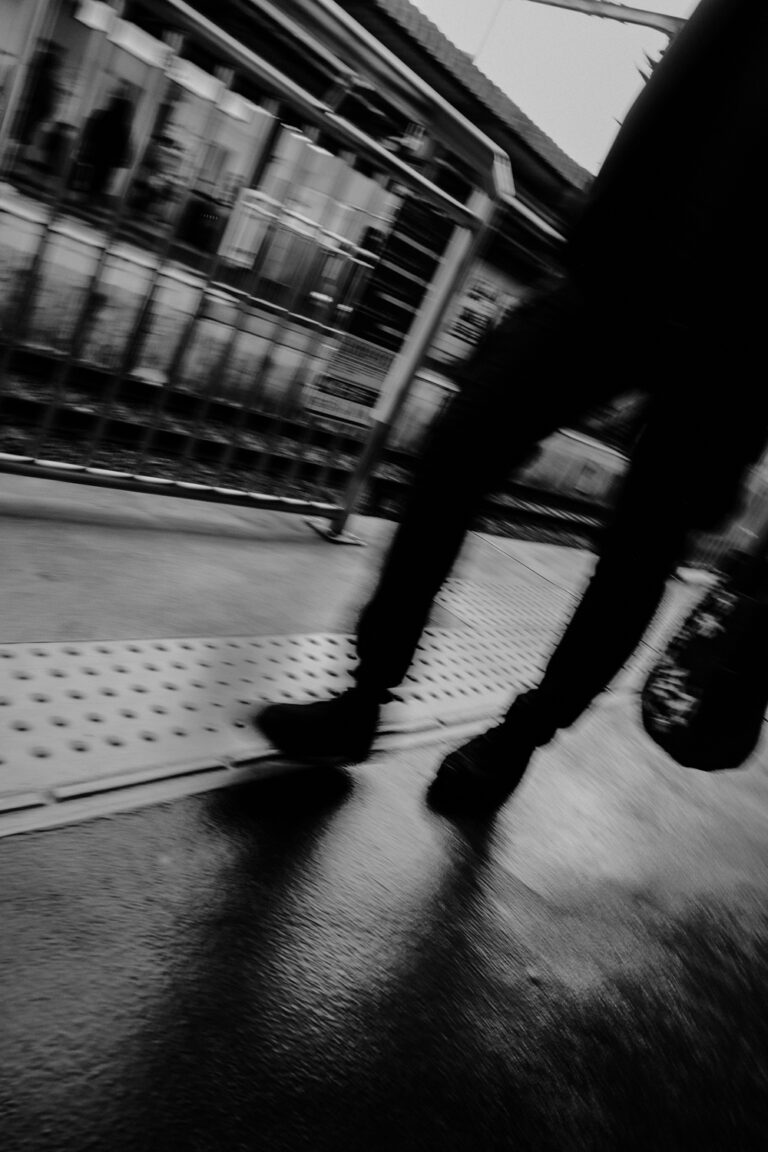
I looked through a contact sheet from the week before, holding it up to the window light rather than turning on the desk lamp, frame after frame in their small grey rectangles. Stopped on one — nothing special, a shot of the train platform at dusk, the kind of photograph that’s technically fine and emotionally absent, the kind that would pass inspection from anyone except the person who took it. I couldn’t say what was wrong with it. Exposure was right. Composition was right, the platform lines leading the eye exactly where they should. Everything that could be measured had been measured correctly.
Something was still missing.
I held it longer than I needed to, the way you sometimes stare at a word you’ve spelled correctly but that still looks wrong somehow, waiting for the wrongness to resolve into something nameable. It didn’t. I didn’t know what was missing, and I’ve learned that forcing an answer before it’s ready rarely produces a true one. I filed it anyway, the way I file most things I don’t understand yet, in the part of my mind where unfinished things wait without complaint — a fairly crowded part of my mind, if I’m honest about it, though it’s never once felt overcrowded. There’s something almost restful about leaving a question open rather than closing it with the wrong answer just to have an answer.
My phone buzzed once while I was packing the camera bag for the day, checking film stock against the small handwritten inventory I keep taped inside the lid, more out of habit than necessity, since I always know exactly how much I have left.
Mion: Good morning. Did you remember to eat breakfast?
I smiled at that — not the kind of smile that means anything dramatic, just the small, ordinary kind that happens before you’ve decided to have an opinion about it, the kind that arrives before you’ve noticed you’re having it. I sat down on the edge of the studio’s single stool to answer, the camera bag half-packed beside me.
Me: Grandmother would never let me forget.
A moment later:
Mion: Good.
That was the whole exchange. No further questions, no anticipation, nothing that needed explaining or expanding or softened into something it wasn’t. Just two people confirming, quietly, that the other one still existed in the same world they did, on the same ordinary morning, eating the same kind of breakfast people have eaten in this town for longer than either of us has been alive. I didn’t reply again. She didn’t either. Neither of us needed to. That was the entire point of it — that a conversation could end exactly where it should, without either side reaching for one more line just to avoid the silence after.
I put the phone in my pocket and looked out toward the garden through the studio’s single window. The light had finally decided what color it wanted to be — pale, a little gold at the edges, catching the top of the persimmon tree and turning its bare branches the color of weak tea. The kind of light that doesn’t last long enough to photograph properly even if you’re fast, the kind that changes its mind again within minutes and becomes something more ordinary, more daylight, less itself.
Spring always arrives quietly. You only realize it happened after you’ve stopped looking for winter — after you’ve stopped checking the sky each morning for some sign of a season ending, and noticed instead, almost by accident, that it already had.
I finished packing the camera bag, slung it over one shoulder, and went outside to find out what else the day intended to be.