The Last Negative Series
Chapter Four: The Second Week
Monday, Second Week of April 2025
The coffee ritual proceeded exactly as it always does, and by now I no longer thought of it as a ritual so much as simply the shape the first twenty minutes of my day naturally took, the way a river doesn’t think of its banks as containing it, only as being what it is. I ground the beans, bloomed the grounds, poured in slow, deliberate circles, and drank standing at the window while the neighborhood did its familiar, unhurried business of waking up around me.
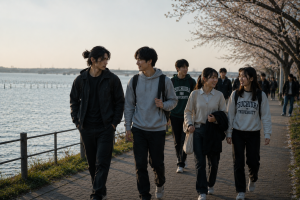
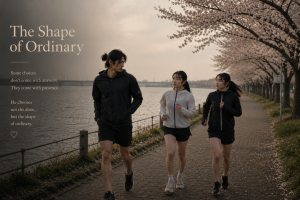
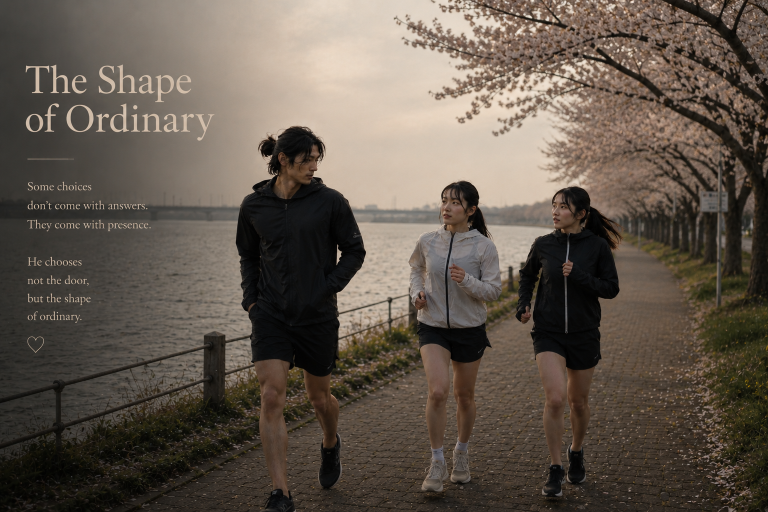
The run that followed was the same run it had been for two weeks now, though the world along it had started shifting in small, specific ways that made even a repeated route feel slightly new each time I took it. The cherry blossoms, fully open for several days now, had begun letting go—not dramatically, not yet the full drift of petals that I understood was still to come, but enough that the wet pavement near the little park showed a scattering of pink stuck flat against the grey concrete, pressed there by the previous night’s rain, already beginning to darken and curl at the edges. I slowed near the tree to look at this, the way I slow for most things worth looking at, and thought that there was something almost instructive in watching a tree let go of what it had spent all winter building toward—not reluctantly, not all at once, just steadily, a little more each day, trusting that the ground underneath would know what to do with what fell.
I ran the rest of the route without further stopping, past the shrine, past the bakery, where the owner’s “good morning” now arrived before I’d even fully passed the window, past the raised embankment where the rice fields stretched out bare and waiting beside me, Kasumigaura wide and calm in the morning light beyond them. The neighborhood had settled, over these two weeks, into something I no longer needed to actively notice in order to navigate. It had become, simply, comfortably familiar, the specific unremarkable comfort of a place that has stopped asking to be discovered and started, instead, simply being where you live.
I found myself, running that final stretch home, thinking about how strange it was that the same streets which had once required my full attention—every landmark memorized deliberately, every turn a small decision—now moved past almost without my noticing them at all. It wasn’t that I’d stopped seeing the shrine, or the bakery, or the wide grey stretch of the lake. I saw them every morning, the same as always. But seeing them no longer required effort. They had become, instead, the specific quiet backdrop against which everything else in my days was now allowed to happen.
That night, before bed, I would write in the notebook: Places change very slowly. People change while you’re watching. But that thought hadn’t arrived yet, that Monday morning, standing at the window with my coffee, watching a city that had taken two weeks to become mine in ways I was only now starting to fully register.
School, by the second week, had lost the specific charged quality of a first arrival and settled into something closer to rhythm. The excitement of new faces and unfamiliar hallways had faded into the plain, comfortable business of routine, and I found that I could now move through the building the way I moved through the neighborhood—without needing to actively map it, simply trusting my feet to know where they were going.
Jin-woo arrived seven minutes late to homeroom that morning, breathless, carrying a paper bag from the bakery near the station that he claimed, without much conviction, sold better melon pan than the one closer to school, and which he’d apparently decided was worth risking Takahashi-sensei’s mild disapproval to fetch. He slid into his seat still chewing, offered half the bag around the nearby desks with the same unthinking generosity he brought to most things, and continued a conversation he seemed to have started with himself somewhere on the walk over, something about a video game update that had apparently ruined an entire weekend’s progress.
Mei Lin, two rows over, had her sketchbook open during the literature lecture, pencil moving in the same quick, economical strokes I’d noticed at lunch that first week, though today her subject was Takahashi-sensei herself, caught mid-gesture at the front of the room, one hand raised to punctuate some point about the reading, the sketch rendering her with more warmth than caricature usually allows. Mei Lin noticed me noticing, glanced up, and simply turned the page to show me without any particular ceremony, the way you’d show a friend rather than seek approval from a stranger. I nodded, and she went back to it, apparently satisfied.
Dmitri and Lukas argued through most of the break between second and third period about something involving processing efficiency that I only partially followed, Dmitri gesturing with increasing animation while Lukas remained methodically unbothered, occasionally producing a single quiet counterpoint that seemed to land with more force for its restraint than Dmitri’s volume ever managed. Neither of them seemed to expect the disagreement to resolve. It seemed, rather, to be simply how they enjoyed each other’s company, an ongoing argument functioning as a kind of friendship in its own right.
Haruka disappeared the moment the final bell of the morning session rang, racket bag already over her shoulder before most of the room had finished packing away notebooks, moving with the specific single-minded urgency of someone who measured her day by how much of it remained before practice rather than by anything happening in the classroom itself. Ikuko hummed something under her breath while organizing her notes during a quiet moment before class, a melody I didn’t recognize but that carried the particular structured quality of choir music, precise even at half-volume. Shun, three desks over, kept a soccer ball tucked against his foot beneath the desk for most of the morning, rolling it back and forth in small, absent motions that seemed to require no conscious attention from him at all, the specific idle fidgeting of someone whose body needed motion even when the rest of him was still.
Nobody offered me a biography of any of this. Nobody needed to. I simply began recognizing it, the way you begin recognizing a piece of music you’ve heard enough times that you no longer need the title to know what’s coming next.
There were smaller details too, the kind that only accumulate through proximity rather than introduction. The boy two seats behind me, whose name I’d learned was Ryo, apparently kept a running collection of eraser shavings on the corner of his desk, rolling them into small pellets during lectures with the same absent attentiveness Shun brought to his soccer ball, an entire miniature architecture built and dismantled several times over the course of a single class. A girl near the front, Emi, always arrived precisely one minute before the bell, never earlier, never later, with a consistency that felt less like habit and more like a private discipline she’d set for herself and had no particular interest in explaining. Takahashi-sensei’s chalk, I noticed, always ran out by Wednesday, and she kept a small paper bag of replacements in her desk drawer that she refilled, without fail, every Monday morning before the first bell, a routine so precise it suggested she’d learned, at some point, exactly how much a week of teaching actually consumed.
None of this amounted to anything I could have called friendship, not yet, not with most of them. But it was the specific raw material friendship is eventually built from—the plain, repeated noticing of small human patterns, absorbed without effort, simply because I was there often enough and paying attention closely enough for them to accumulate. I thought, more than once that day, of how different this kind of knowing was from the kind I’d practiced my whole life through a viewfinder—slower, less deliberate, built from proximity rather than composition, and somehow, for exactly that reason, harder to walk away from once it had started.
Teachers, too, had begun resolving from roles into people, the specific slow process by which a stranger standing at the front of a room becomes, gradually, someone with habits and preferences and small inconsistencies of their own.
Takahashi-sensei, I noticed more each day, watched the room with a specific quiet attentiveness that rarely announced itself directly but seemed to catch nearly everything anyway—a look exchanged between two students, a slight change in someone’s posture, the particular tension in a raised hand versus a reluctant one. She called on people, I began to suspect, not entirely at random, but according to some internal calculation about who needed the practice of being asked and who needed, instead, the relief of not being.
Hiroshi Kitamura, the PE and judo instructor, ran that morning’s session with the specific loose, joking authority of someone who had long ago stopped needing to prove his own competence and could therefore afford to be generous with everyone else’s. He teased the stronger athletes mercilessly, in the particular way that only genuine respect permits, and was notably gentler, though no less direct, with the students still finding their footing. When my turn came to demonstrate a basic judo throw for a unit the class was beginning, he watched with an expression that shifted, partway through, from routine assessment into something more specifically interested, and afterward asked, quietly, whether I’d trained formally.
“Since I was five,” I said.
“It shows,” he said, simply, and moved on to the next student without further comment, though I noticed him glance back once or twice over the remainder of the class, recalibrating something in his approach to me that I suspected would persist for the rest of the term.
Natsuko-sensei, during English, paused at one point beside my desk while the class worked through a pronunciation exercise and asked, with genuine curiosity rather than correction, where I’d learned to shape certain vowels the way I did—closer, she said, to how a native speaker would produce them than how most students her age managed after years of study. I told her, honestly, that I’d learned several languages young, that English had come alongside several others rather than as a single isolated subject, and she nodded, filing the information away with the specific satisfaction of a teacher who has just found a small mystery worth having solved.
Daichi Sakamoto, the art teacher, I encountered only briefly that day, passing through the corridor outside his room while a still-life exercise was underway inside, students arranged around a modest arrangement of fruit and cloth under a single work lamp. He caught my eye through the open door, studied me for a moment with the particular assessing look I recognized from the photography club advisor, and said, without much preamble, “You’ve got an observer’s eyes. I can tell before I’ve even seen your hand.”
“I haven’t taken your class yet,” I said.
“Doesn’t matter. Some things you can see from across a hallway.” He didn’t elaborate further, returning his attention to the students working at their easels, though the comment stayed with me longer than its brevity should have justified.
I passed his room again later that same afternoon, on my way toward the stairwell, and noticed him standing over one student’s easel, quietly redirecting her attention not toward technique but toward what she’d chosen to leave out of the frame entirely—a detail of the composition she’d apparently decided wasn’t worth including, which he seemed to think was the most interesting decision she’d made all period. I didn’t stop to listen properly. It wasn’t my business yet. But I understood, walking on, that Sakamoto-sensei was the kind of teacher who cared less about whether a student could render an apple convincingly and more about why they’d chosen to look at the apple in the first place, and I filed that away the same way I filed most things, certain I’d want it again eventually.
Lunch, by the second week, had expanded well beyond the original small cluster of desks near the window. Nobody had orchestrated this. It simply happened the way rooms tend to reorganize themselves once people stop being strangers—Amara and Fatima drifted over from a different corner of the room sometime during the first week and had simply never drifted back, their easy, warm energy folding naturally into the existing rhythm of the table. A boy named Kenta, who I hadn’t previously spoken with directly, started sitting at the table’s far end after some shared joke with Jin-woo the previous Friday, and had apparently decided, on the strength of that single joke, that this was now his table too.
Conversation that Monday moved easily across a dozen unrelated subjects—the upcoming spring festival and who was planning to work which booth, whether Golden Week would actually bring good weather this year or another disappointing string of rain, an ongoing debate about which café near the station made the best matcha, a complaint about a club’s new attendance policy, someone’s older sibling’s taste in music, which several people at the table disagreed with loudly and at length.
I listened more than I spoke, the way I generally do, though I noticed, that day, a shift I hadn’t fully registered before—people had started actually asking for my opinion rather than simply including me by default. Jin-woo turned to me mid-debate about the festival booths and asked, directly, whether I thought a photo booth would actually draw a crowd or whether it was, as Dmitri was insisting, a waste of the class’s allotted budget.
“It depends on the photographer,” I said. “A bad photo booth is a waste of budget. A good one is the thing people remember the festival by.”
“See,” Jin-woo said, pointing at me with evident triumph, “that’s exactly what I said, except more convincingly.”
“You didn’t say that at all,” Dmitri said. “You said ‘photos are fun,’ which is not an argument.”
“It’s a very good argument.”
I found myself, again, laughing before I’d quite decided to, and the table’s easy noise absorbed it the way it absorbed everything, without particular comment, though Aiko, across from me, caught my eye for a moment with an expression that seemed to note the laugh specifically, filing it away the way she seemed to file most small details about me, for reasons I hadn’t yet fully worked out.
Later in the same conversation, Amara turned the subject toward Golden Week, asking around the table whether anyone had actual plans yet, and the answers scattered in every direction—Fatima mentioned a family trip to visit relatives outside the prefecture, Kenta admitted he’d probably spend most of it sleeping, and Jin-woo launched into an elaborate, largely improvised plan involving a hiking trip that seemed to grow more ambitious with each sentence, until Dmitri pointed out, not unkindly, that the itinerary he was describing would take considerably longer than the actual holiday allowed.
“Details,” Jin-woo said, waving this away. “What about you, Washimine? Big plans? Tokyo trip? Secret double life we don’t know about?”
“Something like that,” I said, which was true enough without being any more specific than it needed to be, and the table let it pass without pressing further, the way they’d learned, over the past week and a half, that I generally meant exactly what I said and nothing more.
“See, that’s the thing about him,” Aiko said, to the table generally, though her eyes stayed on me a beat longer than the comment strictly required. “You ask him something, he gives you the true answer, and somehow it still doesn’t tell you anything.”
“That’s a skill,” Mei Lin said, without looking up from her sketchbook.
“It’s infuriating,” Aiko said, though she was smiling when she said it, and I let the comment sit there without correcting it, mostly because I suspected she wasn’t entirely wrong.
Kenta, at the far end of the table, who had been mostly quiet through the exchange, looked up from his own lunch long enough to add, “For what it’s worth, I think it’s kind of impressive. I’ve been trying to get a straight answer out of my little brother for six years. Washimine gives you a straight answer, it’s just also somehow the only answer you’re getting.”
“That’s the most accurate description anyone’s managed,” Aiko said, pointing at him approvingly, and the conversation moved on from there, the way lunch conversations do, drifting toward whatever new subject someone else introduced, leaving the observation about me hanging in the air a moment longer before dissolving, unresolved, into the general noise of the table.
I had been watching the two of them without entirely meaning to—the easy, practiced rhythm of Aiko pointing and Kenta accepting the point, the specific comfortable shorthand of people who’d clearly done this exact exchange many times before I’d ever sat at this table. “So what’s the story with you two?” I asked, mostly out of curiosity, directing the question at both of them at once.
“There’s no story,” Aiko said, at the same moment Kenta said, “Our mothers are best friends,” and the two answers collided in a way that made Jin-woo laugh before either of them had finished.
“Those aren’t the same answer,” I said.
“They’re the same answer,” Aiko said. “He’s just being dramatic about it.”
“I’m not being dramatic. We’ve known each other since we were four. She used to make me eat mud pies and tell me they were dessert.” Kenta said this with the specific flat resignation of someone who has told the story often enough that it no longer requires any real outrage behind it.
“You ate them willingly.”
“I was four. I trusted you.”
“That was your mistake, not mine.” Aiko said it without any particular heat, the comfortable bickering of two people who had long since stopped needing to actually win these arguments, only to have them. “We’re not a story. We’re just old. Practically siblings, at this point, minus the paperwork.”
“Devastating,” Kenta said, to no one in particular, and returned to his lunch with the specific unbothered ease of someone who’d clearly survived worse insults from her over the years.
“For what it’s worth,” I said, “not that either of you asked, but I think the two of you are going to be good together as you get older. I’d put money on you ending up together eventually. You complement each other better than almost anyone I’ve met.”
The table went quiet for exactly one beat too long. Kenta’s chopsticks stopped halfway to his mouth. Aiko turned to look at me with an expression that had gone, in the space of a single sentence, from mild amusement to something closer to genuine alarm.
“Where did that come from,” she said, not quite a question.
“You’ve known each other your whole lives. You argue like people who trust each other completely. That’s rarer than people think.” I said it plainly, the way I say most things, without any particular weight attached, though I understood immediately, from the color rising in Kenta’s face and the very deliberate way Aiko was now studying her lunch, that the observation had landed with considerably more weight than I’d intended.
“We’re four,” Kenta said. “We were four. That’s not—that doesn’t work like that.”
“I didn’t say now. I said eventually.”
“Eat your lunch,” Aiko told me, pointing her chopsticks at me the same way she’d pointed them at Kenta a moment earlier, though the gesture carried noticeably less confidence this time. “Just—eat your lunch, and never say that again.”
“I’m just observing.”
“Observe quieter,” she said, and Jin-woo, who had been watching the entire exchange with barely contained delight, finally lost the battle and laughed outright, which set off a ripple of laughter around the rest of the table, Kenta included, though his was considerably more strained than everyone else’s. Aiko didn’t laugh. She kept her eyes on her lunch for a while longer than the moment required, and I filed that away too, the way I file most things, uncertain yet what it actually meant, only certain that it meant something.
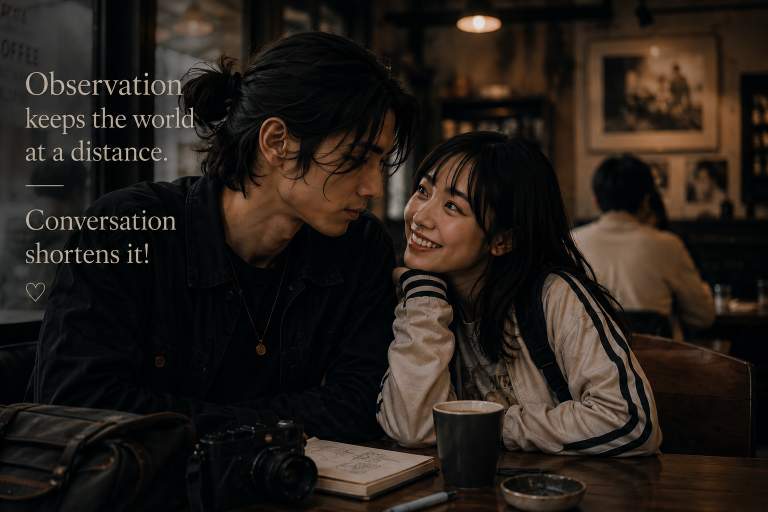
I didn’t go straight home after the final bell that afternoon. I’d noticed, over the previous week, a small café near the station that I passed most days without stopping—the same one I’d first visited during my final week of March, before the term began, the owner unhurried and unbothered by conversation, the cat curled into its custom-fitted shape on the cushion by the register. I decided, that Monday, that it was worth revisiting properly, now that I had an actual reason to want somewhere quiet between the noise of school and the quiet of home.
The owner looked up when the door chimed, and something in his face registered recognition immediately, faster than I’d expected given the weeks that had passed since my last visit. “The usual?” he asked, already reaching for the grinder before I’d said anything at all.
“Please,” I said, and something about the exchange—so brief, so entirely without ceremony—settled into me with a specific warmth I hadn’t fully anticipated. This was, I realized, sitting down at the same table by the window I’d chosen weeks earlier, the first place outside my own house where I had an actual routine, a place that had learned my preferences without my needing to explain them, the way home eventually does for anyone patient enough to let it.
I watched him work while I waited, the same unhurried, practiced motion I recognized from my own mornings—the grind, the bloom, the careful pour—and thought that there was a specific kind of trust involved in watching someone make you something exactly the way you like it without either of you needing to discuss what that meant. He set the cup down without comment, collected the empty saucer from the table beside mine where an elderly woman had just left, and returned to whatever quiet business occupied him behind the counter, leaving me to the particular solitude that a good café offers—not isolation, exactly, just room enough to think without anyone requiring anything of the thinking.
I opened my notebook, more out of habit than any particular need to write, and let the café’s quiet hum settle around me—the owner moving unhurriedly behind the counter, the cat shifting slightly on its cushion, the occasional soft chime of the door as other customers came and went without disturbing the room’s general calm.
The door chimed again perhaps twenty minutes later, and I looked up out of simple habit rather than any specific expectation, and found Suguha standing in the doorway, frozen mid-step, an expression of pure, delighted vindication spreading across her face.
“Ha!” she said, loudly enough that the owner glanced over with open amusement and the cat cracked one eye without otherwise moving. She pointed at me, dramatically, the way you might point at a criminal finally cornered after a long investigation. “I knew this was where you disappeared after school.”
I blinked. “You followed me?”
“No.” A beat, her expression shifting almost imperceptibly. “…Mostly.”
“Mostly.”
“I was already heading this direction,” she said, with the specific unconvincing confidence of someone constructing a defense in real time, “and then I happened to notice you walking somewhere that wasn’t home, and I happened to be curious, and it happened to lead here, and none of that is technically following.”
“That’s technically exactly what following is.”
“It’s following with good intentions. That’s completely different.” She said this with total conviction, as though the distinction were self-evident, and made her way toward my table without waiting for any further invitation, dropping into the seat across from me with the same unceremonious ease she’d claimed at my kitchen table the week before.
The owner, watching this entire exchange from behind the counter, made no attempt to hide his amusement, though he said nothing, simply waiting until Suguha had settled before approaching with the specific patient hospitality he seemed to extend to everyone.
“Cake,” Suguha announced, before he’d even asked. “Whatever’s best. And—” she reached across the table without asking, lifted my cup, and took a decisive sip before I could object, setting it back down with an expression of theatrical consideration.
I gave her the look, the specific flat stare I’d apparently already developed for exactly this situation, though we’d known each other barely a week.
She shrugged, entirely unrepentant. “I had to know if yours tasted better.”
“It doesn’t.”
“It definitely does.” She said it with total, unwavering confidence, the kind that doesn’t require evidence to feel true, and the owner, retreating toward the kitchen to prepare her cake, laughed outright, the first genuinely unguarded sound I’d heard from him in all the visits I’d made to that café.
I looked at her sitting across from me, cake already ordered, my coffee slightly diminished by her theft, and understood that this was, in some small but genuine way, the first time anyone had watched me in a conversation that felt entirely unguarded—no careful calibration of exactly enough words, no polite maintenance of appropriate distance, just the easy, unbothered back-and-forth of someone who had decided, apparently on the strength of one morning and one kitchen visit, that formality between us simply wasn’t going to be a feature of whatever this was becoming.
She noticed the Ricoh sitting on the table beside my notebook a few minutes later, reaching for it with the same unasked permission she seemed to apply to most things, though she stopped herself before actually picking it up, glancing at me first with something closer to genuine deference than her usual boldness.
“Can I?”
“Go ahead.”
She turned it over carefully in her hands, more careful with the object itself than she’d been with my coffee, studying the dials and the small viewfinder with visible curiosity. “How do you know when something’s worth photographing?” she asked, not looking up from the camera. “Like, actually know. Not just ‘it looked nice.'”
I thought about the question honestly, the way it deserved. “Usually I don’t,” I said. “I only know afterward.”
She looked up at that, considering it with an expression more serious than I’d yet seen from her. “That’s not a very helpful answer.”
“It’s the true one, though.”
She turned the camera over once more, then set it down carefully, and looked around the café instead—the counter, the mismatched cups on the shelf, the cat still curled on its cushion, the light falling through the window in a soft afternoon slant across the wooden floor. She took out her phone, framed something for a moment with visible concentration, and took a picture.
“Like this?” she asked, turning the screen toward me.
I looked at it. It was, unremarkably, a shot of the café’s interior, technically fine, the light captured reasonably well, the composition centered in the specific safe, symmetrical way beginners default to before they’ve learned to trust asymmetry. It wasn’t a bad photograph. It also wasn’t, yet, an interesting one.
“Almost,” I said.
She frowned, not offended, just genuinely puzzled. “What makes it almost?”
“You centered the cat,” I said. “Which makes sense—it’s the most obviously interesting thing in the frame, so your eye went straight to it. But look at the light on the floor, there, coming through the window at an angle. If you’d framed lower, letting the cat sit off to one side instead of dead center, the light would have been doing something instead of just filling space behind the subject. Right now the light is scenery. It could be the actual photograph.”
She studied the image again, then looked at the actual scene in front of her, back and forth several times, visibly working to see what I’d just described. “Okay,” she said slowly. “Wait. Okay, I sort of see it. Show me again next time. Properly, not just—” she gestured vaguely, “—words.”
“Next time,” I agreed, and something in the exchange settled a small, specific weight into place—not quite a promise, but close enough to one that I understood, saying it, that I intended to keep it.
She kept the phone out a while longer, turning it toward the window, then the counter, then back toward the cat, testing the frame each time without actually taking another picture, apparently more interested now in simply looking than in capturing anything. “Is that what you do?” she asked eventually. “All the time? Just looking at everything like it might turn into something?”
“Most of the time,” I said. “It’s less a choice at this point than a habit. I don’t always notice I’m doing it.”
“That sounds exhausting.”
“It isn’t, though. It’s more like—” I thought about how to say it honestly. “Most people walk through a room and see the room. I walk through the same room and see forty small decisions someone made without realizing they were decisions. Where the light falls. Why that chair is angled the way it is. It’s not exhausting. It’s more like the room is talking, and I just happen to be listening.”
She was quiet for a moment, an unusual enough occurrence that I noticed it specifically. “That’s actually kind of beautiful,” she said finally, sounding almost surprised at herself for saying so. “Don’t let it go to your head.”
“I won’t.”
“You definitely will a little.”
“Maybe a little,” I admitted, and she looked pleased, as though extracting even that small concession counted as a genuine victory, tucking her phone away again and reaching, without any particular shame, for a second bite of cake she hadn’t offered to share.
She insisted on walking me home afterward, a decision she announced rather than proposed, gathering her bag and standing before I’d even finished the last of my coffee, and I found I had no particular objection to make, so I simply paid for both of us—over her token protest, which lasted exactly as long as token protests generally do—and we left together into the early evening light.
“Suguha,” I said, once we were outside, “it’s supposed to be the boy who walks the girl home. Not the other way around.”
“Says who?”
“Tradition. Manners. Every drama your sister’s ever watched.”
“Well, someone has to do it properly, and you clearly weren’t going to volunteer.” She said this with total confidence, already several steps ahead of me, walking backward for a moment just to make the point directly to my face. “Besides, you’re too tall to be walked home by. It would look ridiculous. This is more efficient.”
“That’s not the reasoning I expected.”
“It’s still good reasoning.” She turned back around, satisfied with herself, and I let the matter drop, mostly because I suspected that whatever argument I offered next, she’d simply out-argue it, the way she seemed to out-argue most things through sheer, cheerful persistence rather than any particular logic.
She talked almost the entire way, moving between subjects with the specific loose, unstructured momentum I was starting to recognize as simply how her mind worked, uninterested in staying on any single topic longer than her own curiosity held. She talked about a friend group still assembling itself around her at school, about a teacher she found unfairly strict, about a cat that lived near her house that she’d apparently been trying to befriend for weeks without success, about a song she’d heard that morning that she couldn’t get out of her head and hummed for me, badly, without any self-consciousness at all.
At one point she stopped walking entirely, mid-sentence, to point at a crow perched on a telephone wire above us, insisting it was following her specifically, a theory she’d apparently developed over several days and had accumulated what she considered compelling evidence for, none of which struck me as evidence at all, though I didn’t say so, mostly because watching her build the case with such total conviction was more entertaining than correcting it would have been.
“You don’t believe me,” she said, catching my expression.
“I didn’t say that.”
“You have a face when you don’t believe something. It’s very subtle. Most people wouldn’t notice it.” She resumed walking, apparently satisfied that she’d caught me regardless of what I’d actually said. “Aiko has the same problem. Neither of you can hide anything from someone who’s actually paying attention. You’re just better at looking like you’re not thinking anything at all.”
“That’s a specific skill to accuse someone of having.”
“It’s not an accusation. I’m complimenting you. Badly, maybe, but it’s a compliment.” She grinned up at me, entirely pleased with the observation, and I found I had no particular argument to offer against it, mostly because I suspected, again, that she wasn’t wrong.
None of it was important. All of it, somehow, felt important anyway, the specific quality of listening to someone simply exist out loud beside you, asking nothing of you except your presence. I barely spoke the entire walk, offering the occasional short response, the occasional question when her momentum paused long enough to admit one, and yet I understood, walking beside her past the bakery and the shrine and the raised path along the rice fields, that I was enjoying myself in a way that had very little to do with anything either of us was actually saying.
She left me at my gate with a wave and an instruction to “actually eat something real tonight, not just rice and one sad vegetable,” and disappeared down the street toward wherever she was heading, still talking, I suspected, even after there was no one left to hear it. I stood at the gate for a moment after she’d turned the corner, listening to the last trace of her voice fade into the ordinary evening noise of the street, and thought that the house behind me, quiet as it still was, no longer felt quite as separate from everything else as it had a few weeks earlier. It was still mine, still the same careful, solitary space I’d built for myself. But it no longer felt like the only place I belonged.
Mion called that evening while I was making dinner, and the conversation moved, without my quite intending it to, away from school and toward the events of the day more generally—the café, the walk, the specific unguarded ease of the whole afternoon.
“You seem lighter today,” she said, partway through, the specific observation she has a talent for making before I’ve fully noticed the thing myself.
“There’s a girl,” I said. “Suguha. Aiko’s younger sister. She followed me to a café today and then denied following me, and then admitted she’d mostly followed me, and then stole my coffee and told me it tasted better than her own even though she’d never actually had her own.”
Mion laughed, the warm, genuine sound I’d come to associate with her more than almost anyone else. “She sounds dangerous.”
“I think she is,” I said, and meant it, though not in any way that troubled me. Dangerous, in this specific sense, meant only that she asked things of me I hadn’t previously allowed anyone to ask—my attention, unguarded, for no particular reason beyond her own curiosity, and my patience with a kind of chaos I’d have deflected from almost anyone else.
“You like her,” Mion said. Not quite a question.
“I do. She makes me think about what it would be like to have a little sister. It’s strange. I’ve known her a week.”
Mion was quiet for a moment on the other end of the line, and when she spoke again, the warmth in her voice had shifted into something gentler, more careful. “You’d be good at that, you know. Having one.”
“I don’t know that I would.”
“You would. You already are, from what you’ve just described—teaching her about light through a café window, letting her steal your coffee, walking her sister’s teasing without flinching. That’s not nothing, Kyo. Some people wait their whole lives for someone to let them in that easily, and you did it in a week without even noticing you’d done it.” There was a warmth in how she said it, the specific generosity she brings to almost everything, glad on my behalf without any trace of the complicated feeling other people might have brought to hearing about a new person occupying my time.
I was quiet for a moment, turning something over that I hadn’t planned to say out loud, though once the thought had arrived I found I didn’t particularly want to send it back unspoken. “Mion. Is there room in your life for me? Just not as a brother, or a friend.”
The line was quiet long enough that I wondered if I’d said something wrong, though when she finally answered, her voice had none of the careful lightness she usually kept ready for exactly this kind of moment—only something steadier underneath it, like a held breath finally let go. “There’s already room, Kyo. There has been for a long time. I just never said anything, because I didn’t want to be the reason you felt like you had to rush toward something before you were ready for it. You had enough people asking things of you already, back then. I didn’t want to be one more.”
“You were never one more.”
“I know that now. I think I’ve known it for a while, honestly. I just didn’t want to say it first and have it change what we already had, if you weren’t in the same place.” She exhaled, something almost like a laugh, though softer, more disbelieving than amused. “So I waited. I told myself I’d wait as long as it took, and that if it never came, at least I’d have this—whatever this already was. That was always going to be enough, if it had to be.”
“You didn’t have to wait.”
“I know. I wanted to.” There was no hesitation in it at all, none of the careful hedging she usually offers even her kindest observations. “I’m not telling you this so you feel like you owe me anything for it, either. I’m telling you because you asked, and because I think you’d want to know the truth of it rather than a softer version.”
“I want the truth. Always.”
“Then that’s the truth. I’ve been waiting for exactly this conversation for longer than I probably should admit out loud.” Another small pause, and I could hear, even through the phone, something like a smile finding its way back into her voice, gentler than before. “We don’t have to settle the rest of it tonight. I’ve waited this long. I can wait a little longer, if there’s still more you need to say.”
“Okay,” I said, and meant it, the specific patient okay of someone who understood that some photographs need more time in the developer than others before anything true comes up out of the chemical dark. “But I want you to know I already have that answer. And you know that when I’ve decided something like that, it doesn’t change. Not in a lifetime.”
She was quiet again, and when she spoke her voice had gone soft in a way I’d rarely heard from her, all the usual polish stripped out of it. “I know that about you,” she said. “It’s part of why I was willing to wait as long as I did. I never doubted that once you decided something, it would hold. I just didn’t know if I’d ever be the thing you decided.”
“You already were. I just hadn’t said it yet.”
“Well.” A small, unsteady laugh, more relief than anything else, the kind that comes after holding something too carefully for too long and finally being allowed to set it down. “I suppose we’ve both been slow about this, in our own ways.”
“Take whatever time you still need to feel settled in it,” I said. “I’m not in a hurry. I already know where I land.”
We talked a while longer after that—her day at the studio, a shoot that had run long, a joke about one of the other photographers that I only partially followed but laughed at anyway because her retelling of it was funnier than the joke itself likely had been, the conversation easing gradually back into its familiar rhythm, though something underneath it now felt different, no longer quite so carefully held at a distance, the way a held note feels different from a played one. When we hung up, I stood in the kitchen for a moment longer than necessary, thinking about how easily the day had assembled itself into something worth reporting to her, when most days, until recently, had simply passed without much to say about them at all.
I ate dinner slowly, thinking without much urgency about the day’s accumulated small moments—the petals stuck to the wet pavement that morning, Sakamoto-sensei’s comment about my eyes from across a hallway, the specific triumph on Suguha’s face when she’d caught me at the café, the careful way she’d handled the Ricoh despite her carelessness with almost everything else. None of it, individually, amounted to much. Together, it felt like the shape of an actual life rather than simply the careful documentation of one.
I opened the laptop afterward, though there was little enough to edit—I hadn’t taken many photographs that day, my attention occupied more by conversation than by composition, which was, I understood, its own kind of small change worth noting. The one frame I did keep was one I’d taken without fully deciding to, on the walk home, of Suguha mid-sentence, gesturing at something outside my frame entirely, caught in a moment of pure unselfconscious animation that no posed photograph could have manufactured. I looked at it for a while, decided it was honest in the specific way I value most, and saved it without further comment.
Before bed, I opened the notebook and thought for a while about what single true thing the day had actually offered, weighing several candidates before settling on the one that felt like it contained the others inside it without needing to name them individually.
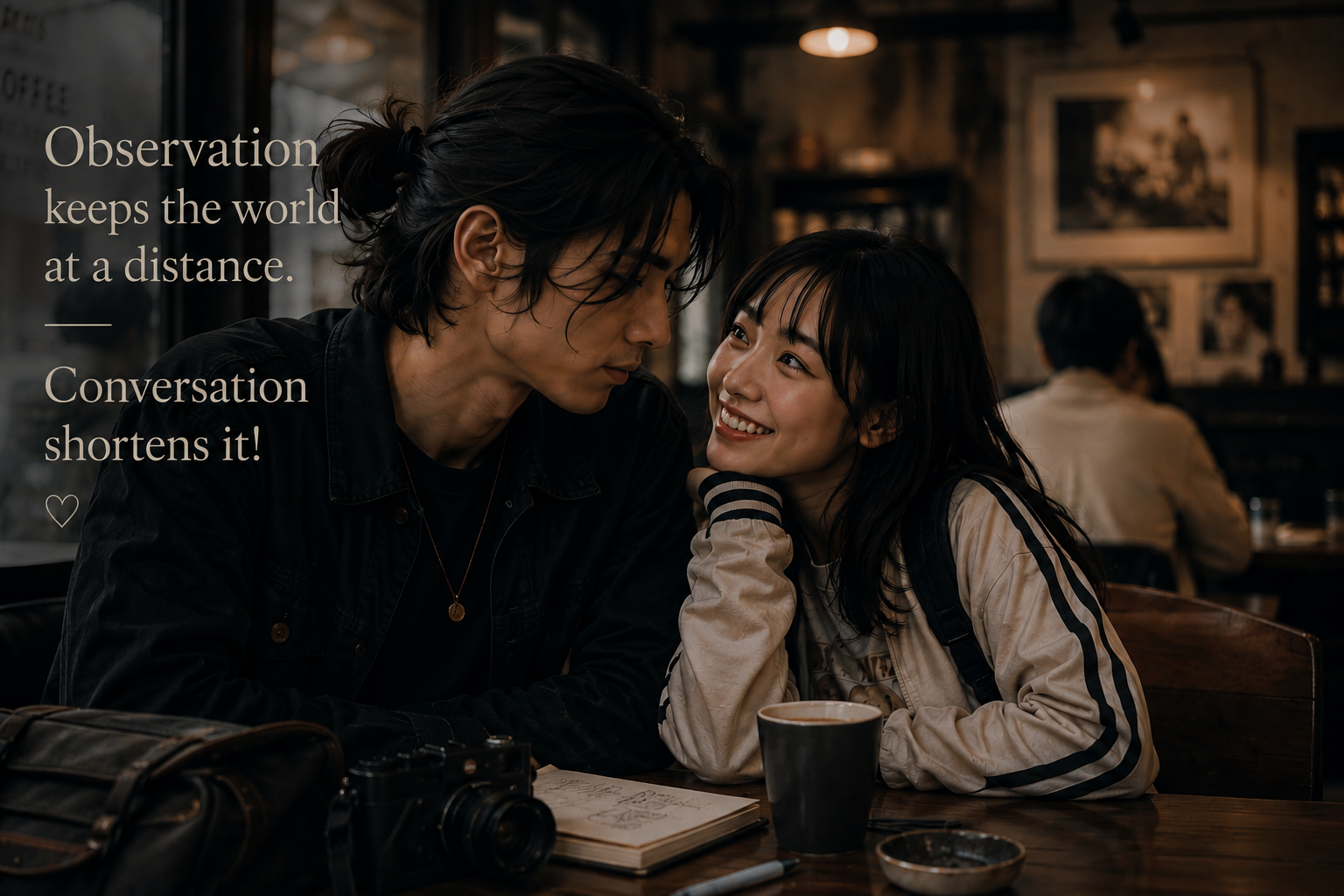
Observation keeps the world at a distance. Conversation shortens it.
I read it back once, decided it was accurate, and closed the notebook.
I turned off the lamp. The room settled into its familiar incomplete darkness, streetlight seeping faintly at the curtain’s edge, and I lay there thinking not of anything dramatic, because nothing dramatic had happened, only of the specific, accumulating warmth of a day that had asked more of me than most days did and had, somehow, cost me nothing in the asking. A café that now knew my order without needing to hear it. A fourteen-year-old who had appointed herself my photography student on the strength of one afternoon and one almost-good photograph. A conversation with Mion that had needed no careful framing to feel worth having.
I had spent most of my life, I thought, watching the world carefully from a slight distance, the specific discipline of an observer who trusts the frame more than the noise inside it. That discipline hadn’t disappeared. I doubted it ever fully would. But something in it had shifted, quietly, over the course of this particular Monday—not a loosening of the frame, exactly, but a widening of it, enough room now for someone to sit inside it with me rather than simply passing through the edge of the shot.
I thought, too, of Sakamoto-sensei’s comment from the hallway—you’ve got an observer’s eyes—and wondered, lying there in the dark, whether that was still entirely true, or whether it had already started becoming something slightly different without my noticing the transition happen. An observer keeps a careful distance by definition. What I’d done today—sitting across from Suguha while she stole my coffee, laughing at Jin-woo’s argument about a photo booth, letting Mion hear the specific warmth in my own voice when I talked about a fourteen-year-old I’d known for barely a week—none of that had kept any distance at all. I wasn’t sure yet what to call whatever I was becoming instead. I decided, drifting toward sleep, that I didn’t need to name it immediately. Some things, like photographs, are better understood afterward than in the moment they’re actually happening.
I closed my eyes, and sleep arrived the way it always does, without ceremony, the last thought I remember having being some vague, unfinished certainty that tomorrow would bring its own small accumulation of ordinary things, and that I was, for the first time in longer than I could easily measure, looking forward to finding out what they’d be.
End of Chapter Four